


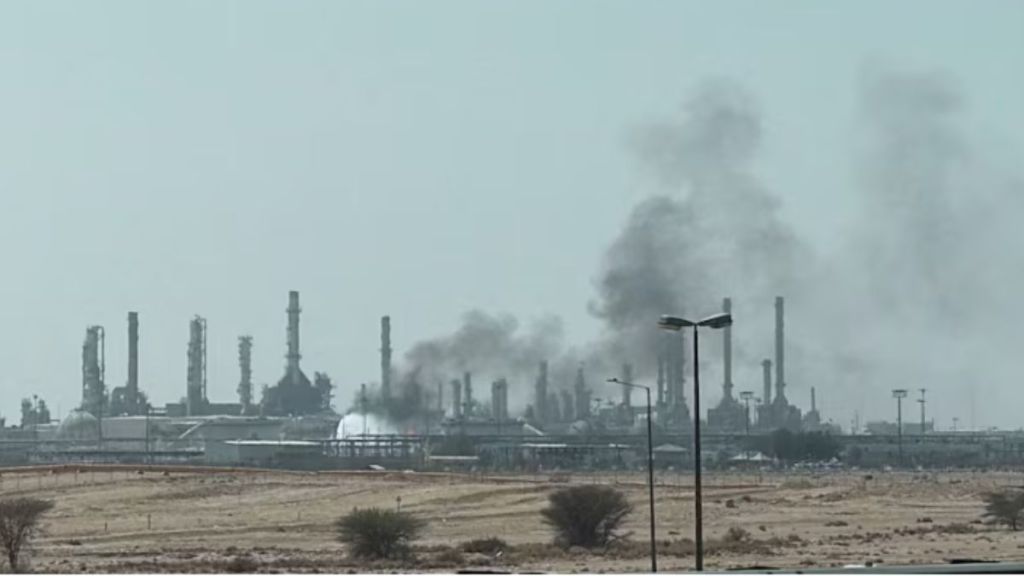

A missile strike damaged an office tower at Saudi Aramco’s headquarters in Dhahran, Saudi Arabia, on Tuesday night. The attack did not disrupt oil production or exports, but it has raised fresh concerns about the safety of the kingdom’s oil supply routes at a time when the global energy market is already under pressure.
The Saudi Energy Ministry reported a limited fire at the site, with no injuries or deaths. A company source told Reuters that the top three floors of the building were hit. There have been no reports of disruptions to oil production, pipelines or export terminals.
Oil prices rose despite the absence of any reported disruption to supplies. Brent crude climbed above $106 a barrel on Wednesday, recovering losses from the previous session as rising hostilities between Saudi Arabia and the Houthis added to concerns about oil supplies. Brent December futures moved close to $107 a barrel.
Dhahran complex is part of the headquarters of Saudi Aramco, the state-owned oil giant that manages the country’s oilfields, pipelines, refineries and export terminals. Hitting an office tower does not automatically affect oil production. However, the strike shows that the Houthis can reach a key centre of Saudi Arabia’s oil operations.
The global oil market is already dealing with supply disruptions linked to the war involving Iran and the closure of the Strait of Hormuz.
Saudi Arabia strikes fuel depot near Sanaa
The Saudi-led coalition carried out airstrikes at the al-Sabaha fuel facility on Tuesday, saying it was being used by the Houthis to support attacks on Saudi airports and energy facilities, as well as shipping in the Red Sea.
The Houthi-controlled Yemen Oil Company had said before the attack that the facility did not hold any stocks of petroleum products. It also said a strike would not affect the country’s fuel reserves or supplies.
The Houthis said the Saudi attack killed two civilians and injured two others. The Saudi-led coalition, however, maintained that it had warned civilians to leave the area before carrying out the operation.
“This operation focused on neutralising the capabilities the Houthi militia uses to threaten the kingdom, Yemen, the southern Red Sea and maritime corridors,” coalition spokesperson Maj. Gen. Turki al-Maliki said in a statement
Earlier on Tuesday, the Saudi-led coalition said it had intercepted a ballistic missile launched towards Saudi Arabia’s Eastern Province and another aimed at Haradh, near the Yemeni border. It also reported intercepting three Houthi drones north of Riyadh.
Saudi Arabia’s alternative oil route faces growing pressure
Since the Iran war began on February 28 and Tehran closed the Strait of Hormuz, Saudi Arabia has relied more heavily on its East-West pipeline to move crude oil towards the Red Sea.
The pipeline carries oil from the kingdom’s eastern oil-producing region to Yanbu, a port on the Red Sea that has become its main alternative export route outside the Hormuz.
Before the war, around 15 million barrels of crude oil passed through the Strait of Hormuz every day. The East-West pipeline offers an alternative, but it cannot fully replace the volumes that normally move through the strait.
The alternative route is also facing its own problems.
The East-West pipeline was suspended on September 12 and restarted on September 22, leaving it out of operation for 10 days. Its flow recovered to around 5.8 million barrels a day by October 6, compared with its capacity of about 7 million barrels a day.
There have also been conflicting reports about responsibility for attacks on pumping stations. Saudi officials have blamed some of these strikes on groups based in Iraq rather than the Houthis.
Red Sea shipments face another security risk
Even if Saudi Arabia manages to increase the amount of oil moving through the East-West pipeline, the country faces another limitation: how much crude can be loaded onto tankers at Yanbu.
Ship-tracking data suggest the port can load around 4.5 million barrels a day, limiting the amount of additional oil that can reach international buyers through this route. Saudi Arabia is studying a plan to convert a gas pipeline to carry oil, which could add 1.2 million barrels a day of capacity within seven to eight weeks.
However, this would take time and would not immediately solve the kingdom’s export problems.
Oil shipments leaving Yanbu must also pass through the Bab el-Mandeb Strait, a narrow waterway connecting the Red Sea with the Gulf of Aden. The Houthis have made gains in the area over the past month, raising concerns about the safety of ships using the route.
Data from Kpler show that crude oil exports through the strait increased from around 4.2 million barrels a day in 2025 to 7.4 million barrels a day in June.
With more Saudi oil depending on the Red Sea route, any further attacks could create fresh problems for shipments.
Oil prices were already under pressure before the strike
The attack comes at a time when the oil market has little room to absorb another major supply disruption.
According to the US Energy Information Administration, Brent crude averaged $114 a barrel in September, up $23 from August. The agency expects prices to decline from their early-October levels, but that will depend on restrictions on oil flows in the Middle East easing and countries being able to rebuild their inventories.
The market is also weighing developments that could push prices in opposite directions.
On one side, a diesel deal brokered by the United States involving Russia could help increase Russian exports towards pre-crisis levels of 3 million to 3.5 million tonnes a month. Higher supplies could ease some of the pressure on fuel markets.
On the other side, data from OPEC show that Saudi Arabia sharply increased oil production in September. This suggests the kingdom is pumping more crude, but getting that oil to international buyers remains a concern.
The Dhahran attack has added to the uncertainty over whether the oil produced in the Gulf can reach the market without further disruption.
Goldman Sachs raises its oil price forecast
Concerns about supply have also prompted changes to oil price forecasts. Goldman Sachs raised its December Brent crude forecast this week to $90 a barrel from $85. The bank also said prices could reach $125 a barrel by 2027 under a worst-case supply scenario.
Its outlook depends on how quickly oil production in the Gulf recovers and whether shipments through the Strait of Hormuz can return to normal.
Further attacks on Saudi Arabia’s oil infrastructure or export routes could complicate that recovery and keep prices higher for longer.
What the Dhahran strike means for India
India is particularly exposed to changes in global oil prices because it imports around 80% to 84% of the crude oil it consumes.
Saudi Arabia remains one of its major suppliers. It accounted for 16.03% of India’s crude oil imports in the first quarter of 2026, making it the country’s third-largest source, according to the data from TradeInt Insights.
Another estimate put Saudi Arabia’s average supply to India at around 700,000 barrels a day, or 14.5% of total imports, between July 2025 and April 2026. Its share reportedly fell towards the high single digits by the middle of the year, although that figure needs confirmation from more reliable trade data.
Any prolonged disruption to Saudi exports could force Indian refiners to look for supplies from other producers, potentially increasing costs.