


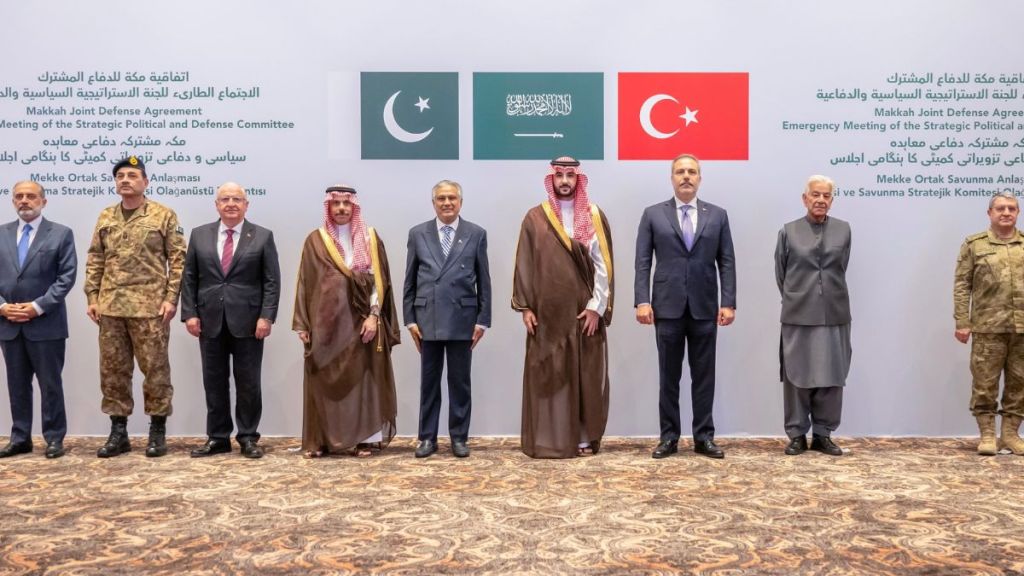

Top officials from Pakistan, Saudi Arabia, and Turkey convened an emergency meeting of the Strategic-Political and Defence Committee of the Makkah Alliance for Defence in Riyadh, the Saudi capital, on Monday to address security developments and threats facing Saudi Arabia, according to a joint statement released by the three countries.
The three nations agreed to activate “deterrence measures” under a mutual defence pact, known as the Mecca Alliance for Defence, which was originally signed on August 7, 2026. This mutual decision marks the first time the pact has been invoked. Together, they condemned what they described as attempted attacks on Mecca, Medina, and Saudi cities and economic facilities, without identifying who was behind the hostilities.
Mecca Pact activated
Signed by Pakistan, Saudi Arabia and Turkey on August 7, 2026, the Mecca Joint Defence Agreement, aka the Mecca Defence Alliance, is an attempt by the regional powers to avert a security vacuum in the Gulf, especially following the ongoing US-Israel war on Iran. The agreement was signed shortly before the Houthis resumed their offensive in Yemen this year.
While the pact was activated for the first time on Monday, during its initial finalisation, all three regional powers stated that the agreement wasn’t targeting any particular actor and would be defensive in nature. Extending a united front, they stressed that an attack on any of them would be deemed an attack on all three.
The tripartite committee has since also agreed on appointing Pakistan’s Retired Lieutenant General Nauman Mahmood as its first Secretary-General for a three-year term.
“The Committee decided to move immediately to the practical implementation of the collective defence commitments and to take the necessary measures to provide the agreed military forces and capabilities and ensure their rapid deployments in the Kingdom, in accordance with the approved arrangements and the national legislation of the Parties, thereby enhancing readiness, military integration, and the collective capacity to confront and counter threats,” reads the joint statement, published by the Pakistani Foreign Ministry’s official social media account on Monday.
Saudi Arabia’s Defence Minister, Khalid bin Salman, also wrote online: “The committee agreed to activate collective deterrence measures, within the framework of the Alliance, in response to the attacks and all those responsible for them.”
He further noted that the alliance “reaffirmed the solidarity and unity of our countries, in confronting the heinous attacks against the Kingdom, and holy sites.”
In a separate statement, Saudi’s Ministry of Foreign Affairs vehemently condemned and denounced the Houthis’ “continued targeting of civilians and civilian and economic facilities in the Kingdom.” It went on to call out the repeated attacks against holy sites, Makkah and Madinah; the cities of Abha, Khamis, Mushait, Jazan, Najran, Taif and Yanbu, and Saudi vessels in the southern Red Sea and the Bab al-Mandab Strait.
Saudi Arabia vs Houthis escalates
The latest agreement under the previously signed Mecca pact comes after the Saudi-led coalition fighting in Yemen recaptured several key areas around the crucial Bab el-Mandeb Strait from Iran-backed Houthi members, according to Yemen officials cited in an Associated Press report. Meanwhile, the Houthis claimed attacks on Saudi Arabia’s airports, military bases and oil facilities amid escalated hostilities on Yemen’s western coast.
In a pre-recorded statement on Telegram, Brig. Gen. Yahya Saree, the Houthis’ military spokesman, said that the group targeted King Khalid International Airport in Riyadh and an oil refinery in the Red Sea city of Rabigh using “a large number of ballistic and cruise missiles and drones.” He further suggested that Houthi-attacked sites include Abha airport, military facilities in Khamis Mushait and other “critical sites” in Najran and Jizan.
“In response to the Saudi aggression against our country, which launched 60 airstrikes and missile attacks in the past 24 hours, targeting the capital Sana’a and the governorates of Al-Jawf, Taiz, Hajjah, Sa’dah, and Ma’rib, resulting in civilian casualties, including women and children,” Saree added in the statement on Telegram.
According to Saree’s claims, the total number of Saudi airstrikes and missile attacks on Yemen since the escalation began had hit 1,576. Consequently, he sent a stark warning to international airlines operating through Saudi airspace “with the exception of the sacred airspace over Mecca and Medina.”
The recent escalation revived Yemen’s civil war, which started in 2014 with a Houthi takeover, following a four-year ceasefire. A 2020 truce between the two sides crumbled in July 2026 after the Houthis allowed an Iranian plane to land in Yemen’s capital, defying Saudi authority over the country’s airspace. In the wake of the surging clashes, the rebels ultimately announced a maritime blockade on Saudi Arabia and seized Yemen’s Red Sea coast and the vital shipping route of Bab al-Mandab Strait.
US Secretary of State Marco Rubio previously told reporters that the Saudi government would, as expected, respond to Houthi attacks to reclaim territory. He emphasised that the Saudis “have a right to defend themselves” after coming under attack, with the Houthis also having ousted the Yemeni government from some of its territory.