


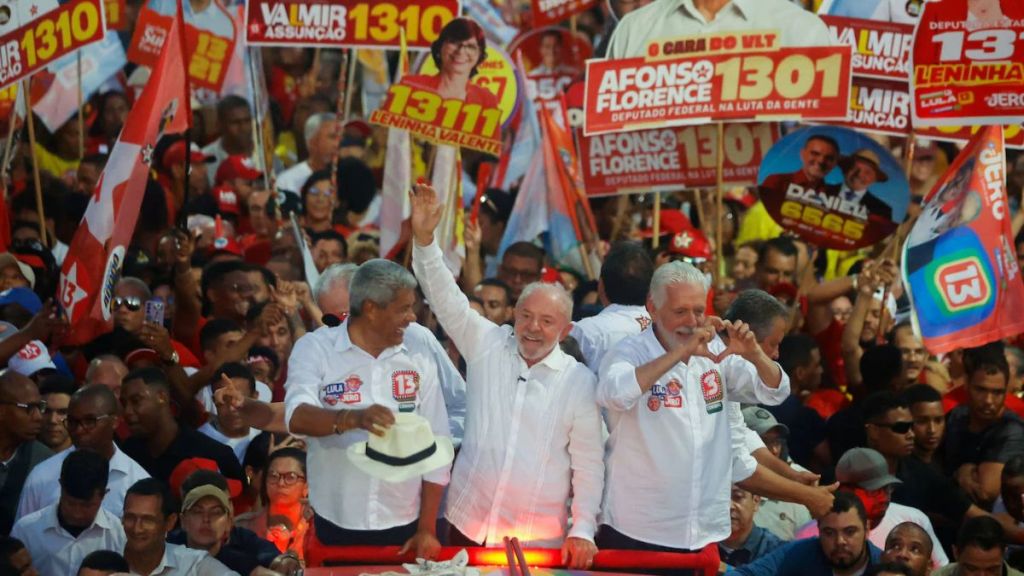

Brazilian President Luiz Inacio Lula da Silva has secured a historic fourth term, defeating right-wing challenger Flavio Bolsonaro in a closely fought presidential runoff. The victory is a major political comeback for the 80-year-old leftist leader, who won 51.79% of the votes after losing the first round of voting.
Lula’s victory comes at a time when Brazil’s economy has performed better than expected in recent years. Record-low unemployment and wage growth outpacing inflation have offered some relief to households. However, rising public debt, high interest rates, persistent inflation and mounting household debt remain major concerns.
Lula will also have to contend with a Congress dominated by conservative lawmakers, making it harder to push through economic reforms and secure support for his spending plans.
His government has promised to protect social welfare programmes, raise the minimum wage faster than inflation and ease the financial burden on households. Delivering on these promises while keeping public finances under control will be one of the biggest tests of his fourth term.
Here are the five major economic challenges Lula faces after his re-election.
Rising public debt and pressure on government finances
Brazil’s public debt has risen by more than 10 percentage points during Lula’s current term to over 82% of gross domestic product (GDP). The increase has raised concerns about the government’s ability to manage its finances and pushed up borrowing costs.
A key reason behind the rising debt is the increase in mandatory government spending. A large portion of the federal budget is already committed to expenses that cannot easily be reduced, leaving less than 8% of the budget available for adjustments. It limits the government’s ability to redirect funds towards new priorities or respond to economic pressures without making difficult spending decisions.
Lula has sent mixed signals on fiscal policy. At times, he has dismissed concerns about public debt as “nonsense”, while arguing that strong economic growth would help address the problem.
His administration has pledged to maintain the existing budget framework, which limits spending growth and sets targets for the primary balance. The primary balance measures government revenue minus expenditure, excluding interest payments on public debt. The government has also indicated that it could tighten these rules.
Meeting the targets, however, could become more difficult as Lula has promised to increase the minimum wage faster than inflation. Such increases can also raise pension costs because several benefits are linked to the minimum wage. The government has already increased welfare benefits and promised additional spending.
The challenge for Lula will be to protect social programmes without allowing public debt to rise further. If investors become concerned about the government’s finances, borrowing costs could remain high, making it more expensive for both the government and businesses to raise money.
High interest rates and persistent inflation
High interest rates and inflation will remain important challenges for Brazil’s economy during Lula’s fourth term. Brazil’s interest rate stood at 13.75%, annual inflation was 4.6%, above the central bank’s tolerance range of 1.5% to 4.5%. The central bank had delivered five consecutive rate cuts amid growing signs of an economic slowdown, but markets expected inflation to remain above the official 3% target until as late as 2029.
High interest rates make borrowing more expensive for households and businesses. Consumers face higher costs on loans and credit card balances, while companies may delay investments because financing becomes more expensive. These pressures can also slow economic activity.
Lula has promised to bring interest rates down through fiscal discipline while protecting social programmes. However, the government faces a difficult choice.
Economists argue that interest rates may fall faster only if the government reduces spending and strengthens its finances. If public spending remains high and investors worry about rising debt, inflationary pressures and borrowing costs could persist. It creates a difficult balance for Lula. Cutting spending could help strengthen public finances, but it could also limit the resources available for welfare programmes and other social commitments. Maintaining spending, meanwhile, could make it harder to achieve the fiscal discipline needed to bring down borrowing costs.
The government’s ability to balance these competing priorities will influence household purchasing power, business investment and Brazil’s broader economic outlook.
Rising debt among households and businesses
Regardless of low unemployment and wage growth outpacing inflation, many Brazilians continue to face financial pressure. According to credit bureau Serasa, nearly 84 million Brazilians and 9.3 million businesses are behind on debt payments. The figures show the extent of the debt burden facing households and companies as high interest rates increase repayment costs.
Mounting debt can leave less money available for everyday expenses, including food, housing and transport. Businesses facing repayment difficulties may find it harder to invest, expand operations or hire workers. This has also contributed to public dissatisfaction, despite some positive economic indicators.
Lula plans to introduce another round of debt relief. The proposal includes discounted purchases of distressed household loans from banks, which could help borrowers settle outstanding dues at lower costs. The government has also discussed forgiving tax debts for some small business owners.
The government has also discussed ways to address the heavy use of easily available but expensive credit, including credit cards and unsecured consumer loans. It has held discussions with the central bank on the issue, but specific proposals have yet to be detailed.
A conservative Congress could slow economic reforms
Lula’s economic agenda will depend not only on policy decisions but also on his ability to secure support in Congress. Although he defeated Flavio Bolsonaro in the presidential runoff, Bolsonaro’s Liberal Party and its allies are expected to control both chambers of Congress. Voters have elected the most conservative legislature since Brazil returned to democracy in the 1980s.
This political balance could make it harder for Lula to push through tax changes, spending measures and other economic reforms.
The administration has indicated that it will continue trying to reduce tax breaks. However, lawmakers have repeatedly resisted measures that increase the effective tax burden.
During his current term, Lula has also struggled to secure Senate approval for nominees to key institutions, including the Supreme Court, central bank, securities regulator and antitrust watchdog. The rightward shift in Congress could make these appointments even more difficult.
The political challenge is particularly important because many of Lula’s economic priorities require legislative support. Reforms aimed at improving public finances, changing taxation and regulating credit may face resistance from lawmakers who disagree with his approach.
Lula will therefore need to negotiate with political opponents and build support for his proposals. Without sufficient backing, his government could struggle to implement its economic agenda even if it has clear policy priorities.
Tax reform and uncertainty over implementation
Tax reform is another major economic issue facing Lula’s government. In 2023, his administration secured congressional approval for a sweeping overhaul of Brazil’s consumption tax system. A new value-added tax is scheduled to take effect in January, marking an important step in the reform process.
However, with less than three months remaining before its introduction, the government had yet to disclose the effective tax rate. Independent analysts estimated that it could be around 28%.
The uncertainty over the final rate could complicate planning for businesses and consumers. Companies may need to adjust prices, accounting systems and compliance procedures, while consumers could face changes in the prices of goods and services.
The reform is intended to overhaul the consumption tax system, but its effects will depend on how the new framework is implemented and how businesses respond.
The government has also delayed sending Congress a bill to regulate a new tax on products considered harmful to health or the environment, including cigarettes and alcohol. The administration had held off on the proposal during the election campaign, amid concerns about a possible public backlash.
The delay could postpone revenue from the tax and has drawn criticism of the government’s handling of tax policy.
Lula will now have to move forward with the reform while managing political opposition and addressing questions about the final tax structure. The government will need to provide greater clarity on implementation to reduce uncertainty for businesses and households.
Can Lula balance economic growth with fiscal discipline?
Lula’s fourth term begins with a mixed economic picture. Brazil has recorded positive developments in employment and wages, but high borrowing costs, rising public debt and household financial distress continue to weigh on the economy.
His policy choices will determine whether the government can sustain economic growth while keeping its finances under control.
The first challenge will be to manage public spending and debt without undermining welfare programmes. The second will be to create conditions for lower interest rates and more affordable credit. The government will also need to help indebted households and businesses, advance tax reforms and secure congressional support for its plans.
These challenges are closely linked. Higher public debt can put pressure on borrowing costs, while expensive credit can worsen household debt and weaken business investment. Political resistance could further delay the reforms needed to address these problems.
Lula has promised that his fourth term will deliver stronger results for Brazilians. Fulfilling that promise will require more than sustaining economic growth. He will need to demonstrate that the government can improve living standards while maintaining fiscal credibility and implementing reforms in a politically divided country