


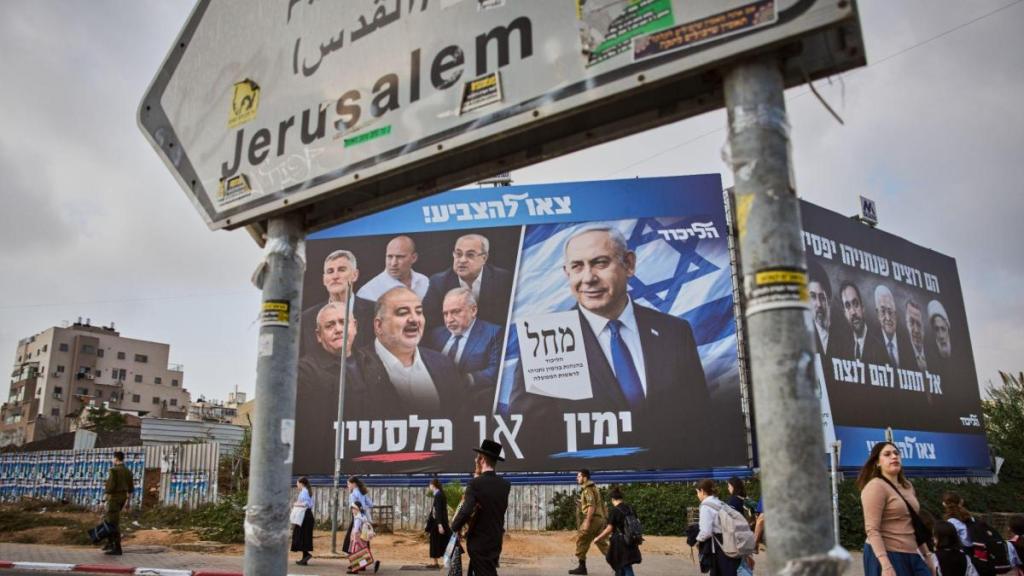

Israel went to the polls on Tuesday (October 27) in their first national election since the Hamas-led attacks of October 7, 2023. Longest serving Israeli PM Benjamin Netanyahu’s security record, political alliances and future as prime minister are all under scrutiny.
Yet even a strong showing by his rivals may not produce an immediate change of government. As CNN reports, opinion polls suggest neither Netanyahu’s camp nor the main opposition bloc has a clear parliamentary majority. The negotiations after voting could prove as consequential as the ballots themselves.
What are Israelis voting for?
Voters are choosing the 120 members of the Knesset, Israel’s parliament. They vote for party lists, with seats distributed proportionally. A list must secure at least 3.25% of valid votes to enter parliament.
The number everyone is watching is 61: the seats needed for a parliamentary majority. A party can finish first and still fail to assemble a government if other parties refuse to join it.
Who is challenging Netanyahu?
Former military chief Gadi Eisenkot is Netanyahu’s leading challenger. He heads Yashar, which draws support from the centre and moderate right and has ruled out serving under Netanyahu. Eisenkot served in Netanyahu’s emergency war cabinet after October 7 before leaving in 2024. His son Gal was killed fighting in Gaza.
Other prominent opponents include former prime ministers Naftali Bennett and Yair Lapid, whose parties have joined forces in the Together alliance; Avigdor Lieberman, leader of the secular nationalist Yisrael Beiteinu; and Yair Golan, who heads the left-leaning Democrats.
The Council on Foreign Relations’ (CFR) explainer noted that the opposition has agreed on several priorities but has not settled who should become prime minister. Bennett also has leadership ambitions.
Netanyahu’s party Likud looks to far-right leaders Itamar Ben-Gvir and Bezalel Smotrich, alongside ultra-Orthodox parties, for support. Netanyahu is campaigning on military achievements and his relationship with US President Donald Trump, who has endorsed him, NPR reported.
Why is this election so charged?
The October 7 attacks, which killed about 1,200 people, have brought Netanyahu’s security credentials under intense scrutiny. NPR reported that he has resisted establishing a state commission of inquiry into the failures surrounding the attack. His opponents promise to set one up.
Military service is another dividing line. Repeated deployments have burdened reservists, while ultra-Orthodox parties seek to preserve exemptions for religious students. Eisenkot wants broader enlistment. For families repeatedly sending relatives to war, this is a question of who bears the burden of national security.
The courts are also at stake. The Associated Press reported that a law increasing politicians’ influence over judicial appointments is due to take effect with the next legislature; the opposition promises to repeal it. Netanyahu’s supporters describe judicial changes as necessary reform, while critics see weakened checks on government power.
Netanyahu is also on trial for corruption; he calls the charges politically motivated, NPR reported.
Household finances matter, too. An Israel Democracy Institute survey published in September found that the economy and cost of living ranked among the top two voting considerations for 38% of Jewish respondents and 46% of Arab respondents. Security dominates much of the political argument, but voters also want answers on affordability.
Could smaller parties decide who governs?
Arab-led parties could provide decisive parliamentary support if both blocs fall short. But most leading Jewish parties remain reluctant to rely on them, NPR reported. Arab citizens account for roughly a fifth of Israel’s population, according to a report by TIME.
Al Jazeera reported that Mansour Abbas’s Ra’am is open to joining an opposition government, although most opposition leaders reject that option.
That could leave Netanyahu’s opponents with enough seats to block him but without an agreed route to replace him. Ultra-Orthodox parties could also become negotiating partners for an alternative coalition, the CFR analysis explained.
Smaller parties face a different danger: missing the electoral threshold altogether. CNN reported that this makes turnout and votes for parties near the threshold particularly important. A modest shift in support could change which bloc has a workable path to power.
What could change for Gaza and the region?
The consequences extend well beyond Israel. TIME, citing Gaza’s health ministry, reported more than 74,000 deaths there since October 2023. The figure does not distinguish civilians from combatants.
However, a Netanyahu defeat would not automatically revive negotiations over Palestinian statehood. CFR analysts noted that substantial agreement across Israel’s major Jewish parties on confronting Iran and opposing a sovereign Palestinian state in the foreseeable future.
There could still be meaningful differences. According to CNN, an opposition government would probably act more firmly against settler violence and be more receptive to regional initiatives. Netanyahu’s far-right partners favour West Bank annexation and Palestinian emigration, positions that have intensified concern about what another term could bring.
The important distinction is between changing Israel’s leadership and changing its strategic direction. A different coalition could alter policies affecting Palestinians even while retaining much of the existing security outlook.
When will Israel know who governs?
Exit polls are expected after voting closes, while the final count could take a few more days. Official results must be published within eight days of voting.
According to the Israeli presidency’s guidance, the president then consults parliamentary parties and selects a lawmaker to attempt to form a government. That person initially has 28 days, with a possible extension of up to 14 days.
CNN identified possibilities including a Netanyahu government, an opposition government or a power-sharing deal. A fresh election remains possible if negotiations fail, with Netanyahu continuing as caretaker prime minister.
“Negotiations will take weeks, and their failure, leading to another election, is quite plausible,” CFR senior fellow Elliott Abrams said.