


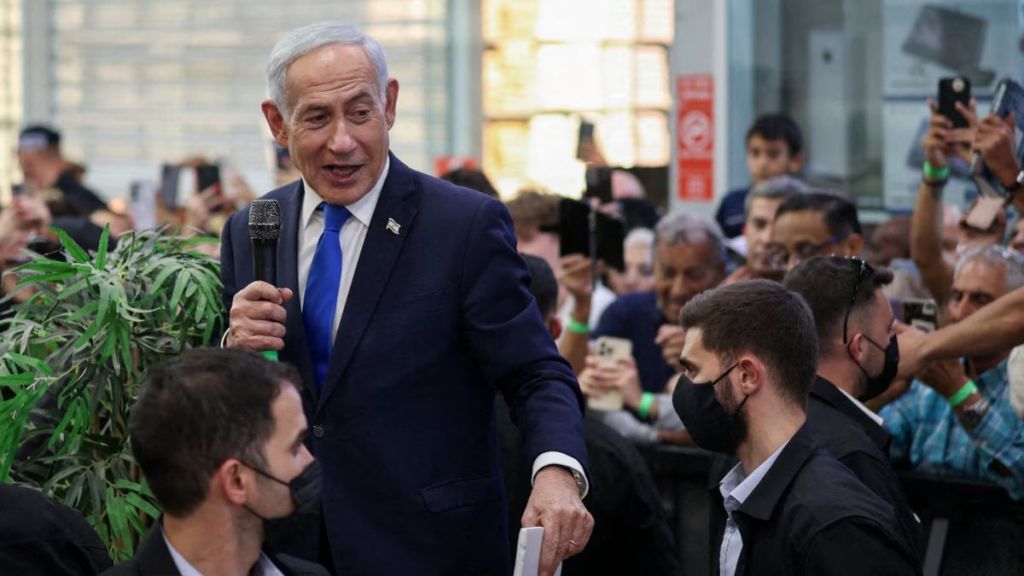

Israel Election Results 2026 Live Update: Israel’s election results have revealed the makeup of the country’s next parliament, but it is still unclear who will become the next prime minister.
Political parties will now begin high-stakes negotiations to form a government. They need the support of at least 61 members in the 120-seat parliament, known as the Knesset, to secure a majority.
The road ahead looks difficult for both Prime Minister Benjamin Netanyahu and his main rival, former military chief Gadi Eisenkot. Neither side has won enough seats to form a government on its own. Arab-led parties, which secured a historic 19 seats, could now play a key role in deciding who takes power.
The results have set the stage for weeks of political negotiations, with the possibility of a prolonged deadlock over who will lead the next government.
What are the possible scenarios after Israel’s election?
– Eisenkot could join hands with Arab-led parties: Eisenkot could form an alliance with Arab-led parties, which together have 67 seats, giving them a majority in the 120-member Knesset.
– Political risks of an Arab alliance: Arab citizens make up around 20% of Israel’s population. They are Palestinians whose families remained in Israel after the 1948 war and largely support the Palestinian cause. An Arab party has joined a governing coalition only once before, in 2021, and that government lasted around 18 months.
– Netanyahu and Eisenkot could form a unity government: Netanyahu could try to bring Eisenkot and his right-leaning allies into his government, giving him a 67-seat majority. Such a government could address issues like military exemptions for ultra-Orthodox Jews and Israel’s economy. However, Eisenkot has vowed not to join Netanyahu.
– Netanyahu could try to win over opposition leaders: Netanyahu could approach former allies Naftali Bennett and Avigdor Lieberman, both of whom support nationalist policies, including expanding settlements in the occupied West Bank.
– Fresh elections could be held early next year: If neither side secures the support of 61 lawmakers, Israel could hold another election, while Netanyahu’s government continues in a caretaker role. This could hurt the opposition, which gained momentum before the polls but fell short of expectations.
Israel's outgoing opposition leader Yair Lapid has claimed that the anti-Netanyahu bloc won the election, despite falling short of the numbers required to form a government.
Lapid described the result as a “win on points” and urged Israelis to remain patient while opposition parties discuss ways to form a coalition.
"Netanyahu got 53 seats. A crash. Even from that small number, 13 seats belong to parties that declare they aren't Zionist. That leaves him 40. That's what he's got. No matter what he does, he has nowhere to pull a government from," he said.
Declaring victory for the opposition, Lapid added, "So we won. It's not a knockout victory. It's a points victory. That counts too. A win is a win."
He admitted that forming a government would be difficult but said the opposition had a responsibility to voters who had turned out for the election to make every effort to form a coalition.
Democrats in the US Congress have given mixed reactions to Israel's election results, welcoming the high voter turnout and the decline in support for Prime Minister Benjamin Netanyahu. However, they have also expressed concern over the lack of a clear parliamentary majority and the political divisions in the country, according to The Hill.
The election has left Israel facing uncertainty over who will form the next government, with neither side securing the 61 seats needed for a majority in the 120-member Knesset.
If neither Netanyahu nor Eisenkot manages to secure the support of 61 lawmakers, Israel could face another election, possibly early next year.
Until voters return to the polls, Netanyahu's government would remain in power in a caretaker role.
However, another election could create problems for Netanyahu's opponents. They entered the latest election with strong momentum, although the results did not meet their expectations.
Their campaign also received support from tens of thousands of Israelis who travelled from abroad to cast their votes. It is unclear whether the same number of voters would make another trip if fresh elections are held.
Netanyahu, on the other hand, could use the additional time to strengthen his position and rebuild his coalition.
Smaller right-wing parties that failed to cross the minimum vote threshold required to enter parliament effectively wasted votes that could have otherwise helped Netanyahu. In another election, these parties may decide not to contest, while their supporters could shift towards larger far-right parties. This could improve Netanyahu's chances of securing a majority.
Israel has faced a similar political deadlock before. After failing to form a stable government in 2019, the country held five elections over just three-and-a-half years.
Netanyahu could also look for differences within the opposition camp and try to bring some of its leaders into his alliance.
The opposition includes parties from across Israel's political spectrum, which could make it difficult for them to remain united during coalition negotiations.
Two possible targets could be former allies Naftali Bennett and Avigdor Lieberman, both leaders of right-wing parties.
Both strongly support nationalist policies, including the expansion of Israeli settlements in the occupied West Bank. Their political positions could make it particularly difficult for them to work with Arab-led parties.
However, both have had years of disagreements with Netanyahu, including personal clashes, and have promised not to join his government.
They also strongly oppose the military exemptions demanded by Netanyahu's ultra-Orthodox allies. This remains one of the biggest issues in the coalition negotiations and could make any agreement difficult.
Eisenkot, meanwhile, has fewer options if he wants to bring more parties into his camp. Netanyahu's Likud party, along with his far-right and ultra-Orthodox allies, has remained firmly loyal to the prime minister over the years.
Another possibility is that Netanyahu could try to bring Eisenkot and his right-leaning allies into his government.
Such an arrangement could give Netanyahu a 67-seat majority. Arab-led parties, along with ultranationalist and ultra-Orthodox Jewish groups, would then sit in the opposition.
A unity government could focus on some of Israel's major challenges, including the issue of military exemptions for ultra-Orthodox Jews and efforts to strengthen the country's economy.
However, bringing the two rival camps together would require several leaders to go back on their election promises.
Eisenkot and his allies have repeatedly said they will not join a government led by Netanyahu. They hold him responsible for the security failures that led to Hamas' October 7, 2023, attack. They have also accused him of weakening Israel's democratic institutions and pointed to his ongoing corruption trial.
Another major obstacle is the demand for an official inquiry into the October 7 attack. This is one of the key demands of opposition voters, but a Netanyahu-led government is unlikely to approve such an investigation.
There is also a political risk for Eisenkot and other opposition leaders. In the past, Israeli opposition politicians who joined Netanyahu's government despite promising not to do so saw their public support fall sharply.
Netanyahu would also have to make a major compromise. He would need to drop his far-right and ultra-Orthodox allies, who have supported him through several wars and other national crises.
One possible option for Eisenkot would be to form an alliance with Arab-led parties. Together, they could have 67 seats, giving them a majority in parliament and a chance to form a government against Netanyahu.
Even if the Arab parties do not formally join his government, their support could help Eisenkot run a minority government.
However, such an arrangement would come with serious political risks for Eisenkot and his Jewish allies.
Arab citizens make up around 20% of Israel's population. They are Palestinians whose families remained in Israel after the 1948 war that followed the country's creation. They also have close ties with Palestinians in the West Bank and Gaza and largely support the Palestinian cause. This has led many Jewish Israelis to view them with suspicion.
An Arab party has joined an Israeli governing coalition only once before, in 2021. That government survived for around 18 months before falling.
Netanyahu has already described the possibility of such an alliance as a betrayal of Israel's Jewish identity and a threat to national security. His remarks could put further pressure on Eisenkot's allies, especially those on the right, to reject any arrangement with Arab-led parties.
Israel's election results have left the country without a clear prime minister, with neither Benjamin Netanyahu nor his main rival, Gadi Eisenkot, securing a majority. Both need at least 61 seats in the 120-member Knesset to form a government. Arab-led parties, which won a historic 19 seats, could play a decisive role in the negotiations. If the rival camps fail to reach an agreement, Israel may hold fresh elections early next year, with Netanyahu continuing as caretaker prime minister until then.
Israel’s Mossad intelligence agency is assisting the Shin Bet in an investigation into alleged foreign interference in the recent parliamentary election, The Times of Israel reported, citing an unverified Channel 12 report.
Authorities are examining suspected attempts to influence Arab voter turnout through financial transfers, with allegations extending beyond Qatar to other foreign countries.
The Shin Bet said its intelligence on suspected voter fraud came from investigations into foreign influence campaigns, not from “any political party or political actor on either side of the political map”.
The agency said that its probe does not concern ballot tampering or vote-counting irregularities.
The agency said the investigation was “focused and limited in scope” and did not “cast aspersions on or accuse an entire sector” that voted democratically and legally. It added: “Only those who acted in violation of the law will be dealt with.”
Shin Bet chief David Zini briefed Prime Minister Benjamin Netanyahu, opposition leader Yair Lapid and Yashar party leader Gadi Eisenkot on the suspicions under review. The agency said its findings would be submitted to Central Elections Committee chairman Justice Noam Sohlberg, who is the authorised decision-maker.
Netanyahu described the controversy as an “earthquake” and urged Zionist parties not to form a government with Ra’am or the Joint List. Qatar denied interfering in the election, while Arab-led parties also rejected allegations linking them to foreign funding.
Meanwhile, the Central Elections Committee published the final results, confirming 53 seats for Netanyahu’s bloc, 48 for the opposition and 19 for Arab-led parties. Likud emerged as the largest party with 27 seats, followed by Yashar with 21.
The final voter turnout was 77.9%, with 5,716,665 votes cast. The official results are due to be submitted to President Isaac Herzog on November 4, while the newly elected Knesset is scheduled to be sworn in on November 10.
Israel’s Mossad intelligence agency is set to join an investigation into allegations that Qatar attempted to influence the parliamentary election through suspected financial transfers worth tens of millions of shekels.
The move follows a request from Israel’s domestic security agency, Shin Bet, for assistance in examining possible foreign involvement in the alleged influence operations.
The Mossad will focus on aspects of the probe involving suspected links to foreign governments. The Shin Bet had reportedly gathered intelligence about possible illegal financial transfers even before the election.
The investigation centres on alleged attempts to influence voters through financial means and does not involve claims of ballot tampering or vote-counting irregularities.
Qatar and Turkey, the two countries at the centre of the inquiry, have denied any involvement in the alleged activities.
Amid the election deadlock, Israel’s opposition leader and B’Yachad No. 2 Yair Lapid has declared a victory for the anti-Netanyahu camp, saying Prime Minister Benjamin Netanyahu has no viable path to forming a government.
"Netanyahu got 53 seats. A crash. Even from that small number, 13 seats belong to parties that declare they aren't Zionist. That leaves him 40. That's what he's got. No matter what he does, he has nowhere to pull a government from," Lapid said.
Declaring victory for the opposition, he added, "So we won. It's not a knockout victory. It's a points victory. That counts too. A win is a win."
Lapid acknowledged that forming a government would be challenging, but said the opposition owed it to voters to make every effort to form a coalition.
Palestinian President Mahmoud Abbas on Thursday expressed hope that the formation of a new Israeli government would create an opportunity to resume peace talks.
"For many years now, we have been extending a hand to the Israeli side in order to achieve peace with them, so that Israel and Palestine may live in security, stability and peace," Abbas said during a meeting with Cypriot President Nikos Christodoulides in Nicosia.
"We hope that, immediately after a new Israeli government is formed, we will be able to engage in dialogue together," he added.
His remarks came after Israel’s election results left both Prime Minister Benjamin Netanyahu’s bloc and the opposition led by Gadi Eisenkot short of the 61 seats needed for a parliamentary majority.
Israel’s final election results have left the country facing uncertainty, with neither Prime Minister Benjamin Netanyahu’s bloc nor the main opposition securing enough seats to form a majority government.
With the results now clear, attention has turned to President Isaac Herzog, who plays a key constitutional role in the government formation process.
Herzog will decide which candidate gets the first opportunity to form the next government as parties begin negotiations to secure the 61 seats needed for a majority in the 120-member Knesset.
One of Prime Minister Benjamin Netanyahu’s longtime ultra-Orthodox allies, United Torah Judaism (UTJ), is considering backing opposition leader Gadi Eisenkot as Israel’s next prime minister, Ynet reported.
The party’s support would be conditional on legislation exempting ultra-Orthodox men from compulsory military service, a senior UTJ official said on Thursday.
“Gadi has the option of forming a government with Netanyahu, but then Netanyahu would be prime minister and he would be a senior minister,” the official said.
“We are offering him the premiership. That’s better than being No. 2 or going to another election,” the official added.
The proposal could give Eisenkot an alternative route to forming a government as neither major bloc secured the 61 seats needed for a Knesset majority.
Israeli Prime Minister Benjamin Netanyahu and his Likud party amplified unsubstantiated claims that Arab-led parties had “stolen” the election, possibly with foreign assistance, shortly before the final results were announced. Netanyahu later said forming a coalition with Arab parties was forbidden.
The opposition accused him of demonising Israel’s Arab population, which makes up around 20% of the country and voted in record numbers.
Election committee chief Justice Noam Sohlberg said “serious suspicions” of foreign interference had been brought to his attention but acknowledged that he could not verify the claims. He asked the Shin Bet to investigate.
Qatar dismissed allegations of involvement as “ridiculous and dangerous”. The election commission said reports about the investigation had been “entirely unfounded”.
Acting director general Dean Livne said, “It does not affect the final results that will be submitted to the president, nor does it concern any particular sector of the population.” The committee separately described allegations of systematic electoral violations as “baseless”.
Israel’s Central Elections Committee (CEC) has published the final results of the parliamentary election, confirming the distribution of seats in the 26th Knesset, The Times of Israel reported.
Prime Minister Benjamin Netanyahu’s Likud won 27 seats, while Gadi Eisenkot’s Yashar secured 21. B’Yachad won 12 seats and the Joint List 11.
The final tally gives Netanyahu’s bloc 53 seats, the opposition 48 and Arab-led parties 19. Voter turnout stood at 77.9%, with 5,716,665 votes cast.
The official results will be submitted to President Isaac Herzog on November 4, after checks into possible errors or complaints. The newly elected Knesset is scheduled to be sworn in on November 10.
The final election results confirmed that Prime Minister Benjamin Netanyahu’s bloc has lost its parliamentary majority, setting the stage for weeks of coalition negotiations. Netanyahu’s bloc won 53 seats, the main opposition secured 48, while Arab-led parties won a historic 19 seats.
Parties must now negotiate to secure at least 61 seats in the 120-member Knesset. Netanyahu remains in office as the political process unfolds.
“Now comes the truly hard part,” centrist politician Yair Lapid said on X, urging patience. He added: “If you want to know if something’s happening behind the silence you’re hearing now, the answer is yes.”
The main opposition parties now face a decision over whether to work with Arab-led groups or consider a unity government with Netanyahu. The debate has also exposed differing views among Israelis on cooperation with Arab parties.
“There are options for all of this, not like in the United States, where there are only two parties,” said Beny Engalrd, a resident of Tel Aviv.
Israel’s opposition leader and B’Yachad No. 2 Yair Lapid has declared a victory for the anti-Netanyahu camp, arguing that Prime Minister Benjamin Netanyahu has no viable path to forming a government. He urged supporters to remain patient as coalition negotiations begin.
“Netanyahu got 53 seats. A crash. Even from that small number, 13 seats belong to parties that declare they aren't Zionist. That leaves him 40. That's what he's got. No matter what he does, he has nowhere to pull a government from,” Lapid said.
Declaring victory for the opposition, he added, “So we won. It's not a knockout victory. It's a points victory. That counts too. A win is a win.”
Lapid acknowledged that forming a government would be challenging, but said the opposition owed it to voters who participated in the election to make every effort to form a coalition.
Protesters gathered outside the home of Yashar chairman Gadi Eisenkot in Herzliya, Israel, on Thursday, urging him to form a government with Arab-led parties, the Jerusalem Post reported.
The demonstration followed the parliamentary election, which left both Netanyahu’s bloc and the opposition short of the 61 seats needed for a majority.
Demonstrators reportedly chanted, “There is no change without partnership,” calling for cooperation between opposition parties and Arab-led groups.
Palestinian citizens of Israel have secured a rare moment of political success, with hundreds of thousands voting in record numbers and giving two Arab-led parties their largest-ever representation in the Knesset.
Many had boycotted previous elections, believing their votes would make little difference. But after years of feeling marginalised and neglected, voters turned out to challenge the government led by Prime Minister Benjamin Netanyahu.
“We are here and we’re not on the sidelines,” declared Ra’am leader Mansour Abbas as supporters cheered while watching exit polls on Tuesday night.
The 19 seats won by Arab-led parties could help opposition groups assemble a coalition to replace Netanyahu. However, it remains uncertain whether opposition leader Gadi Eisenkot and other parties will agree to work with them.
Only once has an Arab-led party served in an Israeli government. Netanyahu and his allies have intensified their criticism of such cooperation, making unproven claims of foreign powers bribing voters and warning that a government involving Arab parties would lead to the “Islamization of Israel.”
Gadi Eisenkot, leader of the opposition Yashar party, has said he will make every effort to form Israel’s next government after the election left both major blocs short of a parliamentary majority, reported Times of Israel.
“I will do everything in my power to form a Zionist government that drafts everyone,” Eisenkot said, pledging to introduce a law on national service for all.
He called on Prime Minister Benjamin Netanyahu to accept the election outcome and leave political life, saying the outgoing coalition had lost public trust.
Eisenkot also described Netanyahu as a caretaker prime minister without a public mandate and urged security and civil service officials to serve the interests of the state.
He said his proposed government would uphold Israel’s identity as a Jewish and democratic state, work to dismantle Hamas and bring the country together.
Israel’s parliamentary election has left the country facing uncertainty over its next government, with Prime Minister Benjamin Netanyahu’s Likud-led bloc falling short of a majority in the 120-member Knesset.
The Central Elections Committee (CEC) published the final results early Friday, giving Netanyahu’s bloc 53 seats and the opposition 48.
The remaining 19 seats went to two Arab-led parties, leaving no single bloc with the 61 seats needed to form a majority government.
Palestinian citizens of Israel turned out in large numbers, giving two Arab-led parties their highest-ever seat count in the Knesset, according to The Associated Press.
The result marks a shift for communities where many voters had previously boycotted elections, believing political participation would bring little change.
The gains could give Arab-led parties a significant role in efforts by opposition leader Gadi Eisenkot and other rivals to form a government without Prime Minister Benjamin Netanyahu.
However, it remains uncertain whether opposition parties will work with them. Only once has an Arab-led party served in an Israeli government.
Netanyahu has urged parties not to form a government with Arab-led parties, warning that it would lead to the “Islamization of Israel”. He has also made unproven claims about foreign powers bribing voters, AP reported.
Israel faces weeks of difficult coalition negotiations after Prime Minister Benjamin Netanyahu’s bloc won 53 seats in the 120-member Knesset, falling short of the 61 needed for a majority. The opposition secured 48 seats, while Arab-led parties won a historic 19 seats.
President Isaac Herzog is expected to begin the government formation process after the final results are certified and submitted to him next Wednesday. If coalition talks fail, Israel could face another election early next year.
The results have prompted rallies urging opposition leader Gadi Eisenkot and other parties to join forces with Arab-led groups. At a rally outside Eisenkot’s home, Danny Elgarat, brother of a late Israeli hostage, called for an “Arab-Jewish partnership”.
Meanwhile, Netanyahu and his Likud party have amplified allegations that Arab-led parties “stole” the election with possible foreign assistance. The Central Elections Committee has said claims of systematic electoral violations are baseless, while the Shin Bet has stressed that its investigation does not cast suspicion on any community.
Israeli Prime Minister Benjamin Netanyahu on Friday reiterated his opposition to forming a government with Arab parties, saying, “It is forbidden to form a government with them.”
In a post on X, Netanyahu shared a video compilation featuring remarks by Arab political leaders and opposition lawmakers.
The video included excerpts from statements by Ahmad Tibi, Iman Khatib-Yasin, Mansour Abbas, Sami Abu Shehadeh, Ofer Cassif, Yousef Jabareen and Ayman Odeh.
The post comes after Israel’s final election results left Netanyahu’s bloc with 53 seats and the opposition with 48, while Arab-led parties secured 19 seats in the 120-member Knesset.
Israel’s final election results, released early Friday, confirmed that Prime Minister Benjamin Netanyahu’s bloc has fallen short of a parliamentary majority, setting the stage for weeks of coalition negotiations. Netanyahu’s bloc secured 53 seats in the 120-member Knesset, while the opposition bloc led by Gadi Eisenkot won 48. Arab-led parties secured the remaining 19 seats, marking a historic showing.
The results mean that neither of the two main blocs can form a government without support from other parties. Political negotiations will now focus on whether opposition parties are willing to join forces with Arab-led groups or whether some parties that campaigned against Netanyahu will consider a unity government with him.
“Now comes the truly hard part,” centrist politician Yair Lapid said in a post on X, urging Israelis to remain patient. Netanyahu, Israel’s longest-serving prime minister, will remain in office while the process of forming a new government unfolds.
The final results must be certified and submitted to President Isaac Herzog next Wednesday. Herzog will then nominate a candidate to form the next government, which could be Netanyahu or another leader considered capable of securing parliamentary support. If multiple attempts to form a coalition fail, Israel could face another election early next year.
Lapid said Prime Minister Benjamin Netanyahu's bloc had secured 53 seats, including 13 seats won by ultra-Orthodox parties United Torah Judaism and Shas. The two parties won seven and six seats, respectively.
Excluding these 13 seats, Lapid argued that Netanyahu was left with only 40 seats.
“That leaves him 40. That’s what he’s got,” Lapid said, adding that Netanyahu had “nowhere to pull a government from”.
“No matter what he does, he doesn’t have any way to form a government,” he said.
Lapid said the opposition, led by Yashar chair Gadi Eisenkot, would make every effort to form a government. However, he admitted that the process would not be easy and there was no guarantee of success.
He also pointed to the voter turnout of 77.9%, the highest in decades, as a sign of strong public participation in the election. A total of 5,716,665 votes were cast.
Lapid asked Israelis to give the opposition time, saying government formation happens behind closed doors and cannot be completed immediately.
Government formation takes place “in small rooms, slowly, away from the cameras”, he said, as reported by The Times of Israel.
Israel's outgoing opposition leader Yair Lapid has claimed that the anti-Netanyahu bloc has won the election, despite failing to secure the numbers needed to form a government on its own.
Lapid, who is the second most prominent leader in the B’Yachad alliance, called the result a “points victory” rather than a complete win. He urged Israelis to remain patient as opposition leaders explore ways to form the next government.
“It's not a knockout victory. It's a points victory. That counts too. A win is a win,” Lapid said.
The anti-Netanyahu parties have together secured 67 seats in the 120-member Knesset. However, forming a government with a majority of 61 seats remains difficult, as the parties have not yet reached an agreement on how to work together.
Israel is heading towards potentially lengthy coalition negotiations after the final election results left both Prime Minister Benjamin Netanyahu’s alliance and the opposition camp led by former military chief Gadi Eisenkot short of the 61 seats required to secure a majority in the 120-member Knesset. Netanyahu’s Likud-led bloc won 53 seats, a significant decline from its 64-seat tally in the 2022 election, while the opposition secured 48. Meanwhile, Arab-led parties, the Joint List and Ra’am, collectively captured 19 seats, achieving their strongest electoral performance so far.
The political uncertainty has deepened following allegations by Likud that foreign funding and outside interference may have contributed to the electoral gains of Arab-led parties. The party, however, has not presented evidence to substantiate its claims. The Central Elections Committee has requested an investigation by the Shin Bet into suspected foreign involvement in the election, while Qatar has rejected the accusations. Opposition figures have supported examining the allegations but warned against allowing them to discredit the election outcome.
President Isaac Herzog is expected to hold consultations with political parties next week before assigning a candidate 28 days to form a government, with the possibility of an additional 14-day extension. Should negotiations fail to produce a viable coalition, Israel may be forced into another election, leaving Netanyahu in office as caretaker prime minister until a new government is formed.
- Inputs from CNBC
Palestinian citizens of Israel participated in unprecedented numbers in the October 27 election, securing a historic breakthrough for Arab-led political parties Ra’am and the Joint List. Together, the two parties won 19 seats in the 120-member Knesset, marking their strongest electoral performance to date. Their combined vote exceeded 800,000, representing an increase of more than 60% compared with the 2022 election.
Voters and political candidates attributed the remarkable turnout to growing discontent over escalating crime in Arab communities, increasingly hostile anti-Arab rhetoric and the policies pursued by Prime Minister Benjamin Netanyahu’s far-right administration.
The election outcome could position Arab-led parties as influential players in opposition leader Gadi Eisenkot’s efforts to establish a new government. However, whether he will seek their support or include them in a governing coalition remains unresolved.
Ra’am has indicated that it is open to joining a coalition, but Eisenkot has outlined several requirements, including a commitment to recognising Israel as a Jewish and democratic state and formally designating Hamas as a terrorist organisation. Meanwhile, Netanyahu and his political allies have strongly opposed the prospect of Arab parties participating in government, with the prime minister warning that such an arrangement would result in the “Islamization of Israel”.
-Inputs from AP
Opposition leader Yair Lapid characterised the election outcome as a points victory rather than a decisive one, arguing that Prime Minister Benjamin Netanyahu’s bloc had not secured enough seats to form a government. In a statement, Lapid highlighted the 77.7 per cent voter turnout — the highest since 1999 — and noted that Netanyahu’s total of 53 seats included 13 from parties that describe themselves as non-Zionist. This, he said, effectively left the prime minister with only 40 seats and no clear route to assemble a governing coalition. Lapid maintained that while the result still counted as a win, it fell short of a knockout victory.