


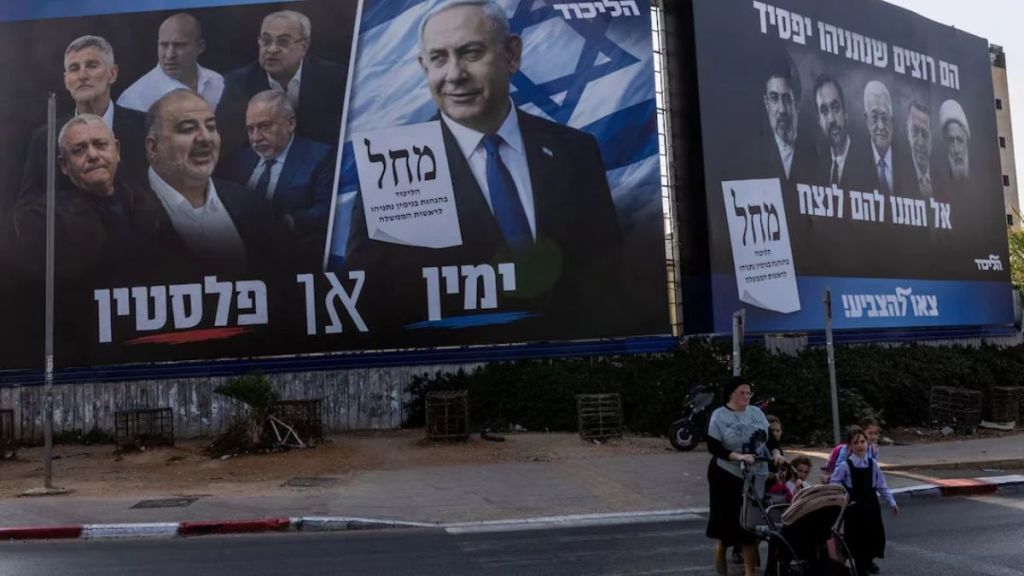

Israel’s first national election since the Hamas-led attacks of October 7, 2023, has ended without a clear winner, with exit polls showing a close contest between Prime Minister Benjamin Netanyahu and former military chief Gadi Eisenkot.
Israel’s latest exit polls show Prime Minister Benjamin Netanyahu’s bloc tied with or slightly ahead of the opposition led by Gadi Eisenkot. However, neither bloc is close to the 61 seats needed for a majority, leaving coalition talks crucial to forming the next government.
The latest projections from Israel’s main television networks put the two rival camps at around 49 to 52 seats each in the 120-member Knesset, the country’s parliament.
Netanyahu’s Likud party has emerged as the largest single party in all the major exit polls, while Eisenkot’s new Yashar party is in second place. However, Likud’s lead as a party does not mean Netanyahu has a clear path to forming the next government.
The projections also show a rise in support for Arab parties and unusually high voter turnout, adding to the uncertainty over who will form the next government.
The official vote count began after midnight on October 28. The final results could take days, while negotiations to form a coalition government may continue for weeks or even months.
Netanyahu calls for strong right-wing government
Israeli Prime Minister Benjamin Netanyahu has called for a strong right-wing government, saying Israel has a “historic opportunity to remove the Iranian threat”. His remarks came as exit polls showed a close contest between his bloc and the opposition led by former Israel Defence Forces (IDF) chief Gadi Eisenkot.
Netanyahu said his bloc had won a “decisive majority” and stressed the need for a strong national government. However, exit polls showed a tight race, with neither side clearly ahead in the fight to form the next government.
“We must establish a strong, right-wing national government,” Netanyahu said.
He also linked the election outcome to Israel’s security, saying the country had a chance to deal with the threat from Iran. “Iran is weaker than ever, Israel is stronger than ever,” he stated.
Netanyahu said Israel was still waiting for the “real results” after exit polls showed his bloc in a close contest with the opposition grouping led by Gadi Eisenkot.
“We are still waiting for real results,” Netanyahu said in an address to the Israeli people.
He also claimed that his Likud party was the “largest party in Israel”, even as the exit polls pointed to a tight race between the two sides.
Eisenkot says voters have rejected Netanyahu
Yashar chairman Gadi Eisenkot said Israeli voters had chosen a change in leadership and did not want Benjamin Netanyahu to continue as prime minister.
His remarks came as exit polls showed a close contest between the pro-Netanyahu and anti-Netanyahu camps. Neither side was projected to win a majority in the 120-member Knesset, Israel’s parliament.
Speaking at his party headquarters after polling stations closed, Eisenkot said the initial projections suggested that the opposition had put up a stronger challenge to Netanyahu.
Israel election 2026: What the exit polls show
Israel’s three main television networks revised their exit polls several times during election night. Their first projections gave Eisenkot’s bloc a narrow lead over Netanyahu’s camp, but the gap later narrowed and, in some polls, disappeared.
Public broadcaster Kan 11’s latest projection put both camps at 51 seats each. Channel 13 also showed a 51-51 tie. Channel 12 projected 52 seats for Netanyahu’s bloc and between 49 and 50 for Eisenkot’s camp.
Reuters reported Channel 12’s projection for Eisenkot’s bloc at 49 seats, while the BBC reported 50.
The other outlets gave different results. Right-leaning Channel 14 projected 60 seats for Netanyahu’s bloc and 43 for Eisenkot’s, while i24NEWS put Netanyahu’s camp at 55 and Eisenkot’s at 49. Channel 14 also projected 17 seats for Arab parties, while i24NEWS put their combined total at 16.
The figures remain unofficial and may change as the vote count progresses.
Likud leads the party race, but Netanyahu faces a challenge
Netanyahu’s Likud is projected to win between 24 and 25 seats in most exit polls. Eisenkot’s Yashar party is expected to win between 19 and 23 seats, depending on the network. Naftali Bennett’s B’Yachad, or Together, party is projected to secure around 11 to 15 seats.
The Joint List, which brings together Arab parties, is expected to win around nine to 10 seats under some projections. The Arab parties’ combined strength across the different lists is estimated at 16 to 18 seats.
Yair Golan’s Democrats party is projected to win nine to 10 seats, while Itamar Ben-Gvir’s far-right Jewish Power party, also known as Otzma Yehudit, is expected to secure six or seven.
The far-right religious parties in Netanyahu’s bloc are projected to win around 13 seats combined. Ofer Winter’s People of Israel party has fallen below the electoral threshold in some exit polls.
These numbers are estimates and differ across networks.
Exit polls reverse the trend seen before voting
Under Israeli law, the final pre-election polls had to be published by Friday. Those surveys showed Eisenkot’s Yashar party ahead of Likud.
Kan 11 projected 22 seats for Yashar and 20 for Likud, while Bennett’s party was expected to win 14. The survey also put Eisenkot’s bloc ahead of Netanyahu’s camp, 52 seats to 50.
Surveys also showed that more respondents preferred Eisenkot as prime minister than Netanyahu. Eisenkot led Netanyahu by 44% to 38%.
Israel records highest turnout at this stage since 1999
Voter turnout reached 77.7% by the time polling stations closed at 10 pm local time, according to Israel’s Central Election Committee. A total of 5,695,682 people had voted.
This was the highest turnout recorded by that hour since 1999. Reuters described it as the highest in more than two decades.
Voting among Arab citizens appears to have increased sharply. Arab voters make up around one-fifth of Israel’s electorate, but only a little over half of them voted in the previous election.
Official counting begins, but early figures offer few clues
The Central Election Committee began releasing results after midnight local time.
The first figures covered only a small share of the votes. At around 1 am, officials had counted votes from 78 of more than 10,000 polling stations.
A results tracker showing 6.5% of polling sections counted put Likud at 27.7% of the vote and Yashar at 16.3%.
These early figures should not be treated as a prediction of the final result. The areas that report first can influence the initial picture, and the balance may change as more polling stations submit their results.
Votes cast by soldiers, diplomats, prisoners and hospital patients are counted separately in double envelopes several days later. Their inclusion could also affect the final tally.
Another important factor is Israel’s 3.25% electoral threshold. Parties must cross this minimum vote share to enter parliament. If a party near the threshold gains or loses enough votes, the number of seats available to other parties can change.