


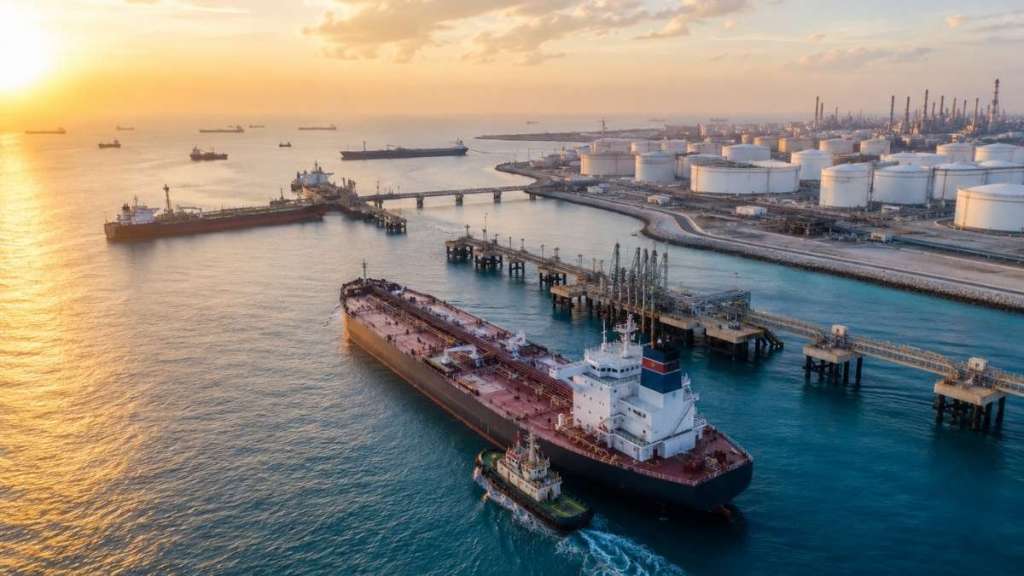

India’s crude oil imports from West Asia rose sharply in September despite continued risks around the Strait of Hormuz, as Gulf suppliers increasingly used ship-to-ship (STS) transfers to keep crude moving through the key shipping route, according to The Indian Express.
At the same time, Russian crude supplies to India fell for a second consecutive month. Stronger Chinese demand, lower Russian export availability and disruptions to Russia’s oil infrastructure have put pressure on supplies from India’s biggest crude source.
The shift is giving Indian refiners more options as geopolitical risks make supplies from both the Gulf and Russia less predictable.
West Asian oil imports jump 74%
India’s imports from West Asia rose 74% month-on-month to 2.10 million barrels per day (bpd) in September, from 1.21 million bpd in August, according to Kpler data released earlier this month.
West Asian suppliers accounted for 39.5% of India’s total crude imports, up from 26% in August and 24.1% in July. India imported around 5.32 million bpd of crude in September.
The September recovery was significant, although West Asia’s share remained below the 59.1% recorded in February, before the conflict disrupted supplies from the region.
The recovery was led by Iraq, Saudi Arabia and Kuwait. Iraq supplied around 538,000 bpd to India in September, followed by Saudi Arabia at 529,000 bpd, the UAE at 449,000 bpd and Kuwait at 344,000 bpd. Oman supplied nearly 136,000 bpd and Qatar 107,000 bpd.
Together, Iraq, Saudi Arabia, the UAE, Kuwait and Oman supplied almost 2 million bpd, or about 37.5% of India’s overall crude basket.
Iraq sees biggest jump
The increase was not uniform across Gulf suppliers. Iraq recorded the sharpest rise, with shipments more than tripling from 163,000 bpd in August to 538,000 bpd in September, an increase of about 230%.
Kuwait’s supplies rose 122% to 344,000 bpd, while Saudi Arabia’s increased 52% to 529,000 bpd.
The UAE was the exception among the major suppliers. Its shipments fell around 18%, from 546,000 bpd in August to 449,000 bpd in September.
Despite the mixed performance, higher shipments from several Gulf producers lifted West Asia’s overall share of India’s crude imports.
How STS transfers are keeping Gulf oil moving
Ship-to-ship transfers have become an important mechanism for moving crude amid the disruption around the Strait of Hormuz. Under a conventional shipment, a tanker loads crude at the supplier’s port and carries it directly to the destination.
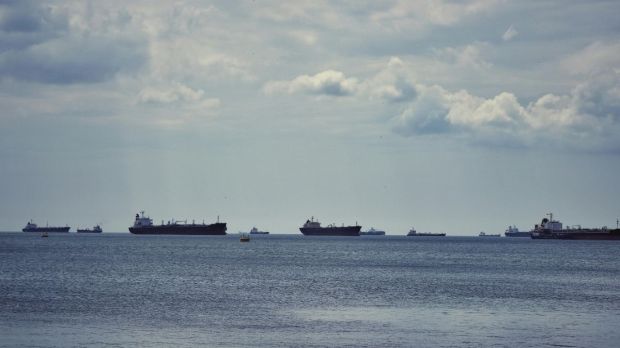
With an STS transfer, one tanker carries the crude through a difficult section of the route before transferring the cargo to another vessel in relatively safer waters. The second tanker then continues towards the final destination.
Gulf suppliers have been using this method to move crude through the Strait of Hormuz, reported The Indian Express Digital.
The arrangement can also shift part of the shipping risk away from Indian buyers. According to The Indian Express report, suppliers generally take responsibility for getting the crude through the more difficult section, after which another tanker can take the cargo towards India.
That means Indian buyers do not necessarily have to send their own chartered vessels deep into the Persian Gulf to collect the crude.
Why the Hormuz route still matters
The Strait of Hormuz remains a critical route for crude and other energy shipments from the Persian Gulf.
Around 40% of India’s crude imports normally pass through the strait, reported The Indian Express. Disruptions linked to the conflict had effectively kept a large part of that supply offline for months.
The increase in STS transfers has allowed some Gulf barrels to reach the market despite the difficult shipping environment, while shifting some of the transportation risk towards suppliers and shipping operators.
Russian crude loses ground
While Gulf supplies recovered, Russian crude imports moved in the opposite direction. India imported around 1.88 million bpd of Russian crude in September, down from 2.09 million bpd in August, according to Kpler data cited in Financial Express Digital’s earlier report.
Russian supplies had reached a record 2.83 million bpd in July, meaning September volumes were about 33.5% below that peak. Russia’s share of India’s total crude imports also fell to 35.3% in September, from 55.9% in July.
Russia remains a major supplier, but the decline marks a significant change after Indian refiners increased purchases of discounted Russian crude following Western restrictions on Russian oil.
China is competing for Russian barrels
Stronger Chinese demand is one reason Russian supplies to India have tightened. Reuters reported on September 28 that Indian refiners expected Russian oil supplies to remain under pressure in October and November because of lower Russian exports and strong Chinese demand.
“Demand from China has been really high. They were willing to book cargoes in advance and to pay firmer prices compared to Indian refiners,” a source involved in Russian crude sales told Reuters.
Russian exports have also been affected by disruptions at the Black Sea port of Novorossiysk. Reuters reported that shipments from the port had fallen by roughly half after repeated drone attacks disrupted loadings.
Russia’s infrastructure problems add to the pressure
Ukrainian attacks on Russian energy infrastructure have added another layer of uncertainty to Russian crude exports.
Attacks had affected both oil production and export logistics, while disruptions to Black Sea infrastructure created additional risks for energy tankers, reported The Indian Express Digital.
Russia has also sought to maximise domestic refinery production to meet its own fuel needs after attacks on its energy infrastructure. That can reduce the amount of crude available for export, adding to competition between Indian and Chinese buyers.
India turns to alternative barrels
The squeeze on Russian supplies has pushed Indian refiners to seek replacement crude from other markets. Reuters reported that refiners had turned to more expensive alternatives, including UAE Murban, which is a close substitute for Russia’s Urals grade, as well as Iraqi Basrah and Angolan crude.
Indian refiners have also increased purchases from Africa, North America and South America as they adjust to disruptions affecting traditional supply routes.

Kpler lead analyst for refining Nikhil Dubey said increased STS activity had supported the rise in Middle Eastern crude in India’s import basket. “Looking ahead, further improvement in ME availability could tilt India’s crude basket more towards ME barrels,” Dubey said, according to earlier The Financial Express Digital report.
He also said Indian refiners could move away from Russian crude as they exercise greater caution over the risk of punitive measures linked to Russian oil purchases.
What does the shift mean for India?
The September data points to a changing crude import mix rather than a full return to normal. West Asian suppliers accounted for 39.5% of India’s crude imports in September, still well below the 59.1% share recorded in February. But the sharp recovery from the summer months suggests that Gulf-linked supplies are becoming more available.
If cargoes classified as “unknown origin” are included, West Asia-linked and unidentified shipments reached 2.75 million bpd in September, or 51.7% of India’s total crude imports. That was only 11.4% below the 3.10 million bpd recorded in February.
For Indian refiners, the key development is therefore diversification. Russian crude remains an important part of the import basket, but its availability is being affected by Chinese competition and disruptions to Russian infrastructure. At the same time, Gulf suppliers are finding ways to keep crude moving through the Hormuz route, while Indian refiners are sourcing additional barrels from other regions.
The recovery in West Asian supplies could give India greater flexibility if the trend continues. But the outlook will still depend on shipping conditions, regional security, Russian export availability and competition from Chinese buyers.