


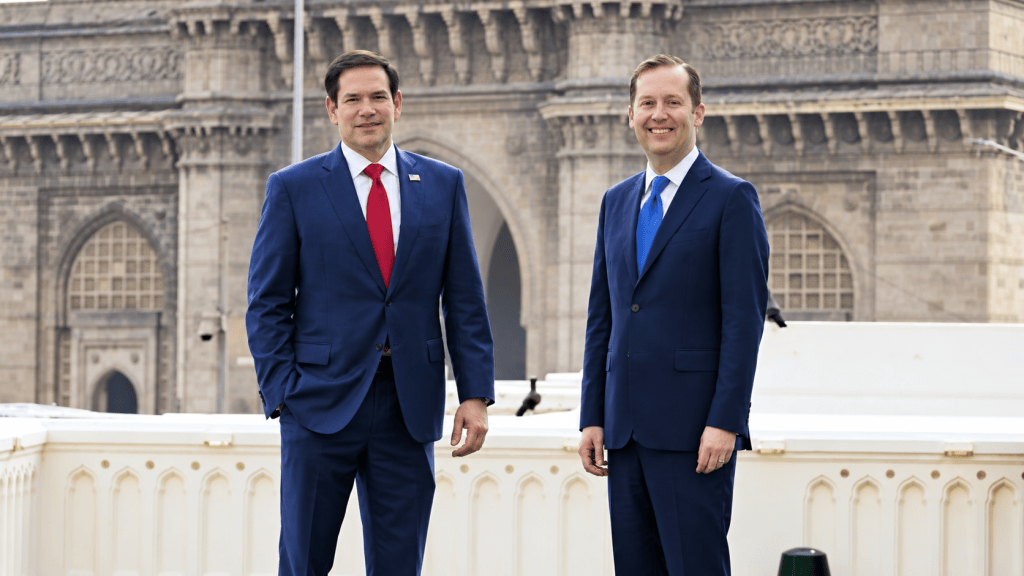

US Secretary of State Marco Rubio and US Ambassador to India Sergio Gor discussed trade, immigration, energy, defence and geopolitical ties in an exclusive interview with India Today TV. In the interview, Rubio was positive about an India-US trade agreement, he defended Washington’s immigration restrictions and called for greater energy cooperation. Gor spoke about rising bilateral trade, defence ties and the close relationship between US President Donald Trump and Prime Minister Narendra Modi.
Here are 10 key takeaways from the interview:
India, US close to trade deal
US Secretary of State Marco Rubio said India and the United States were close to reaching an interim trade agreement, with only a few issues remaining under negotiation. He declined to reveal whether Washington would offer India the competitive tariff advantage it is seeking but expressed confidence that the two sides would reach an agreement soon.
“The point of having an agreement is to be able to have certainty so that people know they can invest, people know what the rules are that are going to govern trade and commerce between the two countries,” Rubio said.
India-US bilateral trade rises to $240bn
US Ambassador to India Sergio Gor said bilateral trade had increased from $20 billion 15 years ago to $240 billion. He said investments by Indian and American companies were creating jobs in both countries and described the relationship as stronger than ever.
Gor cited investments by Indian companies in the United States and the presence of American technology companies in India as examples of how the two economies complemented each other. “This is a win-win situation,” Gor said.
H-1B visa restrictions not aimed at India
Rubio defended the Trump administration’s immigration restrictions amid concerns over their impact on Indian professionals and American businesses hiring them. He said the changes were part of a wider effort to reform the US immigration system and were not directed at any particular country.
The secretary of state cited alleged fraud and abuse in business-related immigration programmes and concerns about competition for jobs among American workers as reasons for the changes. “It’s not one that’s built on India. It’s not one that’s focused on India,” Rubio told India Today.
‘America First’ policy
Gor backed the administration’s immigration policy, saying the United States needed to reassess its approach to immigration and prioritise its national interests. He argued that India’s own emphasis on national interests should help New Delhi understand Washington’s position.
The ambassador maintained that the policy changes affecting Indian professionals were part of a global approach rather than an effort to target India. “When we talk about America first, it doesn’t mean America alone,” Gor said.
Rubio wants India to buy more US oil
Rubio said the United States wanted India to diversify its energy sources by purchasing more crude oil from America and other suppliers in the Western Hemisphere. He argued that the objective was not simply to reduce India’s purchases of Russian oil but to expand its range of suppliers.
Rubio also focused on India’s refining capacity and said investments could help the country process more crude oil. He cited his visit to Reliance Industries’ Jamnagar refinery and the company’s investment in a facility in Brownsville, Texas, as examples of potential cooperation.
“It’s not so much about buying less Russian oil than it is about buying more US crude or Venezuelan or others from the Western Hemisphere,” he said.
India-US defence cooperation
Gor said defence cooperation between India and the United States had reached an unprecedented level, pointing to joint military exercises, co-production and the presence of American defence companies in India. “Our defense cooperation is at an all-time high,” Gor said.
He cited the participation of around 500 US Army personnel in military exercises and the deployment of F-35 fighter jets in India as signs of growing military engagement. Gor also named Lockheed Martin and Boeing as American companies involved in India’s defence sector.
India among first countries considered for US small modular reactors
Rubio said India could become one of the first international markets for American small modular nuclear reactors (SMRs). He credited Prime Minister Narendra Modi’s government with opening the sector to greater private participation through the SHANTI Bill. “India is one of the first places that the United States is looking at possibly to have our first SMRs internationally,” he said.
Rubio acknowledged that regulatory challenges remained and said cooperation would take time because of the complexity of nuclear technology and the long-term nature of the partnership.
India among first 10 countries invited to join Pax Silica
Gor said India was among the first 10 countries invited by Washington to join the Pax Silica initiative, which focuses on strategic technology and supply chains. He called India as a trusted partner and said the United States wanted to expand cooperation with New Delhi. “It’s because we trust India. They’re a valued partner in the supply chain,” Gor said.
The ambassador also announced plans for senior US officials, including the attorney general and representatives of American law enforcement agencies, to visit India for discussions on counter-narcotics cooperation.
US ties with Pakistan will not come at India’s expense
Rubio sought to reassure India that Washington’s relationship with Pakistan would not undermine its partnership with New Delhi or its position on counterterrorism. He said the United States maintained relations with both countries and hoped its engagement with Islamabad would give it greater influence over decisions made by the Pakistani government. “In no way does the relationship with Pakistan come at the expense of our relationship with India,” Rubio said.
Rubio also cited American operations against the Islamic State and al-Qaeda to focus on Washington’s commitment to counterterrorism. He declined to disclose details of his diplomatic conversations with Indian and Pakistani leaders during Operation Sindoor.
Trump, Modi in regular contact, says Gor
Gor said Trump and Modi shared a close relationship and remained in regular contact, including through multiple phone calls during the month of the interview. He described both leaders as focused on delivering results and advancing cooperation between their countries. “They’re dear friends and it works well because of that, because they see eye to eye on moving the ball forward, on getting things done, on delivering,” Gor said.