


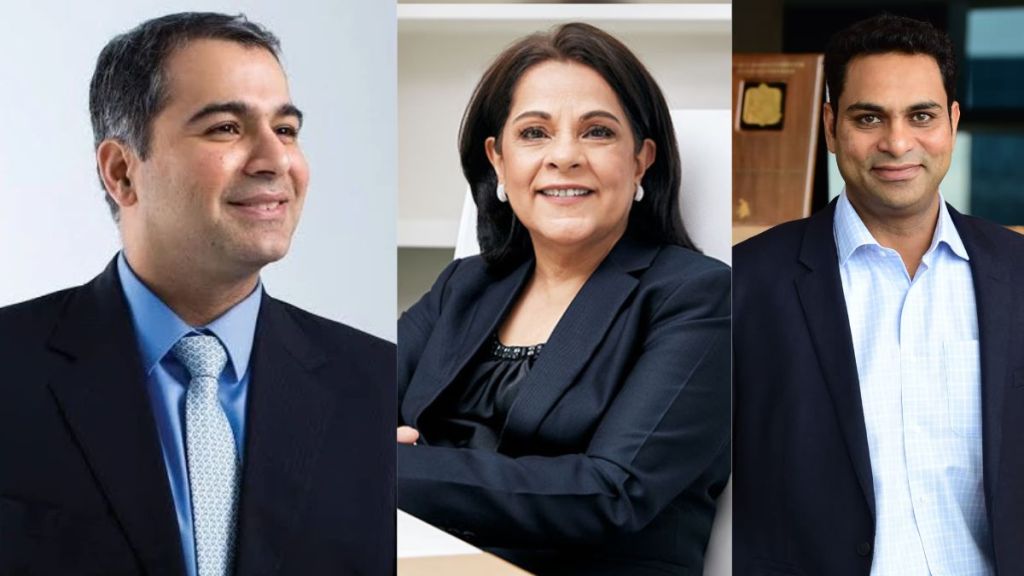

For decades, the Indian wealth story was largely built at home. Factories, pharmaceuticals, consumer brands and traditional businesses created fortunes that were rooted in Mumbai, Delhi, Ahmedabad, Hyderabad and other Indian business centres.
The latest Hurun India Rich List gives us a very different picture. Of the 346 new names added to the 2026 list, eight of the ten wealthiest new entrants now live outside India. Three are based in Dubai and five in the United States. Only two remain in India.
Their fortunes also show a changing economic landscape. Artificial intelligence, semiconductors, data centres and technology services feature prominently, alongside the Gulf’s retail and infrastructure businesses. The result is a group of new entrants whose fortunes have been built across borders, often far from the country where their families or businesses first took root. The ten wealthiest new entrants have a combined wealth of more than INR 3.6 lakh crore.
Renuka Jagtiani: The biggest new entrant
At INR 70,500 crore, Renuka Jagtiani is the highest-placed new entrant on the 2026 Hurun India Rich List. Jagtiani, 71, heads Dubai-based Landmark Group, the retail conglomerate founded by her husband Micky Jagtiani. The group has built a sprawling presence across fashion, footwear, home improvement and other consumer businesses in the Middle East and beyond.
Her appearance also complicates the idea that every new entrant represents a young technology entrepreneur. Jagtiani is the oldest person among the ten wealthiest debutants, with a fortune built around a consumer empire that has been developing for decades.
Sridhar Pinnapureddy: Building India’s digital backbone
Sridhar Pinnapureddy and his family enter the list with a fortune of INR 46,100 crore through CTRL S Datacentres. Based in Hyderabad, Pinnapureddy is one of just two people in the top ten who continue to live in India. His wealth is tied to an increasingly critical piece of the digital economy: the infrastructure required to store and process enormous volumes of data. As cloud computing and artificial intelligence drive demand for computing capacity, data centres have moved from being largely invisible infrastructure to one of the most important businesses underpinning the technology economy.
Darshan Hiranandani: Data centres from Dubai
Darshan Hiranandani, with wealth of INR 37,900 crore, represents the other side of the same infrastructure story. He runs Yotta, the data centre business of the Hiranandani Group, and is based in Dubai. His debut alongside Pinnapureddy means two of the country’s ten richest new entrants have built their fortunes around data-centre infrastructure.
Ravi Pillai: A Gulf fortune built over decades
At INR 37,300 crore, Ravi Pillai is another example of wealth created outside India’s borders. The founder of RP Group, Pillai built his business empire around construction and workforce services in the Gulf. Based in Dubai, he represents a very different route to wealth from the younger technology entrepreneurs elsewhere on the list.
Vivek Ranadive: From enterprise software to the NBA
Vivek Ranadive brings another distinctly American chapter to the list. The Palo Alto-based entrepreneur enters with a wealth of INR 36,800 crore. Ranadive founded enterprise software company TIBCO and is also the owner of the NBA’s Sacramento Kings. He is the first of five US-based names among the ten richest new entrants.
Sharad Pitamber Chauhan: A consumer giant remains at home
The second India-based entrant is Sharad Pitamber Chauhan and family, with wealth of INR 32,000 crore. The fortune comes from Parle Products, the Mumbai-based food company behind some of India’s most recognisable snack and biscuit brands. Unlike several others in the top ten, Chauhan’s wealth remains closely tied to a quintessentially Indian consumer business and is still based in the country where that business was built.
Jitendra Mohan: An AI infrastructure fortune
The technology shift becomes particularly clear with Jitendra Mohan. Mohan enters the list with wealth of INR 28,800 crore as co-founder of Astera Labs, the Santa Clara-based semiconductor company that develops connectivity solutions used in AI and data-centre infrastructure.
His fortune belongs to a newer generation of technology wealth. Rather than being built around traditional software or internet businesses, it is tied directly to the hardware and connectivity infrastructure required to support the AI boom.
Sanjay Gajendra: Two new fortunes from one company
Astera Labs has another name in the top ten: Sanjay Gajendra, who enters with wealth of INR 27,600 crore. Gajendra, also based in Santa Clara, co-founded the company with Mohan. Their simultaneous appearance among Hurun’s ten richest new entrants is unusual, putting a single AI infrastructure company behind two of the year’s biggest new fortunes.
Rajiv Jain: An investment fortune from Florida
Rajiv Jain takes a different route. The Fort Lauderdale-based investor enters the list with wealth of INR 27,100 crore through GQG Partners, the investment management firm he founded. Jain’s fortune stands apart from the technology-heavy pattern of the list. While his business operates within the global financial system rather than the AI economy, his story shares one feature with many of the others: his wealth has been built outside India.
Raj Sardana: Technology services from Atlanta
Rounding out the top ten is Raj Sardana, who enters with wealth of INR 21,600 crore through Innova Solutions, the Atlanta-based technology staffing and IT services company. His debut adds another US-based entrepreneur to a list already dominated by American technology and technology-adjacent businesses.
A new map of Indian wealth
The ten richest new entrants tell a story that extends beyond individual fortunes. Eight live outside India. Three are based in Dubai, five in the US and just two in India. Their businesses span retail, construction, investment management, food, technology services, data centres and semiconductors. Two of the ten are tied to data centres, while two more are founders of a semiconductor company supplying infrastructure for AI workloads. These are businesses that sit underneath the consumer-facing AI products attracting much of the attention today.
At the same time, the presence of Jagtiani and Pillai shows that the Gulf remains an important wealth-creation hub for Indian-origin entrepreneurs, particularly in retail, construction and services. The list captures two distinct but increasingly important paths for new Indian-origin wealth: the long-established diaspora economy of the Gulf and the newer technology economy of the United States.