


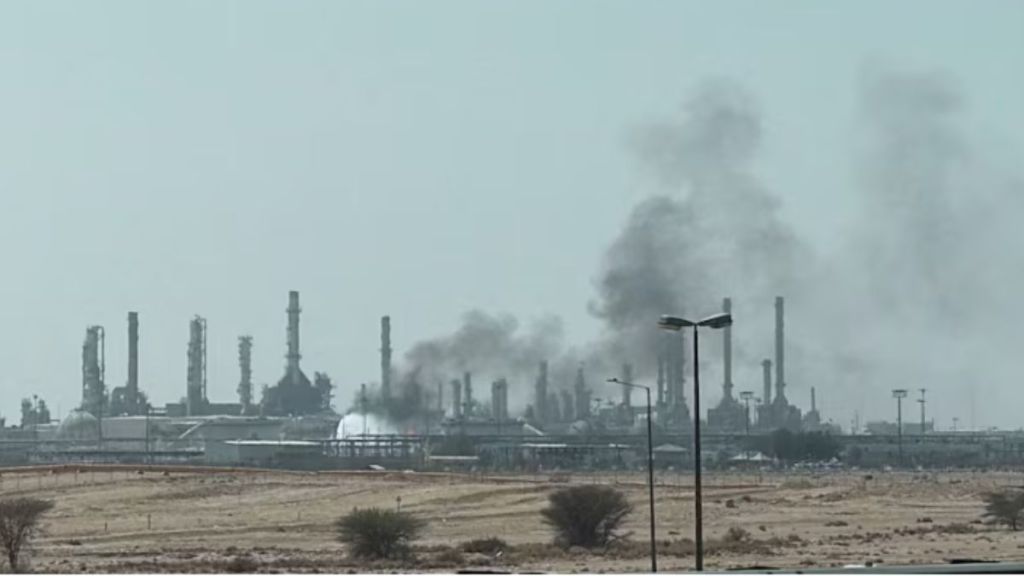

Houthi rebels have repeatedly struck Saudi Arabia since war broke out across West Asia earlier this year. More than 300 people were injured and at least 12 killed over the weekend as missiles struck the King Khalid International Airport in Riyadh — the deadliest attack in any Gulf Arab country since the start of the Iran war. Matters worsened on Tuesday night as the headquarters of oil giant Saudi Aramco suffered extensive fire damage. The Houthis have since vowed to ramp up their strikes against airports and oil facilities.
The attacks have focused on the civilian core of Saudi Arabia — targeting key infrastructure and its economic lifelines. The Iran-backed rebels in neighbouring Yemen have also seized vital positions along the Red Sea coast and taken virtual control of the strategic Bab al-Mandeb Strait.
Airlines have been forced to cancel flights, and top oil executives were dropped from a crucial event as Riyadh strove to restore normalcy this week. It also appears increasingly likely that fewer Western financiers will attend the Future Investment Initiative in the Saudi capital later this month.
Saudi economy faces 3.3% slump in 2026 due to disruptions in oil trade
Saudi Arabia’s economy is expected to shrink by 3.3 percent in 2026, according to the International Monetary Fund’s latest World Economic Outlook, as intensifying Houthi attacks and disruptions to vital regional shipping lanes weigh on economic activity in the world’s biggest oil-exporting nation.
The IMF has also warned of an economic downturn across the wider region, pointing to Iran’s restrictions on maritime traffic through the Strait of Hormuz, a strategic chokepoint that serves as a key passage for global oil shipments.
The strikes are also a massive blow to Vision 2030 — Saudi Arabia’s multi-billion-dollar programme to diversify the economy away from oil, modernise society and position the kingdom as an investment and tourism hub. Crown Prince Mohammed bin Salman Al Saud had incidentally set a target for inflows of foreign direct investment to reach $100 billion a year by the end of the decade.
Why are the Houthis striking Saudi Arabia?
The Saudis and the Houthis began fighting in 2015 when the kingdom entered Yemen’s civil war on behalf of the internationally recognized government. There had been relative calm after a 2022 ceasefire — until the Houthis resumed attacks in July. They claimed Saudi Arabia had fired at Sanaa airport while a plane from Iran was trying to land. The flight had carried a Houthi delegation to Tehran for the funeral of late Supreme Leader Ayatollah Ali Khamenei and eventually rerouted to another airport. The strikes were claimed by Yemen’s internationally recognized government, which is heavily backed by Riyadh.
Fighting has escalated in recent weeks as a Saudi-led coalition provided air support for Yemeni government forces attempting to reverse recent Houthi gains along the Red Sea. Those gains gave the rebels better surveillance of shipping on a corridor that is a crucial alternative to the Strait of Hormuz — currently blockaded by both Iran and the United States.
Concerns about wider attacks persist even as the Houthis insist they are only targeting Saudi shipping as part of a blockade in retaliation for the one imposed on them. The rebel group had previously launched attacks ‘in solidarity with Palestinians’ and ‘entered’ the Iran war by launching ballistic missiles targeting military sites in Israel.
Riyadh Airport closure and flight cancellations: What’s the economic toll for Saudi?
The attacks against Riyadh airport have also triggered a lengthy airport closure and sweeping flight cancellations. Multiple airlines have paused flights to Saudi Arabia and neighbouring countries after the deadly weekend attacks — adding to wider disruption in the region since the Iran war began. According to an official notice, the King Khalid International Airport will remain shut until October 17.
Keeping a major airport closed can cost a country millions per day in direct losses and also inflict longer-term damage to the economy. Reports citing the Dubai Civil Aviation Authority had pegged total damages at more than $5 billion after Dubai International Airport and Al Maktoum International experienced near-total shutdowns between February 28 and March 3. The government reportedly put the verified economic loss at approximately $1 million per minute — giving a rough estimate of the losses Saudi Arabia might be facing. This figure does not account for broader disruptions to trade, aviation and tourism caused by the attacks.
Flight cancellations will also likely complicate business travel for many consultants and bankers who commute to Riyadh weekly from regional hubs. The repeated failure of well-resourced Saudi Arabian defences in intercepting the incoming strikes over several days is likely to spark alarm for both tourists and financiers.
The impact has rippled through the business community almost immediately as firms shifted to remote work and top executives withdrew from in-person attendance at this week’s WPC Energy Congress. According to a Reuters report, the chief executives of ExxonMobil, TotalEnergies, BP, Chevron and Shell were all removed from the conference agenda at the last minute.
The kingdom has pressed on with its planned events despite the attacks — underscoring a determination to keep its economic agenda on track. Events like the WPC and FII are crucial for the kingdom which has spent many years and billions of dollars to emerge as the financial capital of the Gulf.
From pipeline closures to FII no-shows — Saudi feels the strain
The Riyadh airport strikes coincide with the start of a traditionally busy season for events and conferences in Saudi Arabia. The lengthy list of events includes its flagship Future Investment Initiative that typically draws thousands of visitors and speakers from the top echelons of Wall Street — including oil executives that dropped out at the last minute.A Saudi-led military coalition fighting the Houthis later said it had intercepted more missiles and drones aimed at the kingdom — including areas that are home to key oil and gas facilities.
The country was forced to shut down its East-West pipeline for part of September after the vital oil conduit faced aerial attacks. The 1,200-km pipeline running across the Arabian Peninsula has served as the main route out for global supplies of Middle East oil for the past six months while the Strait of Hormuz has been largely shut by war. It has been moving 4 million to 5 million barrels per day, amounting to 4% to 5% of global supply, sparing Saudi Arabia the brunt of the disruption that has crippled other Gulf oil and gas exporters.
Saudi Aramco shut its 400,000-barrel-per-day Jazan refinery on July 27 after a Houthi attack damaged the facility.
NASA satellite images showed a thick cloud of black smoke over the Jazan refinery and white smoke rising from an oil distribution centre in Abha last month.
Vital gas and stabilization infrastructure at Shedgum and Tanajib was targeted by Houthi missile strikes in October 2026.
Why Saudi maritime oil routes are under pressure
Trading routes have also faced heavy strain after the Houthis successfully advanced along Yemen’s southwestern coast to seize areas overlooking the Bab al-Mandeb Strait.
Saudi oil assets in the Jazan, Abha and Najran regions were also struck last month — with the geographic location of these strikes raising questions about safety along the broader maritime trade corridor.
The Houthis declared a complete naval blockade on Saudi Arabia (which relies partly on the Red Sea to access global oil markets) in July.
Two months later the militant group seized control of the strategic Yemeni port city of Mokha and several islands near the Bab el-Mandeb Strait — expanding their control over the Red Sea coastline.
Major blow to Crown Prince MbS’ Vision 2030
Saudi Arabia is the second largest oil producing country in the world — with crude supply to market reaching 7.122 million barrels per day in August. But the country saw its crude oil production drop to its lowest level since 1990 as renewed hostilities between the United States and Iran and export routes from the region. Tanker-tracking data compiled by Bloomberg showed Saudi crude exports fell by approximately one-third to around 3 million barrels per day.
The enduring threat to oil tankers passing through the narrow Strait of Hormuz as well as Houthi-controlled parts of the Red Sea may threaten flows of oil cash to state coffers. At the same time, Saudi oil wealth is expected to generate lower returns over time — prompting the country to pivot towards non-oil revenue systems. .
According to a Bloomberg update the Saudi financial overhaul had already been facing pressure before the Iran war broke out. The publication noted that officials were ‘reprioritising’ spending plans in the months before the clash. The Saudi Ministry of Finance also revised its GDP forecast earlier this month — with the economy now projected to shrink by 3.6% in 2026. The figure is a sharp reversal from the original budget forecast of 4.6% growth.
Foreign investment and financing has become increasingly important for the country. Bloomberg highlighted that state-owned oil giant Aramco was exploring a wave of divestments spanning everything from energy facilities to real estate, in deals that could eventually raise as much as $35 billion.
The kingdom has also committed large sums towards hotels, resorts and entertainment for international visitors, making tourism an important test of its ability to sustain investor confidence.
Investor confidence at risk?
For months Saudi Arabia has appeared to weather the West Asia conflict better than many neighbours as the East-West pipeline allowed it to bypass the Strait of Hormuz. But Houthi-led attacks against energy infrastructure, threats to Saudi shipping and strikes on airports are exposing the limits to its insulation.
It remains unclear how the October attacks will impact investor sentiments in upcoming data. But the stock market is already feeling the pressure: Saudi Arabian long-dated bonds tumbled and Riyadh-listed equities slid to a three-and-a-half-year low on Monday as markets opened after the weekend attacks.
According to data shared by the General Authority for Statistics, the country saw its Business Confidence Index rise to 56.7 in August amid continued optimism in the non-oil economy. The figure fell marginally to 56.5 in September — nonetheless recording a sharp recovery from the 52.1 noted in March this year.
Investments have also been slower than expected — with United Nations Trade and Development data indicating net FDI inflows in 2025 were $33 billion. The figure is only a third of the target outlined by Crown Prince MbS. Increasingly strained finances and a projected budget shortfall can be offset by a surge of investment into the non-oil economy.
As a counterpoint, a prolonged regional war that poses a direct threat to Saudi infrastructure could make overseas investors less keen to deploy capital, and discourage major companies from setting up shop in Riyadh. The country’s relatively low national debt and $500 billion of foreign reserves give it a bulwark of financial security. But without a sufficient degree of military protection, the overseas capital required to create a virtuous circle may stay away.