



The United Arab Emirates left the OPEC alliance in May this year, ending a nearly 60 year partnership amid the West Asia conflict. The move had implications beyond crude — aligning instead with the country’s gradual transition to a post-oil economy. Another notable milestone came later that month as the UAE reported that non-oil foreign trade had surpassed $1 trillion for the first time.
India has emerged as a foundational pillar of the country’s changing business landscape, with a $200 billion trade target for 2032. According to government data, bilateral merchandise trade between the two countries had crossed $100 billion for the first time in FY26. The two countries had also signed a Comprehensive Economic Partnership Agreement in 2022 — making a vast majority of goods duty free, fast-tracking approval for Indian pharmaceuticals and outlining dedicated frameworks for joint innovation and startup corridors.
The India-Middle East-Europe Economic Corridor is central to this global supply chain pivot. Union Minister Piyush Goyal predicted in 2025 that IMEC would reduce logistics costs by up to 30% and transportation time by 40% and “and create seamless trade linkages across continents”. The transformative route will connect three continents when completed — using shipping routes, railways, and energy-data networks to connect India with Europe.
According to official data, UAE entities have invested over $25 billion into India since 2000. Meanwhile Indian companies have also pumped more than $16 billion into the UAE for various projects. Nearly five million Indian nationals live and work in the Emirates — its largest diaspora group and often the human backbone behind its expansion. By some estimates, the Gulf nation will need to add another 1 million human workers by 2030 to maintain its developmental pace.
Beyond oil: How India-UAE trade has evolved
The Gulf country has gradually cemented its position as a global hub for trade and investment — with non-oil foreign trade exceeding AED1.9 trillion during the first half of 2026. Official data cited by WAM indicates this segment has grown 78.8% when compared against the same period in 2022.
Dr Thani bin Ahmed Al Zeyoudi told the AIM Investment Summit in September that the UAE had attracted FDI inflows of $48.3 billion during 2025. The Minister of Foreign Trade added that the cumulative stock of FDI in the country exceeded AED1.17 trillion. He added that the next phase would “witness rapid shifts in the geography of the global economy, a transition towards technology-led economies and the transformation of sustainability into an investment opportunity”.
The UAE is now one of India’s largest trading partners, a major energy supplier, and a key investor in infrastructure and renewable energy. The cooperation has also shifted towards direct investments as Emirati sovereign funds deploy billions into Indian infrastructure, clean tech, and digital platforms. Many domestic companies have also begun setting up manufacturing bases and regional headquarters in the Gulf country to access global supply chains.
According to Ahmed Al Alawi, cooperation has evolved to include “advanced manufacturing, automotive, engineering, clean energy, technology, and supply-chain industries”. The Director of Trade and Logistics Development at Abu Dhabi Investment Office noted that the growing industrial collaboration would help create “new pathways for sustainable economic growth beyond traditional sectors”.
“Indian companies can leverage Abu Dhabi’s business ecosystem as a strategic base to expand into regional and international markets, strengthen operational efficiency, and integrate into global value chains,” he told Financial Express.
A $25 billion investment
Investment has become a cornerstone of India-UAE ties — with a bilateral treaty signed in February 2024. Cumulative FDI from the UAE into India amounted to $25.59 billion (DPIIT) from April 2000 to March 2026 — making UAE the seventh-largest overseas investor in India. The outcome has been a well-diversified portfolio spanning real estate, infrastructure, energy, private equity and financial services.
Sovereign Wealth Funds have also established a strong presence in India — with GIFT City in Gujarat emerging as a key node. The Abu Dhabi Investment Authority (the largest SWF in the country), Abu Dhabi National Insurance and logistics giant DP World have all opened offices in the city.
“The future of India–UAE industrial collaboration is a bright one. As both countries continue to strengthen economic ties, we fully expect to see greater investment across advanced manufacturing, mobility, clean energy, technology and logistics – areas of mutual cooperation,” Al Alawi added in conversation with FE.
India-UAE growth corridor
According to details shared on the Dubai consulate website, the UAE now ranks as the “third-largest trading partner and second-largest export destination” for India. Bilateral trade has surged sharply — from $180 million annually in the 1970s to $101.25 billion in FY26 — while exports exceeded US$ 37.35 billion in FY26. The trade basket remains “well diversified” and encompasses petroleum products, gems and jewellery, food items, textiles, chemicals, electronic goods, and engineering goods.
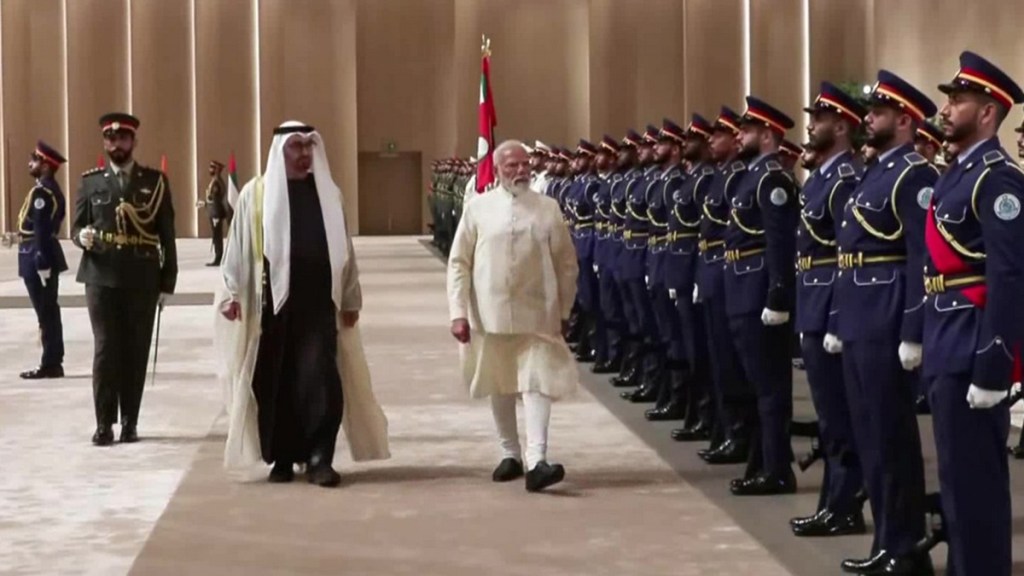
The two countries have also linked their financial systems — allowing for digital rupee settlements via UPI and cooperation through GIFT City. Joint initiatives have been announced to build supercomputing clusters, data centres in India, and establish ‘digital embassies’ that house critical sovereign data repositories. A major $5 billion investment and strategic cooperation package covering energy, defense, and advanced technology was announced in mid-May as Prime Minister Narendra Modi visited Abu Dhabi.
Pacts were also signed on strategic petroleum reserves and supply of liquefied petroleum gas. The Abu Dhabi National Oil Company (better known by its acronym ADNOC) has entered into a 10 year LNG Supply Agreement with Hindustan Petroleum Corporation Limited for delivery of 0.5 million tonnes per year from 2028. The visit had also yielded a Letter of Intent on investment cooperation for the Dholera Special Investment Region, and an MoU on food safety to facilitate agri-trade between the two nations.
From oil trade to industrial investment
There have been several standout agreements and investments signed between the two countries in recent years. Abu Dhabi and New Delhi are also exploring civil nuclear partnerships — including Small Modular Reactors and advanced reactor tech — following the enactment of India’s SHANTI Act.
Trade initiatives such as Bharat Mart, the Virtual Trade Corridor, and Bharat-Africa Setu are currently being built in the UAE to support MSME exports. According to an earlier press release from PIB, the Bharat Mart is “envisaged as a marketplace that provides Indian traders, exporters, and manufacturers access to markets in the Middle East, Africa and Eurasia”. The 1400 unit facility spread across an area of 1,00,000 sq mt. is slated for completion in 2026.
- Automotive manufacturing hub in KEZAD
A prime example of this cooperation is an upcoming 87,000-square-metre manufacturing hub in Abu Dhabi. The project is being established by domestic auto-component giant Samvardhana Motherson International with support from the ADIO in the Khalifa Economic Zones of Abu Dhabi.
“The facility will manufacture automotive components for Motherson’s global operations as well as third-party OEM customers. Once fully operational, it is expected to create more than 1,000 jobs and serve as a regional manufacturing and export base…” Al Alawi explained.
- Developing the Dholera Special Investment Region
The Gujarat government had signed a letter of intent with the UAE Ministry of investment in January this year to develop the Dholera Special Investment Region. According to an official statement, the envisioned partnership would include the development of key strategic infrastructure, including an international airport, a pilot training school, a maintenance, repair and overhaul facility, a greenfield port, a smart urban township, railway connectivity, and energy infrastructure.