


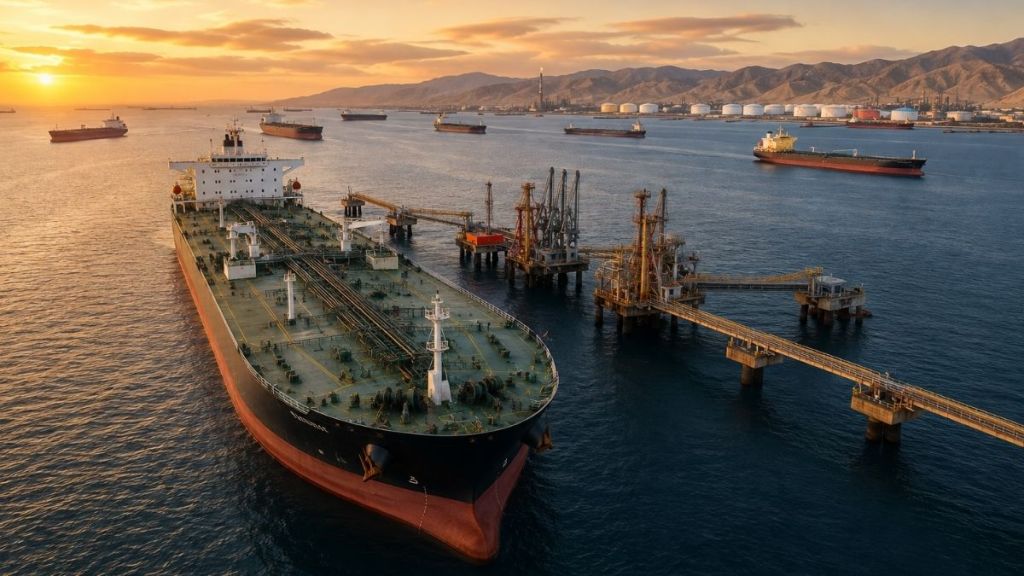

The global oil market is facing an unusual problem. The routes meant to provide an escape from the Strait of Hormuz are coming under pressure at the same time.
Traffic through Hormuz has fallen sharply since the war disrupted shipping. The Bab el-Mandeb Strait, another key route connecting the Red Sea with the Gulf of Aden, is facing new security threats. Now, Saudi Arabia’s main east-west oil pipeline, a crucial alternative to Hormuz, is also under threat.
Saudi Arabia could lose up to 4% of global oil supply if its East-West pipeline does not restart within days, reported Reuters. The pipeline moves crude from Saudi Arabia’s oil-producing east to Yanbu on the Red Sea, allowing the kingdom to bypass Hormuz.
The problem is that the bypass itself is now unavailable. At the same time, Commodity vessel traffic through Hormuz had fallen to single-digit numbers per day over the weekend, reported Reuters. The 10-day average was 14 vessels a day, compared with about 125 large commercial vessels a day before the Iran war began on February 28.
Hormuz normally handles about 20% of the world’s daily crude oil and liquefied natural gas supply. That leaves global buyers with alternatives, but none can quickly replace all the volumes that normally move through the Gulf.
For India, the exposure is particularly important because the country is heavily dependent on imported crude and LPG. India’s crude sourcing has become more diversified, but a prolonged disruption could still push up freight and oil costs, with the impact eventually reaching consumers.
Why are global oil routes under pressure?
The Strait of Hormuz is the central maritime link between the oil-producing Gulf and global markets.
Saudi Arabia, Iraq, Kuwait, Qatar, the UAE and Iran all depend on infrastructure and shipping routes connected to the strait. When it functions normally, tankers can carry large volumes of Gulf crude to customers in Asia and elsewhere.
But traffic has collapsed since the war disrupted shipping. Only single-digit numbers of commodity vessels crossed Hormuz per day over the weekend, reported Reuters. Four vessels exited the Gulf and 10 entered, according to preliminary ship-tracking data.
The figures exclude ships that may have switched off their Automatic Identification System transponders, meaning the exact level of traffic remains uncertain. But the decline from normal levels is substantial.
That has increased the importance of alternative routes, particularly for Saudi Arabia.
Saudi Arabia’s pipeline was key bypass
Saudi Arabia’s East-West pipeline, also known as the Petroline, runs from the country’s oil-producing eastern region to Yanbu on the Red Sea. Its strategic purpose is straightforward: it allows Saudi crude to reach the Red Sea without passing through Hormuz.
That became especially important after the war disrupted shipping through the strait. Saudi Arabia had used the pipeline to reroute about 4 million barrels per day to Yanbu. That is roughly 4% of global oil supply, reported Reuters.
The pipeline therefore acted as a pressure-release valve for the global market. But a drone attack on September 11 forced Saudi Arabia to shut the route.
Saudi Arabia has not provided a detailed estimate of the damage or said when the pipeline will fully restart. Reuters reported that sources gave different repair estimates, with one suggesting five to six weeks and another saying pumping could resume sooner, at least partially.
The uncertainty is important because Yanbu does not have unlimited stocks. The terminal had enough stocks to maintain exports for only five to seven days if the pipeline remained shut, reported Reuters. Saudi Arabia also has supplies at Egypt’s Ain Sukhna and Sidi Kerir terminals, but those stocks are limited.
That means the pipeline does not need to remain offline for weeks to create pressure. Even a prolonged outage of several days could force Saudi Arabia to reduce exports unless other routes compensate.
Bab el-Mandeb adds another layer of risk
The timing is particularly difficult because Saudi Arabia’s Red Sea alternative faces a separate security problem. The Bab el-Mandeb Strait lies at the southern entrance to the Red Sea, connecting it with the Gulf of Aden. It is an important maritime route between the Middle East, the Suez Canal and global markets.
Shipping through the waterway has already declined sharply because of Houthi attacks. Traffic through Bab el-Mandeb had fallen by about 60% since the Houthis began attacking some ships in late 2023, reported AP.
Shipping had increased in 2026 as Saudi Arabia sought alternatives to Hormuz, but renewed Houthi threats have curtailed that activity, AP reported, citing Lloyd’s List Intelligence.
The capture of Mayun Island, also known as Perim, on September 11 added to the uncertainty. The island sits inside the Bab el-Mandeb and occupies a strategic position near the shipping lane.
The Houthi advance could give Iran greater leverage in its effort to push up global oil and gas prices. The group has also threatened Saudi-linked shipping. The Houthis declared a blockade of Saudi shipping in July and had attacked Saudi oil infrastructure and vessels, reported AP.
This creates a problem for Saudi Arabia’s alternative export system. Crude can move from the eastern side of the kingdom to Yanbu through the East-West pipeline. From there, ships can use the Red Sea. But vessels heading towards the Indian Ocean and Asian markets still have to pass Bab el-Mandeb.
Saudi Arabia can instead move some crude north through the Red Sea towards the Mediterranean using the Suez Canal or Egypt’s pipeline network. But that route is longer, particularly for Asian customers.
Saudi Arabia had already begun looking for such alternatives after Houthi attacks threatened Red Sea shipments.
The choices therefore become progressively more expensive:
- If Hormuz is disrupted, Saudi Arabia can use its pipeline.
- If the pipeline is unavailable, it can rely more heavily on Red Sea routes.
- If Bab el-Mandeb also becomes unsafe, it can send some crude north through Egypt.
But every diversion adds distance, time and freight costs. S&P Global reported on August 5 that Indian and Chinese oil importers faced an unusual supply-chain risk because both Hormuz and Bab el-Mandeb were facing disruption at the same time.
Some crude cargoes bound for the Far East had already been diverted around the Cape of Good Hope because of Bab el-Mandeb risks. S&P Global estimated that a very large crude carrier on such a route could cost about $20 million per voyage.
Why does this matter for India?
India is directly exposed because it is one of the world’s biggest oil importers and depends heavily on imported crude and LPG. Indian government said on March 11 that the country consumes about 5.5 million barrels of crude oil a day.
India has increased the geographic diversity of its supplies. The government said about 70% of crude imports were coming through routes outside Hormuz at the time, compared with about 55% earlier.
The Petroleum Ministry also said India imports crude from around 40 countries. Russia had become its largest supplier, while purchases from other producers had also increased.
India imported crude from more than 40 countries during the first half of 2026, with Russia remaining the largest supplier at 1.82 million barrels per day, reported S&P Global.
India also increased imports from countries including the UAE and Brazil as refiners sought to diversify supplies. That diversification provides some protection from a disruption at a single chokepoint.
But supply availability and price are two different issues. If India and other major Asian buyers compete for alternative cargoes from Russia, West Africa, Latin America or the US, the cost of those barrels can rise. Longer shipping routes can add another layer of expense.
The impact can eventually reach Indian consumers through petrol, diesel, aviation fuel, transport and manufactured goods.
LPG is a bigger vulnerability
India’s LPG exposure is more concentrated. The government said on March 11 that India imports about 60% of its LPG consumption, with around 90% of those imports coming through the Strait of Hormuz. That makes LPG more vulnerable to a prolonged disruption than crude oil.
The government has already taken steps to reduce the immediate risk. On March 8, India ordered refineries and petrochemical complexes to maximise LPG production by diverting certain refinery streams into the LPG pool. The government said domestic LPG production subsequently increased by about 25%.
It also said domestic LPG production was directed towards household consumers, while hospitals, educational institutions and other essential sectors received priority for non-domestic LPG.
The government approved Rs 30,000 crore in compensation for oil marketing companies to cover LPG under-recoveries, according to March 11 PIB release.
These measures can cushion households from an immediate supply shock. But they cannot completely insulate India from global oil and freight prices.
How important is Saudi Arabia for India?
Saudi Arabia matters to India not only because of its position in the Gulf but also because it is a significant supplier of both crude and LPG. According to the Embassy of India in Riyadh, India imported 33.14 million metric tonnes of Saudi crude in the 2024-25 financial year, accounting for 13.58% of India’s total crude imports.
Saudi Arabia also supplied 3.34 million metric tonnes of LPG to India in 2024-25, or 14.99% of India’s total LPG imports.
A prolonged disruption to Saudi export infrastructure could therefore force Indian refiners to compete more aggressively for alternative supplies.
Again, that does not mean India will run out of crude. It means the cost of securing those barrels could rise.
What happens if alternative routes remain disrupted?
The pressure does not stop with crude oil. Refineries need crude to produce petrol, diesel, jet fuel and other petroleum products. If crude becomes more expensive and ships take longer to deliver it, refinery margins can come under pressure.
Higher fuel costs can then spread through transport, aviation, manufacturing and other parts of the economy.
Global fuel prices had already reached record highs amid the wider supply disruption. US diesel prices crossed $6.20 a gallon on September 13, according to Reuters report, while oil prices had moved above $100 a barrel during the previous week.
Higher energy prices can feed inflation because fuel affects the cost of moving goods, producing goods and running businesses.
That creates a difficult environment for central banks. If energy prices remain elevated for long enough, inflation can stay high even as economic demand weakens.