


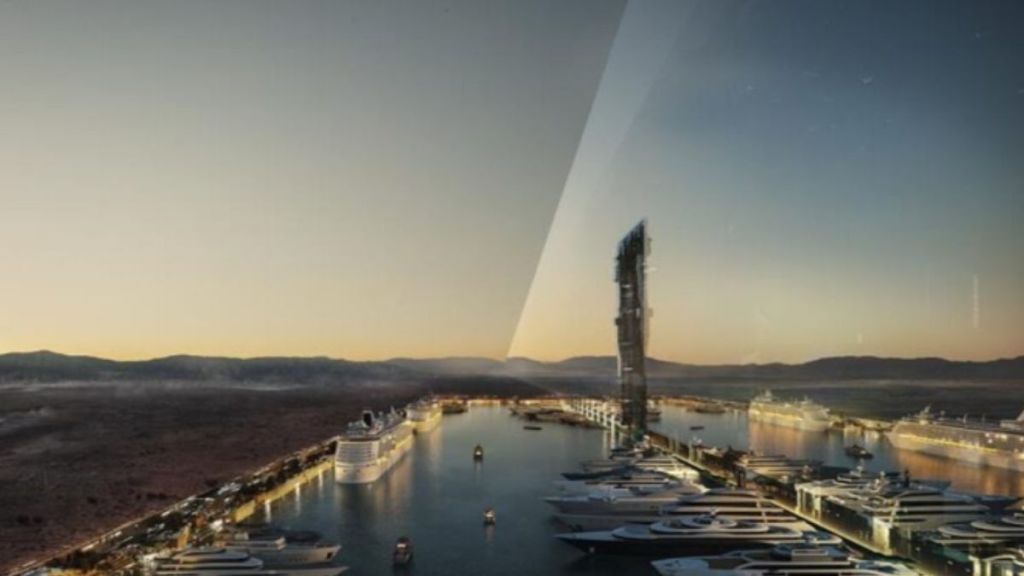

Saudi Arabia’s NEOM was designed as one of the world’s biggest experiments in building a new city from the ground up, combining futuristic urban development, clean energy, artificial intelligence, tourism and advanced industries.
The Public Investment Fund (PIF), Saudi Arabia’s sovereign wealth fund, said in its 2024 Offering Circular that NEOM’s expected total capital expenditure was about $500 billion, funded through PIF equity and external sources.
But the project is now entering a different phase. Reuters reported on October 4 that Saudi Arabia has quietly shelved plans for the NEOM Stadium, one of the venues originally planned for the 2034 FIFA World Cup. Two people familiar with the matter told Reuters that the stadium had been put on hold indefinitely following delays and the scaling down of development around it.
The decision has implications beyond football. NEOM is one of the most visible projects under Crown Prince Mohammed bin Salman’s Vision 2030 programme, which aims to reduce Saudi Arabia’s dependence on oil and develop new sources of economic growth.
What is NEOM?
NEOM is not a single city or construction project. It is a planned city and economic zone in Saudi Arabia’s Tabuk region, covering around 26,500 square kilometres, near the kingdom’s northwestern border. The project was announced by Mohammed bin Salman in October 2017.
PIF described NEOM as a model for living and innovation designed to support the non-oil economy through sectors including energy, water, transport, biotechnology, food, manufacturing, media, entertainment, tourism, sports, technology and digital sciences.
The project was also intended to have a separate legal and regulatory framework, including its own tax and labour laws and an autonomous judicial system.
The $500 billion figure refers to expected capital expenditure across the wider NEOM development, rather than the cost of one building. Saudi Arabia initially said NEOM would be backed by more than $500 billion from the kingdom, PIF and local and international investors.
Why ‘The Line’ became the symbol of NEOM
The most recognisable part of NEOM is “The Line”, announced in 2021 as a linear city. PIF’s 2024 document described it as a planned city 170 km long, while Reuters has described the proposed steel-and-glass development as about 100 miles, or roughly 160 km.
The concept was radically different from a conventional city. The Line was planned without traditional roads dominated by cars and was supposed to rely on high-speed transport and AI-enabled infrastructure.
The original plan also called for 95% of the natural environment to be preserved, with the city powered entirely by clean energy.
But its status has changed. In April 2026, PIF Governor Yasir Al-Rumayyan said The Line was no longer a priority. He said there were directives for NEOM to “reprioritize” and that having The Line completed by 2030 was not essential.
What else is being built inside NEOM?
The Line is only one part of the wider development. PIF has identified several major projects, including Oxagon, Trojena and Sindalah.
Oxagon was designed as an industrial and advanced manufacturing zone and was selected for a major green hydrogen project. NEOM Green Hydrogen Company announced in 2023 that it had secured financing for a facility with a total investment value of $8.4 billion, powered by renewable energy from wind and solar.
Trojena was planned as a mountain tourism destination, including outdoor skiing, while Sindalah was designed as a luxury island destination featuring an 86-berth marina, golf course, hotel rooms and serviced apartments.
How much money has gone into NEOM?
The $500 billion figure represents expected capital expenditure, not money already spent. PIF’s documents show, however, that NEOM has already moved beyond the planning stage.
NEOM Company was established in 2019 to oversee the project, with PIF owning 100% of the company as of December 31, 2023. NEOM Bay Airport opened in 2019 and began receiving commercial flights.
The project has also secured external financing. In April 2024, NEOM announced a SAR 10 billion revolving credit facility to support short-term financing requirements for developments including The Line, Trojena, Oxagon and Sindalah.
PIF also said NEOM had signed agreements worth more than SAR 21 billion for the first phase of residential community expansion, aimed at providing housing and infrastructure for its growing workforce.
Why World Cup puts NEOM under pressure
Saudi Arabia will host the 2034 FIFA World Cup, making the tournament an important deadline for the kingdom’s sports and infrastructure ambitions.
Reuters reported that Saudi Arabia is developing or renovating 15 World Cup venues across five cities. MEED Projects estimated the combined value of those stadium projects at $22.7 billion.
The NEOM Stadium was supposed to be one of the most unusual venues. Reuters reported that it was planned as an elevated arena inside The Line. MEED estimated its cost at $2.5 billion and capacity at 46,000 seats, while listing the project as “on hold” without a completion date.
This creates a fundamental difference between the World Cup and NEOM’s other projects. Saudi Arabia can delay or redesign parts of NEOM. The 2034 World Cup has a fixed deadline.
Other World Cup projects remain under development. Reuters reported that the Aramco Stadium in Al Khobar, for example, is expected to be completed by the end of 2026 and host its first match in January.
Why is Saudi Arabia changing its NEOM priorities?
PIF had approved a new five-year strategy for 2026-2030, with a larger share of investments directed towards the Saudi economy, reported Reuters.
PIF Governor Yasir Al-Rumayyan told Reuters, “Local investment should be 80% and we aim for international investment to be 20%.”
The strategy covers six areas: tourism, travel and entertainment; urban development and livability; advanced manufacturing and innovation; industrials and logistics; clean energy, water and renewables infrastructure; and NEOM.
That does not mean Saudi Arabia has abandoned NEOM. The project remains part of PIF’s investment strategy.
Instead, the focus appears to be shifting within NEOM.
The Line, once presented as the defining symbol of the project, no longer has the same urgency. Reuters has also reported that Saudi officials are placing greater emphasis on projects capable of generating revenue sooner rather than expensive developments with uncertain or distant returns.