


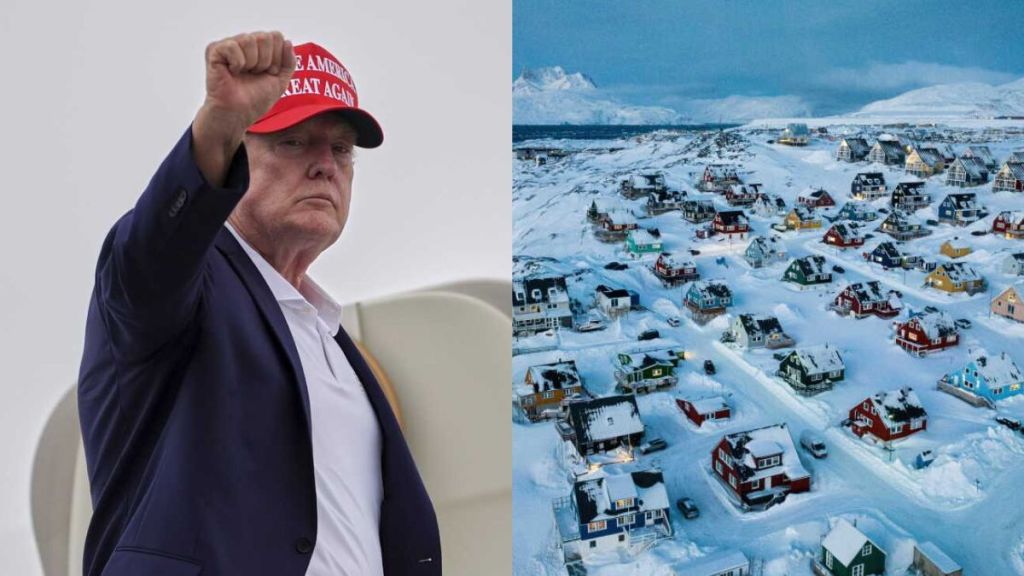

Months after US President Donald Trump threatened to take control of Greenland, the United States, Denmark and Greenland have reached a security agreement that expands the US military presence on the strategically located Arctic island while stopping short of an American takeover.
Trump signed the agreement with Danish Prime Minister Mette Frederiksen and Greenland Prime Minister Jens-Frederik Nielsen at the United Nations General Assembly in New York on Tuesday.
The agreement allows the United States to establish two new military sites in Greenland, expand its existing presence and deploy its planned Golden Dome missile defence system on the island. It also restricts military installations and sensitive investments by countries outside NATO, NATO partner states and the European Union.
The deal does not, however, give the United States ownership of Greenland. Trump had repeatedly called for the US to acquire the semi-autonomous Danish territory, citing its strategic location, natural resources and the growing presence of Russia and China in the Arctic. His refusal to rule out military or economic force triggered months of tension with Denmark and Greenland.
The new agreement instead provides a framework for a larger US military role while reaffirming Greenland’s right to self-determination.
From annexation threat to military access
Greenland sits between North America and Europe and lies along the shortest route between Russia and the United States for potential missile attacks. Its location has made the island important to US and NATO defence planning for decades.
The United States already operates Pituffik Space Base in northwestern Greenland, which supports missile warning, missile defence and space surveillance.
Under the new agreement, Washington can establish two additional defence areas at Narsarsuaq in southern Greenland and Mestersvig on the east coast.
Trump said in his UN speech that the US would “immediately begin the process of developing a large military presence in the appropriate location” and would build “two very major military bases”.
The agreement also gives US aircraft and vessels access across Greenland and its territorial waters. Washington can seek additional military sites in the future, although those would require agreement between the parties. The pact has no end date and can be amended only by mutual consent.
What has actually changed?
The scale of the change is more complicated than Trump’s description of the agreement as giving the US greater control over Greenland might suggest.
A 1951 defence agreement between the United States and Denmark already gave Washington extensive military rights in Greenland. The arrangement was updated in 2004 to give Greenland a greater role in decisions involving US military facilities and operations.
“The substance seems more modest than the lofty rhetoric,” said William James, an assistant professor at the S Rajaratnam School of International Studies, according to CNA. James said much of what has been announced builds on rights Washington already possessed.
“The reality is that the new deal is indeed very close to the 1951 treaty,” said Ole Waever, a professor of international relations at the University of Copenhagen, according to TIME.
The major additions include the specific designation of Narsarsuaq and Mestersvig as new defence areas, provisions for the Golden Dome missile defence system and tighter restrictions on foreign investment in sensitive sectors.
The agreement also formally bars non-NATO countries from establishing military installations or maintaining a persistent military presence in Greenland.
The Arctic security angle
The agreement comes as the Arctic becomes increasingly important to the security calculations of the United States and its allies. Russia has expanded its military activity in the Arctic, while China has shown growing interest in Arctic shipping routes and critical minerals.
Greenland’s position gives it importance beyond its small population and vast territory. The island is roughly three times the size of Texas, while about 57,000 people live along its coastline.
Elizabeth Buchanan, a senior fellow at the Australian Strategic Policy Institute, described the planned expansion as having “immense strategic weight” for the Arctic, according to CNA.
She said the importance of the expansion goes beyond the number of troops or bases involved. “Looking ahead, as the space domain emerges as a sphere for great power contest, the strategic edge delivered by bolstering networked radar and satellite linkages in Greenland is clear,” she told CNA.
The agreement also calls for stronger cooperation with NATO allies in the Arctic. “We believe that it is vital to keep NATO strong, also in the Arctic, where the alliance has a key role to play,” Nielsen said at the signing ceremony.
Frederiksen said the agreement strengthens the NATO alliance while respecting Greenland’s right to self-determination.
Investment restrictions add another layer
Military security is only one part of the agreement.The pact restricts investors from countries outside NATO, NATO partner states and the European Union from gaining control or significant influence in sensitive sectors of Greenland’s economy.
Those sectors include critical infrastructure and resource extraction.Greenland will screen investments to enforce the restrictions. The agreement does not specifically address US investment in Greenland’s mining and resources sector. The restrictions shows wider concerns among Western governments about Chinese and Russian access to strategic infrastructure and resources in the Arctic.
Greenland’s sovereignty remains intact
For Denmark and Greenland, the agreement was also about establishing limits after months of pressure from Washington. The text reaffirms the sovereignty and territorial integrity of the Kingdom of Denmark and Greenland’s right to self-determination.
Frederiksen described the agreement as a deal that can “last forever”. Nielsen said the agreement recognises Greenland’s interests and emphasised the role of NATO in maintaining security in the Arctic.
At a press conference after the signing, Nielsen said Greenlanders would still have to rebuild trust with the United States after Trump’s threats to take the island by force.
“I believe the crisis is over now, but I don’t think the conflict is over in the sense that this agreement could very well be used – if the Americans wish – as a platform to force through further concessions,” said Mikkel Vedby Rasmussen, a political science professor at the University of Copenhagen to Reuters.
The comments point to the central tension surrounding the agreement. The immediate dispute over US control of Greenland has moved into a formal security framework, but questions about the balance between American military interests and Greenlandic autonomy remain.
What happens next?
The agreement still needs approval from the parliaments of Denmark and Greenland before it can take effect. Its provisions are designed to remain in place even if Greenland eventually becomes independent from Denmark, according to the agreement.
For Washington, the deal provides a larger military footprint in a region that has become increasingly important to US defence planning. For Denmark and Greenland, it gives a way to increase Arctic security cooperation with the United States without transferring sovereignty over the island.
The result is a significant change in the nature of the Greenland standoff. The dispute that began with demands for US control has ended, for now, with an agreement centred on military access, Arctic defence and restrictions on potential rivals rather than ownership of the territory.