


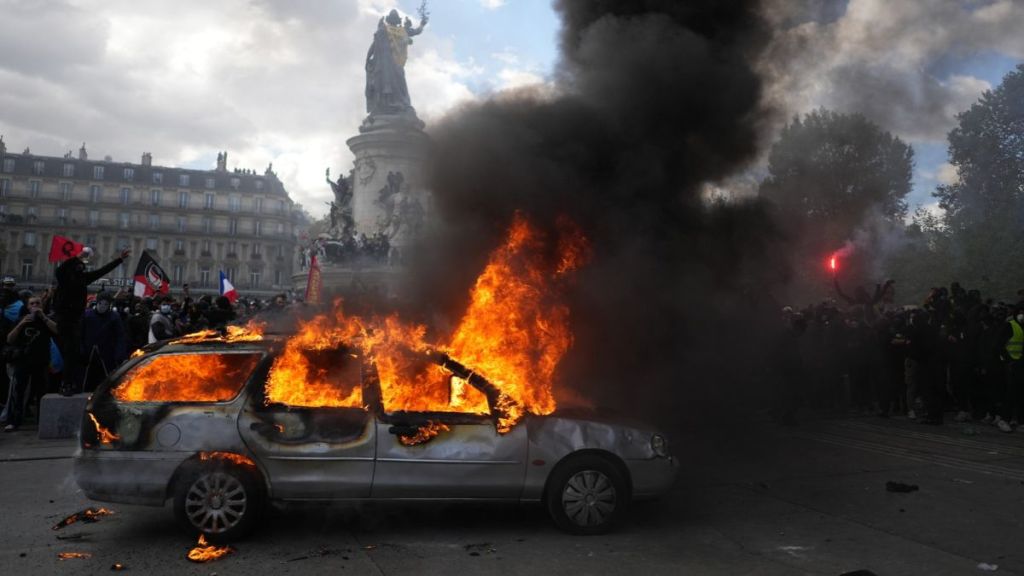

Violent clashes broke out across France on Saturday as student protests escalated into greater social unrest in the country. Prime Minister Sébastien Lecornu said over 1,200 people were arrested and more than 150 police officers got injured as people from many walks of life came together amid nationwide demonstrations against rising living costs and declining public services.
The arrest tally had jumped from 400, as Interior Minister Laurent Nunez previously disclosed, who said 110 nationwide marches drew about 550,000 people. Backing the high school students movement, far-left presidential candidate Jean-Luc Mélenchon also joined the protest in Paris on Saturday.
Meanwhile, organizers, including the CGT labour union and students’ organizations, reported a higher figure, saying about 800,000 protesters took the streets, the Associated Press reported.
Describing the cross-generational protesters as an “extremely violent, radical far-left group,” Nunez said the demonstrators sought to confront the police and target public buildings, including city halls and local government offices.
French protesters vs Police
Videos and photos coming from France captured the violent turn of events, with one even showing France’s third-largest city Lyon’s tourism office on fire while a protester stands in front of it wrapped in a French national flag. Yet another photo by the AFP pictured protesters vandalizing a municipal police station in Marseille, while a Reuters image vividly captured demonstrators holding up French and Palestinian flags as they stood on the statue of the Place de la République in Paris.
Countless individuals could be seen wearing hoods and masks as they threw fireworks, paving stones and other things at police officers in the Place de la République, northeast of the Paris city center.
Prefect Maurice Barate told AFP news agency that the building of Limoges City Hall, in south-west central France, is now “largely lost” as it was set on fire amid the rising demonstrations. The local prefecture noted “the roof collapsed onto the lower floors, except for the west wing, and two-thirds of the facade has already disappeared. Considering the town hall opened in 1883, and parts of it were designated a historic monument in 1975, Barate described the devastation as a “heritage catastrophe.”
On the other hand, police resorted to using tear gas and water cannons to take control of the situation. Consequently, numerous metro stations, including the ones around the Champs-Élysées and near the presidential palace, parliament and government offices, were also shut down at the request of police officers.
With the crisis taking shape into the worst unrest the country has seen in years, police also continue to face their share of backlash, with lawyers and rights groups arguing that teenagers have suffered war-like injuries from the weapons deployed by the authorities.
Earlier, Interior Minister Laurent Nunez told the Senate that internal investigations had been opened into over 30 allegations of police violence against protesters. These included instances of four children reportedly being “mutilated” by explosive weapons and six suffering from “significant injuries,” among other complaints of alleged sexual assault or physical blows.
Addressing the growing conflict, French President Emmanuel Macron said in a message on X, “There is no place for violence in our Republic. Those who vandalized property, attacked government offices and businesses, and even looted our town halls will be prosecuted and punished.”
“We will stand united against those who sow chaos … and who prevent people from peacefully expressing their demands,” Macron added.
What triggered the France protests?
As gasoline, energy and food prices continue to spike in the country, French protesters joined calls for reviving the “yellow vest” movement, originating in 2018 against social injustice. Although the protests have taken a larger-than-life shape in recent week, student groups have been protesting since mid-September, urging others to join them.
As one of France’s major labour unions, the General Confederation of Labour or CGT backed the demonstrations, demanding “higher wages and pensions, lower prices and the protection of public services that meet people’s needs.”
Issuing a new statement on its website, the trade union branded the latest wave of protests “a new stage in the mobilization process,” stressing that the government “must respond without delays to the demands” of the people. Additionally, it called for “continuation of the peaceful mobilization with young people,” culminating in a “great inter-union day of strike” on November 5.
A 19-year-old student told Reuters, “We fight because living conditions are too harsh, the cost of gas is too high.”
Similarly, a 24-year-old publicity industry worker told the news outlet that his younger sister, who is set to take her French baccalaureate, hasn’t had a single French lesson since last year due to a lack of teachers.
“The conditions aren’t good. And the cost of living is very high. We’ve really got to be careful with spending so that we can live decently. We’re also here to protest for that,” he said.
At first, protesters aligning with the “yellow vest” movement wanted that fuel tax hike to be ended. Their list of demands has since expanded, urging that social injustice be dismantled. As a result, their focus is now also on lowering taxes on workers and pensioners, raising taxes for the rich and increasing public spending to aid the working class.
President Macron instantly agreed to the first of the lot and got rid of the fuel tax rise, offering 10 billion euros in tax cuts and other moves for workers and pensioners. However, he has no plans to reintroduce a wealth tax.