


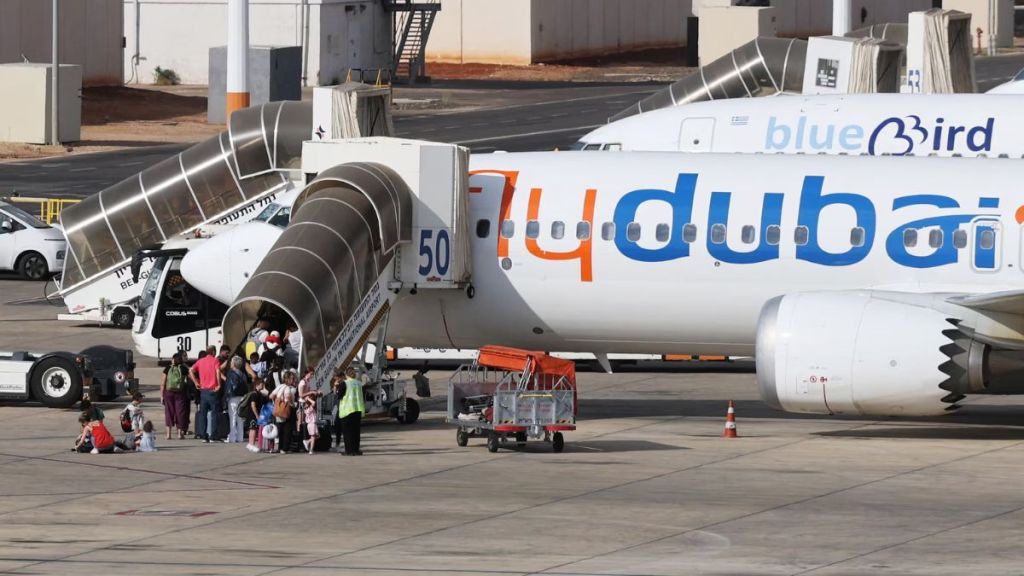

The Flydubai flight from Dubai to Tel Aviv had barely taken off when Israeli authorities already had the names of everyone on board.
The passenger and crew list for Flight FZ1073 had been sent to Israel before the Boeing 737 MAX 8 left Dubai on September 30, according to Israeli newspaper Haaretz. Yet the accused Omani co-pilot, who allegedly attacked Indian Captain Smit Machchhar and was reportedly previously banned from flying by Oman over concerns regarding radical and extremist views, was not stopped.
The incident has since raised serious questions about how the co-pilot was hired, why Oman did not apprise other countries about him, and why Israeli authorities did not flag him before the flight.
According to reports, 174 passengers and eight crew members were on the aircraft. Most of the passengers were Israeli. The flight took off from Dubai at 7:05 am and climbed to about 34,000 feet. More than two hours later, the aircraft suddenly began to lose altitude. Flight-tracking data showed it falling more than 17,000 feet in around two minutes.
The plane eventually levelled off at about 15,000 feet after passengers and crew overpowered the co-pilot. Two reserve pilots who were travelling on the aircraft then took control and landed the plane safely at Tabuk in northwest Saudi Arabia at around 9:45 am local time.
Captain Machchhar was injured during the attack and was later taken to hospital before being moved to Abu Dhabi.
What had Oman flagged about the co-pilot?
One of the biggest questions is why the concerns about al-Hammami did not follow him when he moved to another airline. People familiar with the matter told the Wall Street Journal that Oman had already taken action against him because of concerns about his online activity and alleged radical views.
But Oman did not broadly flag those concerns to other authorities or airlines, according to WSJ.
People familiar with the matter said that when Flydubai hired him in February, it did not contact Oman to check his previous employment or the concerns that had led to him being removed from flying duties.
Flydubai did carry out a criminal background check, according to a person familiar with the process.
The airline later placed him on the sensitive Dubai-Tel Aviv route, where he flew several times.
The UAE is now investigating Flydubai employees involved in his hiring, according to people familiar with the investigation. Flydubai has declined to comment while the investigation is underway.
Why was the co-pilot allowed to fly to Israel?
Oman does not have diplomatic relations with Israel. Pilots from countries without diplomatic relations with Israel are not supposed to fly to the country. Yet al-Hammami was on a flight to Tel Aviv.
Israel requires foreign airlines to send passenger and crew lists before their flights arrive in the country. The Israel Tax Authority confirmed that it received the manifest for FZ1073.
But it remains unclear whether the relevant Israeli authorities actually checked the names. According to Haaretz, Israeli security sources said the Transport Ministry and Mossad were supposed to check the crew list.
The Transport Ministry, however, declined to say whether it had checked the list.
The ministry later said it did not believe it had the authority or the intelligence capability needed to vet foreign airline crews. It also said it had never requested a passenger or crew list from the database since it was created in 2023 and said it had not known that it could access it.
Instead, the ministry said Flydubai had agreed to check the background and nationality of its pilots. The ministry said it requires foreign airlines to use pilots from countries that have diplomatic relations with Israel and to conduct background checks.
It said it did not itself check or approve al-Hammami.
Who was the co-pilot?
The co-pilot has been identified as Hamam al-Hammami, a 29-year-old Omani national. The Wall Street Journal reported that Omani authorities had earlier flagged his interest in extremist material and barred him from flying for Oman Air.
The report further stated that authorities had reviewed his online activity and found material that raised concerns. He was reportedly sent through a deradicalisation programme and moved to an administrative role.
He left Oman Air in early 2025. He later travelled to Morocco and underwent around three months of training with Royal Air Maroc. Moroccan state media reported that he was ultimately not hired by the airline.
In February 2026, he joined Flydubai.
A LinkedIn profile in his name, which was seen by CNN before it was deleted, said he had worked for Oman Air for seven years and left in February 2025. It also showed that he joined Royal Air Maroc in June 2025 and left in January 2026.
Buckinghamshire New University confirmed that al-Hammami had completed a distance-learning course in aviation management. The university said he had not received pilot training there.
CNN, citing sources, also reported that he was born in the UAE to a Syrian mother and had spent several years there. Investigators are now trying to establish whether he acted alone or had links to extremist groups.
Why is the UAE calling it a ‘terrorist act’?
The UAE is leading the probe as the aircraft is UAE-registered and operates under its flag. Attorney General Hamad Saif al-Shamsi said investigators found that the co-pilot had begun a “terrorist act.”
On Thursday, al-Shamsi had ordered investigators to determine whether the incident was linked to terrorism, whether there was an intention to carry out such an act and whether anyone else had planned or directed it.
Investigators are examining physical and digital evidence and looking for possible links to other people.
Saudi Arabia, the UAE and Israel suspect that the co-pilot may have been trying to crash the plane in Tel Aviv, according to people familiar with their thinking.
All three countries are also investigating whether he acted alone.
How did passengers stop the co-pilot in the cockpit?
According to the UAE authorities and reports based on the captain’s account, the co-pilot attacked Machchhar with an emergency crash axe kept inside the cockpit.
The captain later told Prime Minister Narendra Modi that he had been knocked to the floor and was badly hurt. At the same time, he realised that the aircraft was going down.
Machchhar said he understood that he had to make one last attempt to save the plane.
“I had fallen, but I realised, understood, that the aircraft was going down. I thought, ‘Smit, you need to do something; you need to give one last push. The door is just there.’ I was in a lot of pain, but I just opened it, and the others came in,” he told Modi, according to The National.
Once the cockpit door opened, passengers and crew rushed inside and overpowered the co-pilot.
Passenger footage later captured people shouting that “he tried to crash the plane” and telling others to sit down. The aircraft’s transponder was also switched to code 7500. The code is used by pilots to signal unlawful interference, including a possible hijacking.
The plane remained on the 7500 code for about an hour before it was changed back to 7700, the general emergency code.
According to the Wall Street Journal’s investigative findings, the Flydubai incident has exposed major gaps in aviation security. Experts say the failures happened at multiple levels, from background checks and intelligence sharing to Israel’s screening of foreign airline crews. Investigators are now trying to establish what Oman, Flydubai and Israel knew before the flight and why those warnings did not stop the co-pilot from reaching the cockpit.