


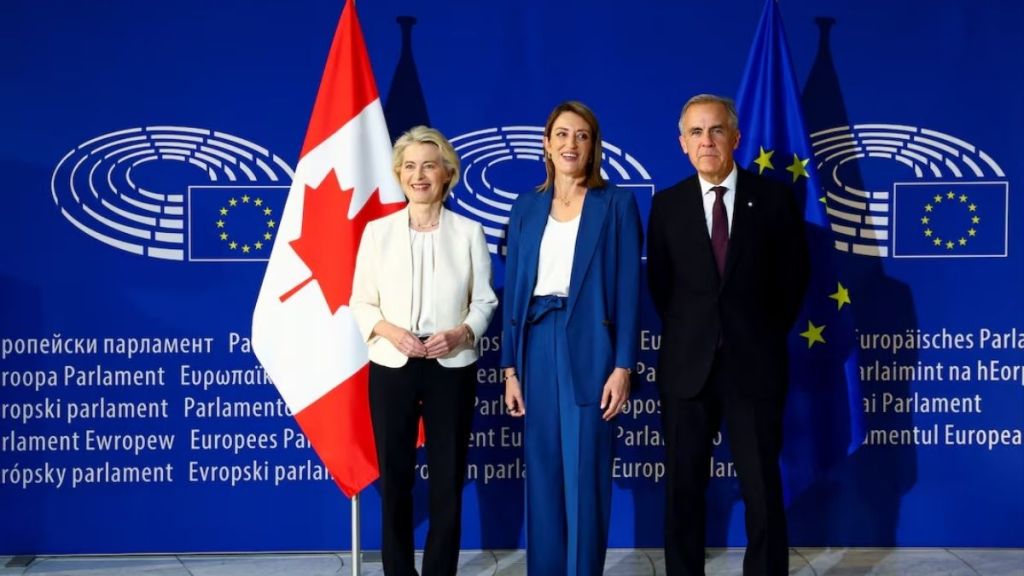

European Commission President Ursula von der Leyen has proposed opening the door for Canada to become the European Union’s first “associate member”, a closer economic and defence relationship that would stop short of full EU membership.
Von der Leyen made the proposal on September 16 during her annual State of the Union address to the European Parliament in Strasbourg. Canadian Prime Minister Mark Carney was present for the speech.
Von der Leyen wants to build a deeper relationship with Canada as Ottawa seeks to reduce its dependence on the United States, while the EU looks for stronger partners in trade, defence, technology and critical minerals, reported Reuters.
Carney has not asked Canada to join the EU. Earlier this week, he said Ottawa was seeking a “unique alliance” with the bloc. The proposed “associate member” status is also not an existing category under EU treaties. Von der Leyen has proposed the idea, but EU member states would have to decide whether and how such a relationship could be created.
For now, therefore, the proposal does not change Canada’s legal relationship with the EU.
What could change for trade and jobs?
The biggest potential impact would be deeper economic integration. Canada and the EU already have the Comprehensive Economic and Trade Agreement (CETA), which was signed in 2016 and provisionally entered into force in September 2017.
CETA has removed many tariffs and expanded market access for Canadian and European companies. However, it has not been fully ratified by all EU member states, according to Reuters report.
An associate relationship would therefore not simply replace CETA. It could build on the existing framework and potentially expand cooperation in areas such as manufacturing, technology, energy, digital commerce and critical minerals.
Those sectors are particularly important because both sides are trying to make their supply chains more resilient.
The EU is seeking to reduce its dependence on China for some critical raw materials, while Canada has significant mineral resources used in batteries, electric vehicles, renewable energy and advanced manufacturing.
Canada and the EU were already discussing closer cooperation in critical minerals, supply chains, defence and digital security, reported Reuters. The two sides have also been working on digital and defence cooperation.
Canadian Foreign Minister Anita Anand met EU foreign policy chief Kaja Kallas in Ireland on September 2. According to the Canadian government, they discussed implementing the new Canada-EU Strategic Partnership of the Future, closer defence-industrial cooperation, negotiations on a Canada-EU digital trade agreement, critical minerals and economic security.
For businesses, deeper integration could mean more opportunities to sell products and services across the Atlantic and build joint supply chains.
But associate membership would not automatically give Canadian companies unrestricted access to the EU Single Market.
The Single Market provides free movement of goods, services, capital and people within the bloc. Canada does not currently have that level of access.
Deeper access would require Canada to align more of its rules and regulations with EU law, reported Reuters. That could affect product standards, regulation and market access for Canadian businesses.
The exact impact on jobs would depend on the terms eventually agreed. Greater trade and investment could create employment opportunities in sectors such as manufacturing, technology, energy and defence, but there is no agreement guaranteeing a specific number of jobs or giving Canadians automatic employment rights in the EU.
Canadian citizens would also not automatically gain the same freedom of movement as EU citizens.
What could change for defence?
Defence could become one of the most significant parts of the proposed relationship. Canada and the EU already have a Security and Defence Partnership, while Ottawa and Brussels have expanded defence-industrial cooperation through the EU’s Security Action for Europe, or SAFE, financial instrument.
The Canadian government said on September 2 that cooperation had advanced since the Canada-EU Summit in June 2025, including defence-industrial ties, economic security and critical minerals.
Canada has also been strengthening defence relationships with individual European countries.
On September 10, the Canadian government said Canadian defence exports to Europe had increased by 56% over the previous year. It also said more than 20 memorandums of understanding had been signed between Canadian and European organisations at the MSPO defence exhibition in Poland.
An associate relationship could deepen that cooperation. Von der Leyen said the EU and Canada could work towards integrating their defence industrial bases. In practice, that could mean closer links between defence companies, supply chains and production.
The relationship could also cover emerging technologies such as artificial intelligence and areas such as Arctic security.
Canada’s large Arctic territory is strategically important, while the EU has increased its focus on Arctic security, energy, critical minerals and geopolitical competition.
However, closer defence cooperation would not automatically make Canada part of the EU’s political or military structures. Canada would not become an EU member state or gain voting rights in EU institutions simply through an associate arrangement.
Is ‘associate membership’ an actual EU status?
EU treaties currently provide for accession by European states, and Canada is not on the normal path to full EU membership.
There is currently no EU treaty provision establishing an “associate member” category, reported Reuters. Earlier proposals for closer association involving other countries have also faced political and legal obstacles.
That means von der Leyen cannot create the new status on her own. The EU’s member states would have to agree on the framework. If treaty changes were required, all 27 member states would have to agree and ratify those changes through their domestic processes.
At this stage, Reuters reported there is no indication that von der Leyen is proposing to create a treaty-based “associate member” category.
The proposal is therefore better understood as an attempt to design a new form of strategic relationship rather than an offer of EU membership to Canada.
How is this different from full EU membership?
Full EU membership comes with rights that Canada would not automatically receive under the proposed arrangement. EU member states participate in EU institutions and decision-making and have access to the Single Market under the bloc’s rules. An associate member would not automatically receive those rights.
The idea could also raise questions within Europe because several countries are seeking full EU membership. Montenegro, Albania, Ukraine and Moldova are among the more advanced candidates, while the EU has said it could admit new members as soon as 2030, Reuters reported.
A special relationship for Canada could therefore raise questions about how much access a non-European country should receive without going through the accession process.
For Canada, however, the calculation is different. Ottawa is not seeking full EU membership. Carney has described the goal as a “unique alliance”.
Canada is instead looking for a closer partnership with Europe at a time when its relationship with the US is under pressure and Ottawa is seeking to diversify its trade and investment links.
The next major step could come at the Canada-EU summit in Montreal on October 29-30. The Canadian government said on September 2 that both sides were preparing for the summit and intended to continue advancing their strategic partnership.
Until then, the proposed associate membership does not immediately change Canada’s trade rules, immigration rights or defence obligations.