


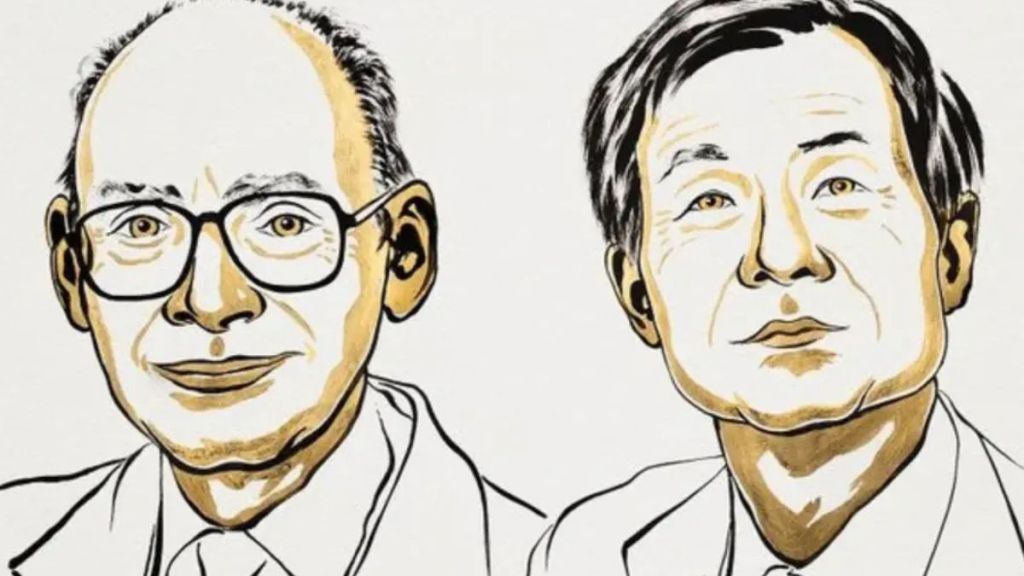

The 2026 Nobel Prize in Chemistry has been awarded to Henri B. Kagan of France and Kenso Soai of Japan for their work on asymmetric organic synthesis.
The Royal Swedish Academy of Sciences announced the award on Wednesday. The scientists were recognised “for the discovery of non-linear effects and autocatalysis in asymmetric organic synthesis.”
Their discoveries have helped scientists understand how chemical reactions can produce molecules with a specific three-dimensional structure. Their work has also helped explain how molecules with the same handedness, known as homochirality, can emerge during chemical reactions.
Solving a century-old chemical mystery
Many molecules exist in two forms that are mirror images of each other. These forms are known as enantiomers. They are similar to a person’s left and right hands, which are mirror images but cannot be perfectly placed on top of each other.
Amino acids, which are the building blocks of proteins, are an important example. They exist in two mirror-image forms, but living organisms mainly use only one form in their proteins.
Scientists have long wondered how this preference for one mirror image could emerge naturally. Chemical reactions that produce these molecules usually create both forms in equal amounts.
Finding ways to produce only one of the two forms is important in medicine. A drug can behave very differently depending on which mirror-image form is used. The Nobel committee said Kagan and Soai’s work helped provide an answer to this long-standing question.
“Henri Kagan and Kenso Soai have provided a solution to a chemical mystery that is over a century old: how homochirality can emerge spontaneously. The chemical reactions they have developed are spectacular,” Heiner Linke, chair of the Nobel Committee for Chemistry, said in a news release.
Kagan’s breakthrough in 1986
Henri Kagan, 95, was born in France and is affiliated with Universite Paris-Sud in Orsay, France. Kagan made a major breakthrough in 1986 when he discovered a new way to influence chemical reactions. His work showed that it was possible to produce a much larger amount of one mirror-image molecule than scientists had previously thought possible. His discovery helped scientists understand how chemical reactions could favour one form over another.
Soai’s work on autocatalysis
Kenso Soai, who was born in Japan, is affiliated with the Tokyo University of Science. Soai built on Kagan’s work. In 1995, he published a study describing a chemical reaction that had the potential to produce molecules with the same handedness.
His research focused on autocatalysis, a process in which a chemical product helps drive the same reaction that produced it. Soai achieved a major breakthrough in 2003 when he demonstrated a reaction in which only one of the two possible mirror-image forms was produced. The Nobel committee said no one other than life itself had previously achieved this feat.
Why the discovery is important?
The discoveries by Kagan and Soai have helped chemists develop reactions that can produce molecules with a specific three-dimensional structure. This is particularly important in pharmaceutical research. Many medicines interact with molecules in the human body in highly specific ways. The two mirror-image forms of a molecule can therefore have very different effects.
The Nobel committee said the discoveries have been decisive for chemists designing reactions used to manufacture pharmaceuticals. “Thanks to Henri Kagan and Kenso Soai, we now know how homochirality can emerge. Their discoveries have been decisive for chemists who design reactions for the manufacture of pharmaceuticals,” the statement concluded.
Who are the laureates?
Kagan is 95 years old and is affiliated with Université Paris-Sud in Orsay, France. Soai is affiliated with the Tokyo University of Science in Japan. The Royal Swedish Academy of Sciences announced the prize in Stockholm on Wednesday.
What do Nobel laureates receive?
Nobel laureates receive a diploma, a medal and a document detailing their cash award. The prize money in 2026 is 12 million Swedish kronor, equivalent to just over €1 million or about $1.2 million. The amount is shared if there is more than one laureate receiving the prize.
Last year’s chemistry Nobel
The 2025 Nobel Prize in Chemistry was awarded to Susumu Kitagawa, Richard Robson and Omar Yaghi for the development of new molecular structures that can trap large quantities of gas inside them. These structures could have applications in areas such as capturing greenhouse gases from the atmosphere and collecting water from dry environments.
Nobel prizes announced so far
The 2026 Nobel Prize announcements began with the medicine prize on Monday. Karl Deisseroth, Peter Hegemann and Georg Nagel received the Nobel Prize in Physiology or Medicine for their pioneering work on optogenetics. The technique uses light to control nerve cells and has helped scientists study how the brain works.
The physics prize was announced on Tuesday. It was awarded to Francis Halzen, a Belgian-born astrophysicist, for work that helped scientists understand a rare group of neutrinos and opened new possibilities in astronomy.
The Nobel Prize in Literature is scheduled to be announced on Thursday. The Nobel Peace Prize will be announced on Friday. The Nobel Memorial Prize in Economic Sciences will follow on Monday.