


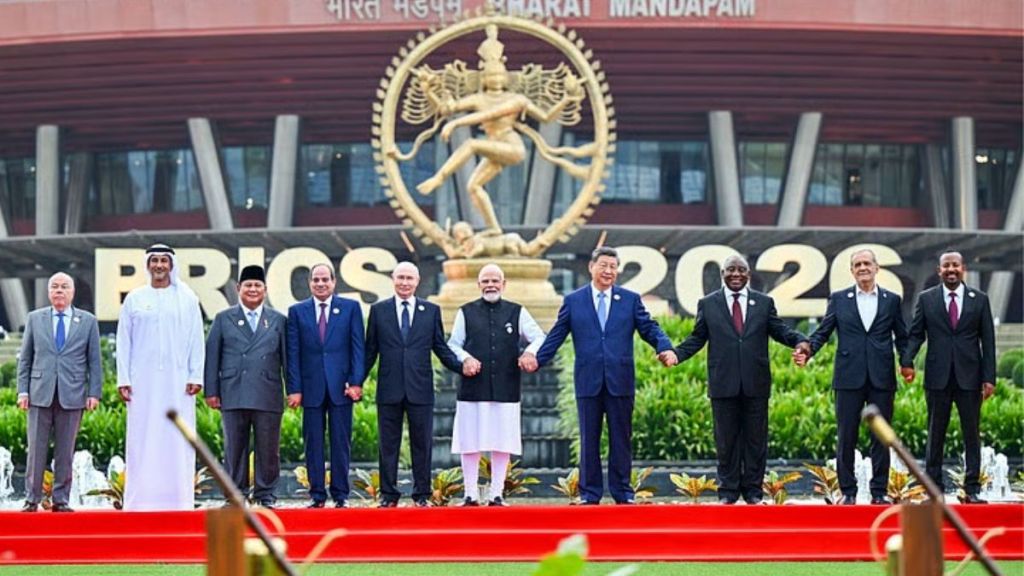

For two days at Bharat Mandapam, leaders of the expanded BRICS group faced a question that has been around for years, that is can the group’s growing economic strength give it more influence over global trade, finance and the US dollar?
The 18th BRICS Summit, held in New Delhi on September 12–13 under India’s chairship, ended with a 140-paragraph New Delhi Declaration. The document repeated many of BRICS’ long-standing economic demands. It called for a stronger global trading system, opposed unilateral tariffs and sanctions, and supported greater use of local currencies for trade and investment.
BRICS has made similar demands at earlier summits in Kazan in 2024 and Rio de Janeiro in 2025. The bigger question is whether the New Delhi summit can take the group beyond statements and help create systems that give its members more economic power.
BRICS has considerable economic weight. Trade between BRICS countries was around $1.17 trillion in 2024, according to UNCTAD figures. This gives BRICS a strong economic base. However, the group also has countries with very different interests and priorities.
The New Delhi declaration therefore comes at an important time. BRICS is much larger and more economically important than it was when the group was formed. However, it is still trying to build the institutions and systems needed to turn that economic strength into real influence.
Trade tensions put BRICS on the defensive
The declaration used some of its strongest economic language against protectionism. BRICS criticised unilateral tariffs and other trade barriers. It also objected to what it described as protectionism through environmental measures. The group opposed carbon border adjustment mechanisms, including the European Union’s carbon border adjustment mechanism, calling such measures discriminatory and protectionist.
The criticism comes at a time when global trade is becoming more divided. Major economies are increasingly using tariffs and other restrictions to protect their industries and pursue wider strategic goals.For BRICS, the issue is not only about how high tariffs are. It is also about who gets to make the rules for global trade.
The group again called for reforms at the World Trade Organization and for the restoration of its dispute settlement system. It supported Most-Favoured-Nation treatment and Special and Differential Treatment for developing economies. It also called for greater participation by developing countries in higher-value parts of global manufacturing.
BRICS also supported Ethiopia and Iran’s bids to join the WTO.The problem is that many of these demands are not new. The WTO’s Appellate Body has not been functioning since December 2019 after the United States blocked the appointment of new members. BRICS has repeatedly called for the dispute settlement system to be restored. However, the latest declaration does not offer a new mechanism that could force such a change.
This shows one of BRICS’ biggest problems. The group has enough economic strength to influence the global conversation on trade. It can collectively oppose tariffs, sanctions and other trade restrictions. However, getting those positions to actually change the global trading system is much harder.
The gap between BRICS’ economic size and its ability to act together becomes even clearer when we look at trade within the group. If BRICS wants to build an economic system that is less dependent on decisions made by major Western economies, its members would need to do more business with each other through their own financial and payment systems.
De-dollarisation will be a gradual process
The same issue can be seen in BRICS’ approach to the US dollar. The New Delhi declaration supports greater use of local currencies for trade and investment. It also asks the BRICS Payment Task Force to continue working on making different payment and messaging systems work together.
However, there is no commitment in the declaration to create a common BRICS currency. There is also no single BRICS payment system that can suddenly replace the existing international financial system.
Instead, the declaration focuses on further discussions, technical cooperation and a gradual approach led by individual member countries. This is important because reducing dependence on the dollar has become one of the most closely watched parts of the BRICS agenda.
For countries facing sanctions or financial restrictions, having alternatives to dollar-based payments can be strategically useful. For other BRICS members, the aim is less about abandoning the dollar and more about having more choices when settling trade and making investments.
India’s position shows how complicated this issue is. New Delhi has supported greater use of local currencies but has remained cautious about creating a common BRICS currency. This makes India’s role particularly important. The country that hosted the summit is also one of the members that has consistently resisted treating de-dollarisation as a single political project.
The numbers also show why moving away from the dollar quickly would be difficult. The dollar accounted for 57.13% of global foreign exchange reserves in the first quarter of 2026, according to IMF data. The dollar remains even more important in foreign exchange markets.
According to the Bank for International Settlements’ 2025 Triennial Survey, the US currency was involved in around 89% of global foreign exchange transactions. These numbers show that BRICS is nowhere close to replacing the dollar.What the group can potentially do is create more alternatives around the existing system.
Over time, this could reduce the dollar’s role at the margins, particularly in trade between BRICS countries. However the change would be gradual. It would depend on whether companies, banks and governments find it easy and useful enough to use local currencies on a much larger scale.
The New Development Bank provides a clearer test
The New Development Bank, or NDB, provides one of the clearest examples of how BRICS can turn its plans into measurable action. The bank’s earlier strategy had set a target of having 30% of its lending in members’ local currencies.
The bank’s next strategy is more ambitious. New Development Bank President Dilma Rousseff outlined plans to increase local-currency lending to 40–50% during 2027–2031. The bank has also announced a $7.5 billion five-year commitment to India, which includes a planned rupee bond programme.
This is a more concrete form of economic cooperation than statements about reducing dependence on the dollar. It also gives BRICS something that many parts of the New Delhi declaration do not have: clear targets that can be measured.
A bank can report how much of its lending is done in local currencies. Governments can track whether more trade is being settled in local currencies. Payment systems can show how many transactions they are handling. These are the numbers that will ultimately show whether BRICS’ economic plans are working.
Other initiatives are moving at different speeds
BRICS is also continuing work on a proposed Grain Exchange. The idea is to increase cooperation in food and commodity markets. However, the initiative is still at the discussion stage, with members working on its structure and how it would operate.
The group has also called for more diverse and fair supply chains for critical minerals. At the same time, it has stressed the right of countries with these resources to control their own mineral wealth.
Critical minerals could become an important area of cooperation for BRICS. These minerals are important for industries such as technology and manufacturing and are also becoming increasingly important for national security.
BRICS includes countries with large mineral resources as well as countries with major industries that need those resources. The challenge, once again, will be implementation.
The declaration also includes measures related to small and medium businesses, export-oriented companies, global supply chains and special economic zones. These issues may appear less dramatic than the debate over de-dollarisation. But they could become more important over time.
For example, better access to finance for smaller exporters, easier customs procedures and stronger links between businesses in BRICS countries could slowly increase trade within the group.
One of the clearest tests in the near term will be customs cooperation. BRICS members have indicated that they are ready to move ahead with an agreement on cooperation and mutual administrative assistance in customs matters, subject to their domestic legal processes.
Unlike a call to reform the global monetary system, this is a specific target. The agreement can be signed, implemented and measured. The same will be true of the payment initiative if it moves beyond technical discussions and becomes an operational system with clear participants, timelines and measurable use.
India’s BRICS chairship
India’s year as BRICS chair also left a clear mark on the summit. India said it held more than 400 meetings across 30 cities during its chairship. These meetings covered areas ranging from agriculture and health to education, urban development and small businesses.
BRICS is no longer simply a forum where the five original members discuss economic cooperation. Its expanded membership has made the group more representative of developing countries. However, the larger group has also made reaching agreement more difficult.
India also gave technology and artificial intelligence a bigger role on the BRICS agenda. The declaration’s discussions on AI were linked to the AI Impact Summit hosted by India in February 2026.
New Delhi also proposed a BRICS Risk Lab at Gujarat’s GIFT City. This could give India’s financial centre a role in the group’s wider financial cooperation. India’s chairship also required considerable diplomatic work.
The expanded BRICS includes countries with competing interests and, in some cases, direct disagreements. Keeping these countries within the same negotiating framework is difficult. This helps explain the careful language used in the New Delhi declaration. The document repeatedly talks about continuing discussions, technical dialogue and phased implementation.
A stronger economic programme could have included sharper targets. However, it could also have exposed big differences between members. The New Delhi declaration instead focuses on keeping the group moving in roughly the same direction.
The real BRICS test begins after New Delhi
The New Delhi declaration should not be seen as an immediate challenge to the dollar or the Western-led global trading system.
Its importance will depend on whether BRICS can turn political agreement into actual changes in the way its members trade and conduct financial transactions.
The first test will be whether the customs agreement is actually signed and implemented. The second will be whether the BRICS Payment Task Force can move from discussions about connecting payment systems to an operational system with clear timelines and measurable transactions.
The proposed Grain Exchange will also need to move beyond discussions about how it should work. The New Development Bank will provide another clear measure through the share of its lending that is carried out in local currencies.
None of these developments would immediately weaken the dollar or change the global trading system. They could, however, make it easier for BRICS countries to conduct more of their trade and financial activity without depending entirely on Western financial systems.
BRICS can represent a large part of the global economy while its members continue to rely mainly on existing financial systems. They also have very different economic relationships with the United States, Europe and with each other.
The dollar’s falling share of global reserves shows that countries are already diversifying their holdings. BRICS can add to this trend by creating more options for trade and finance. However, it cannot decide the speed of that change through a declaration alone.
BRICS can oppose unilateral tariffs and call for a stronger WTO. However, its ability to influence global trade rules will ultimately depend on what economic alternatives its members can create.
If trade between BRICS countries increases, local-currency payments become easier, development financing becomes less dependent on traditional channels and customs barriers come down, the group’s collective bargaining power could grow. If these initiatives remain stuck at the level of declarations and technical discussions, their economic impact will remain limited.