


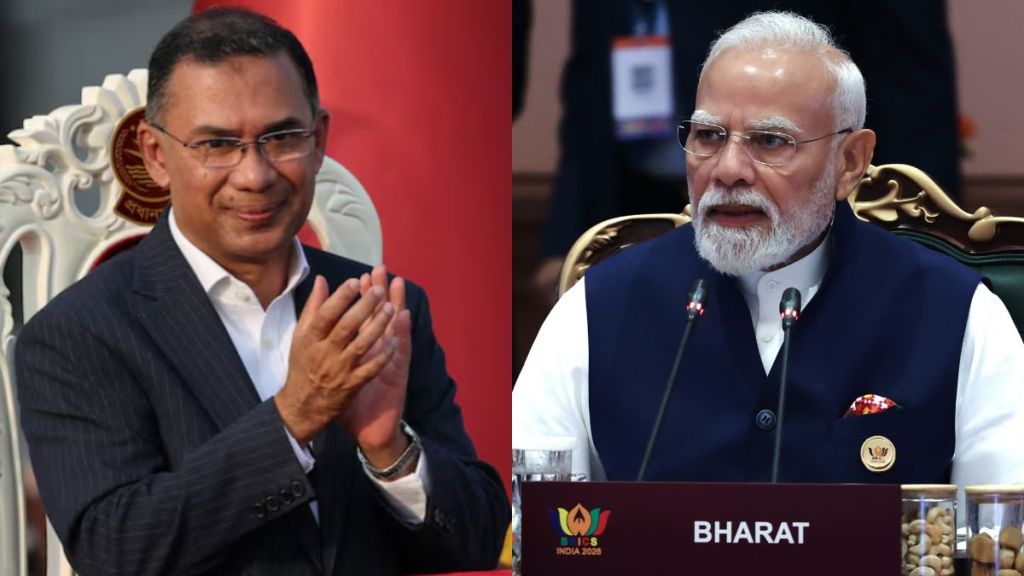

Following Bangladesh’s noticeable absence at the 18th BRICS Summit under India’s chairship, the country’s State Minister for Foreign Affairs Humaiun Kobir told reporters in Dhaka that Bangladesh wants to “reset” its ties with New Delhi. He described the 15-year relationship with India as “uncomfortable” during what he called an “authoritarian, corrupt and exploitative” regime.
Kobir’s latest remarks came days after he publicly disclosed that India had invited the new Bangladeshi Prime Minister Tarique Rahman to the two-day BRICS Summit in New Delhi, but only as the head of the Bay of Bengal Initiative for Multi-Sectoral Technical and Economic Cooperation, not as the PM. Speaking to reporters at the Foreign Service Academy in Dhaka, the Bangladeshi State Minister for Foreign Affairs emphasised that PM Rahman’s first visit to India can’t be a “multilateral” one.
The India-Bangladesh relationship has repeatedly come under strain over the past few years due to multiple reasons. New Delhi’s decision to offer Sheikh Hasina refuge after she fled to India after an officer ouster amid a youth-led movement in 2024 particularly fuelled the rift between the two sides. It even resulted in India’s nearly two-year-long suspension of tourist visa issuance to Bangladeshi citizens. New Delhi resumed the service in late June.
On top of that, India and Bangladesh share a border over 4,000 km long, one of the world’s longest, which has also emerged as a contentious topic. Given India’s larger effort to identify and deport immigrants it claims are in the country illegally, Bangladesh pushed back over claims of improper repatriation, leaving many stranded along the border. The border and migration issue has made efforts by both nations to mend relations after Hasina’s 2024 ouster even more complicated.
Their strained ties were pushed further into a crisis after the killing of a 27-year-old member of Bangladesh’s Hindu minority during last year’s protests in Bangladesh.
Bangladesh wants to ‘reset’ bilateral ties with India first
The last few days have seen Humaiun Kobir repeatedly bring up the issue of India-Bangladesh ties. He has since insisted that a “new relationship” between the two countries “should be done through bilateral discussion, not through a multilateral forum.” At the same time, however, he slammed a single-minded “fascination with India,” adding that it’s just another country with which Bangladesh “wants good bilateral relations.”
Explaining his similar claims about wanting to sit out a “multilateral forum,” Kobir clarified that it was “mainly applicable to India,” and it didn’t mean that Bangladesh had no plans of attending any multilateral event.
“When the environment is favourable, and mutual respect is maintained, bilateral visits will take place,” Kabir said ahead of the weekend, again hinting at Dhaka’s openness to bilateral engagement with New Delhi.
Beyond the Sheikh Hasina row, Tarique Rahman, the son of the former military dictator General Zia Rahman, had been in exile for almost 17 years due to a military-backed government convicting him of corruption.
Ganga Water Treaty in limbo amid pending bilaterals
At the moment, the most pressing issue between the two sides is the 1996 Ganges Water Sharing Treaty. The 30-year water-sharing arrangement is set to expire in December 2026.
“The Ganga Water Treaty was signed in 1996 for a period of 30 years and all water-related issues, river-related issues between India and Bangladesh are discussed as part of the agenda of the bilateral Joint Rivers Commission,” Indian Ministry of External Affairs spokesperson Randhir Jaiswal said last month.
While a separate bilateral invitation aimed at welcoming Bangladeshi PM Tarique Rahman for his first India visit has remained pending since February, Indian High Commissioner to Bangladesh Dinesh Trivedi met the neighbouring country’s Foreign Minister Dr Khalilur Rahman in Bangladesh in July.
A post shared by Press Trust of India (PTI) (@ptinews_multimedia)
Indian media reports previously suggested that Rahman would be visiting New Delhi from August 23-25. The Bangladeshi leader’s press secretary, however, later contradicted the claims, saying no decision had been made on the issue. Later, India’s Foreign Ministry Spokesperson Randhir Jaiswal told reporters at a media briefing that Indian official didn’t have any comments on the potential visit.
Speaking to reporters at the time, the Indian official said, “We have opened up the visas, as you know, and so from both sides for the mutual benefit of people from India and Bangladesh both. They are extremely happy. And this relationship is historical. We share not only the borders but the history, culture and the dreams.”
Responding to questions surrounding PM Rahman’s potential India visit, Trivedi told the media then, “From our side I can tell you for sure that we are anxiously waiting for a visit from the Honourable Prime Minister of Bangladesh for a visit to India, and I am sure in the near future it will happen. We are very hopeful and we are looking forward to it.”
Rahman, on his part, stated that at the time nothing specific was discussed, alluding to the treaty. “There are some irritations, and he knows it, and I also know it. We need to resolve it and we will work on it. This was a courtesy meeting in diplomacy,” he said of the July meeting.
Although separate from the Ganga Water Treaty, the Teesta agreement regarding the allocation of the Teesta River’s water resources has also long remained unresolved. While an interim agreement was drafted in 2011, the signing was abruptly called off over arguments that it would adversely impact Indian farmers in northern West Bengal. The proposed plan involved allocating 42.5% of the river’s water to India and 37.5% to Bangladesh.
‘Hasina being in Delhi’ shouldn’t impact ties, says expert
Pinak Ranjan Chakravarty, a former Indian High Commissioner to Bangladesh and a former member of the Indian Foreign Service, recently spoke exclusively with The Indian Express, digging deeper into the implications of the current India-Bangladesh ties. In the interview, he asserted that Bangladesh can’t simply “wish away” India or replace it with another country because of both countries’ “shared civilisational heritage.”
Claiming that the ball really is in Dhaka’s court, the ex-Indian High Commissioner stressed that India won’t stop the relationship, “in terms of people-to-people, business-to-business, education, etc.,” as India’s policies towards its neighbours have long centred around dealing with “whichever government is in power.”
হাই কমিশনার শ্রী দিনেশ ত্রিবেদী বাংলাদেশের পররাষ্ট্রমন্ত্রী ড. খলিলুর রহমানের সঙ্গে সৌজন্য সাক্ষাৎ করেন এবং পারস্পরিক আগ্রহ ও পারস্পরিক কল্যাণের ওপর ভিত্তি করে বাংলাদেশের সঙ্গে একটি ইতিবাচক, গঠনমূলক ও ভবিষ্যতমুখী অংশীদারিত্ব এবং সকল ক্ষেত্রে জনগণকেন্দ্রিক সহযোগিতাকে আরও গভীর করার… pic.twitter.com/zDc0fn74fI— India in Bangladesh (@ihcdhaka) July 29, 2026
When asked about Sheikh Hasina’s importance to India, Chakravarty told IE that India shared a good relationship with hers, leaving no reason for the Indian government to “say no” to her coming to India.
“The Bangladesh President, who has been a senior BNP leader, said that Hasina being in Delhi should not affect our bilateral ties. I think that was the general approach that everybody felt would be followed. But some lobbies have gained ground and said that Hasina must be handed over,” the official said during the interview. “Bangladesh has made several requests. But extradition is a judicial process, and the Bangladesh government has not tried to initiate one.”
Chakravarty remained optimistic about repairing ties, but asserted that achieving this would need both sides’ engagement. “India has made enough overtures. Now it’s up to Dhaka,” he told The Indian Express. Noting that India will primarily focus on “basic pillars of the relationship,” he added, “Bangladesh’s main problem today is economic. We are providing fuel and electricity to the extent we can.”
Since the Teesta agreement was never actually signed, both countries currently share the sole Ganga treaty, which is also set to expire later this year.
Noting that the Teesta agreement didn’t happen due to objections from West Bengal, Chakravarty told IE, “The immediate issue is the Ganga waters treaty. There will be hard bargaining. Bangladesh may ask for more guaranteed flows of water, which may be very difficult for India to accept. Per capita water availability is not growing (climate change and shrinking glaciers are a factor) and demand is rising.”
He also pointed out that while numerous discussions have taken place on the water issue, none have worked out in the long run, given the continued tensions.