


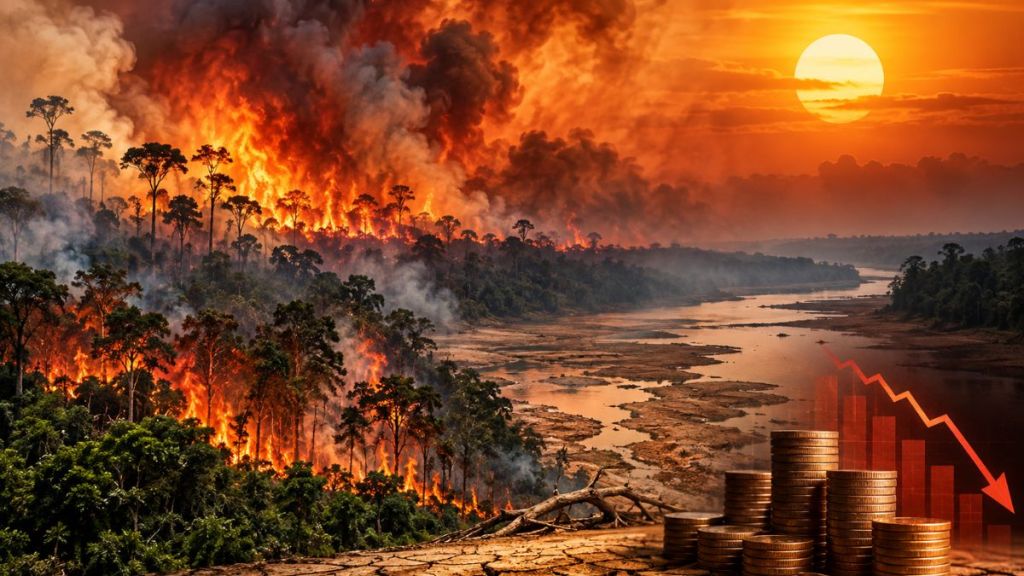

Brazil’s Amazon is facing a severe wildfire crisis as El Nino, climate change and human activity combine to prolong dry conditions, spread smoke and threaten livelihoods. The forest fires give us an understanding of how extreme weather can impose costs far beyond the areas directly affected, disrupting public services, damaging ecosystems, threatening health and adding pressure to economies already dealing with food and energy risks.
The scale of the crisis is visible in Brazil’s Amazonas state. According to Reuters, the state recorded 1,679 fires in the first two weeks of October, a 253% increase compared with the same period last year. Smoke has increased respiratory problems, forced school closures and led to the cancellation of outdoor events in Manaus, the state capital, which is home to more than two million people.
The immediate challenge is to contain the fires. The larger concern is what they reveal about the economic consequences of increasingly severe weather, particularly as the current El Nino develops towards its expected peak.
How El Nino is increasing the wildfire threat
El Nino is a naturally occurring climate phenomenon that typically develops every two to seven years and lasts around a year. According to the BBC, it occurs when trade winds across the Pacific Ocean weaken or reverse, allowing warm water to spread eastwards. The ocean releases heat into the atmosphere, raising global temperatures and altering rainfall patterns across different regions.
These changes do not produce the same weather everywhere. Some areas experience heavier rainfall and flooding, while others face drought, heat and an increased risk of wildfires. The BBC reported that the current El Nino has already broken records for daily sea surface temperatures in a key region of the central-eastern Pacific. On September 19, temperatures there were 3.05°C above average, exceeding the previous record of 3.02°C set during the strong 2015 El Nino.
Scientists distinguish between different measures of the phenomenon’s strength. The Oceanic Nino Index measures sea surface temperatures against a historical average, the Relative Oceanic Nino Index accounts for warming across the wider tropical oceans. The latter helps scientists separate the relative strength of El Nino from the background warming caused by climate change.
Professor Adam Scaife, head of long-range prediction at the UK Met Office, told the BBC, “We have been signalling for months that the developing El Nino will be an unprecedented event.”
He added, “The fact that it has already exceeded previous records – with several weeks to go before it peaks later this year – shows the enormity of this El Nino.”
The distinction is important because an exceptionally strong El Nino does not automatically guarantee unprecedented impacts everywhere. Its effects depend on regional weather patterns, local conditions and the extent to which human activity has increased vulnerability.
In the Amazon, the combination of heat, water stress and delayed rainfall has made fires more difficult to contain. Reuters quoted Carlos Durigan, a geographer and researcher at the Amazon Environmental Research Institute, as saying, “Water stress and heat stress are hitting with extreme intensity, creating a potentially dangerous situation that, compounded by human activity, threatens this biodiversity, people’s health, and the productivity of these lands.”
Why human activity makes the damage worse
El Nino helps create the conditions in which fires spread, but it does not explain every ignition. In the Amazon, fires are rarely natural and are commonly set to clear land for agriculture or ranching.
Reuters reported that Brazil’s environment minister, Joao Paulo Capobianco, spotted fires inside protected forest during an aerial survey of Amazonas. The environment ministry said their presence pointed to deliberate arson intended to clear land for deforestation and promised an investigation.
The distinction between the weather conditions and the causes of ignition is important. Dry vegetation and high temperatures allow fires to spread more easily, while land-clearing practices can introduce flames into already vulnerable landscapes.
Similar things are taking place in Indonesia, where deforestation and peatland drainage have increased the vulnerability of forests to fire. Down To Earth reported that slash-and-burn land clearing and unusually dry conditions associated with El Nino have contributed to the country’s wildfire crisis. Although such land clearing is banned in Indonesia, enforcement remains difficult.
Data from the wildfire monitoring platform Nusantara Atlas showed that Indonesia recorded 1,061,746 wildfire hotspots by October 14, 2026, exceeding the 885,037 hotspots recorded in 2019. The platform estimated that 895,657 hectares had burned by August 2026, compared with 2.63 million hectares over the whole of 2019.
These figures show the importance of distinguishing between the number of detected hotspots and the total area burned. They measure different aspects of the crisis, but both indicate the scale of the threat.
The economic implications extend beyond the immediate cost of firefighting. Repeated fires can damage forests, reduce the productivity of land, destroy habitats and make communities more vulnerable to future dry seasons. Where land management is already weak, extreme weather can magnify the consequences of existing environmental pressures.
The hidden costs of smoke and public health
The economic damage of wildfires does not stop at burned land. Smoke carries fine particles and other pollutants into populated areas, increasing health risks and disrupting daily activities even for people who live far from the flames.
In Amazonas, Reuters reported that at least 36 municipalities declared states of emergency. Poor air quality disrupted outdoor activities in Manaus, while public schools were closed as smoke blanketed the city. Residents reported breathing difficulties, highlighting the immediate human consequences of the fires.
These disruptions also create economic costs. School closures interfere with education and can force parents to rearrange work or childcare. Respiratory illness can increase demand for medical services and reduce the ability of people to work. Cancelled events and reduced outdoor activity can affect businesses that depend on customers, tourism and public gatherings.
The same pattern is visible in Southeast Asia. Down To Earth reported that smoke from fires in Indonesia contributed to a regional haze crisis, prompting Malaysia to close schools in several regions and Singapore to announce subsidies for people seeking treatment for haze-related illness. Malaysia also called for an ASEAN meeting to discuss the crisis and offered firefighting assistance.
The consequences are therefore not confined to the country where the fires begin. Smoke can cross borders, spreading health risks and forcing governments to spend money on public protection and emergency responses.
In Indonesia, Down To Earth also reported that conservationists and authorities had rescued orangutans trapped by smoke and flames. Andi Muhammad Khadafi, head of the Central Kalimantan Natural Resources Conservation Agency, said: “She had to leave her habitat, and we had to rescue her, primarily because of the flames.”
The rescue of wildlife adds another dimension to the damage, as fires threaten biodiversity and the ecosystems on which local communities and economic activities depend.
How extreme weather threatens food and energy security
The economic effects of El Nino extend beyond forests and public health. Changes in rainfall can affect agricultural output, water availability and electricity generation, creating risks for food prices, household incomes and government finances.
The BBC reported that El Nino years tend to bring below-average monsoon rainfall to India. By September 22, 2026, India’s southwest monsoon had delivered 15% less rainfall than normal, according to data from the India Meteorological Department. Reduced rainfall can affect crop production and water supplies, although the eventual economic impact depends on regional conditions, irrigation and other factors.
Energy systems face similar pressures. Down To Earth reported that Myanmar’s energy ministry warned of electricity outages as an unseasonal heatwave increased power consumption. The ministry attributed the rise in demand to severe El Nino conditions and higher temperatures. In the Philippines, Energy Secretary Sharon Garin said the government was preparing for greater electricity demand and possible declines in hydropower generation because of hotter, drier weather.
These pressures can reinforce one another. Lower hydropower generation may increase reliance on alternative energy sources, while heatwaves raise electricity demand for cooling. Agricultural losses can push food prices higher, placing additional pressure on household budgets, particularly among lower-income families.
The International Monetary Fund has also warned about the broader food security risks. According to Down To Earth, IMF chief Kristalina Georgieva told AFP she was “very concerned” about El Nino’s global impacts, particularly on food security. She said the IMF was preparing to support countries that might struggle to absorb the effects.
The United Nations Development Programme warned that higher borrowing costs, rising energy prices and El Nino could combine into “a perfect storm that could throw tens if not hundreds of millions of people back into poverty”.
Why the economic burden could last beyond the fires
The central economic risk is that extreme weather creates immediate emergency expenses while weakening the resources communities need to recover. Governments must fund firefighting, healthcare and disaster relief at the same time that affected households and businesses face lost income, damaged assets and higher living costs.
The burden can be particularly difficult for countries already facing financial constraints. A poor harvest can increase food insecurity, while the cost of responding to wildfires can compete with spending on healthcare, education and infrastructure. Repeated disasters can also delay recovery before the next extreme weather event arrives.
The Amazon crisis demonstrates why prevention matters alongside emergency response. Brazil has deployed aircraft and firefighting crews to Amazonas, while authorities investigate suspected deliberate burning. Better enforcement against illegal land clearing, protection of forests and early detection of fires could help reduce the damage when dry conditions intensify.
Indonesia’s experience similarly shows the importance of addressing deforestation and peatland drainage rather than treating every wildfire as an isolated emergency. Regional cooperation is also necessary when smoke crosses national borders.
The World Meteorological Organization has warned that El Nino is likely to bring above-average temperatures to much of the world and alter rainfall patterns, increasing the risk of droughts and floods in different regions. Its eventual effects will vary, and the strength of the climate phenomenon alone cannot determine the scale of every disaster.
El Nino is a natural climate cycle, but the damage it causes is shaped by decisions about land use, infrastructure, public health preparedness and disaster management. Climate change adds to the challenge by warming the background environment in which these events unfold.
The economic lesson from Brazil is that the cost of extreme weather is not measured only in hectares burned or money spent fighting fires. It also includes lost working hours, disrupted education, pressure on health services, damage to ecosystems and the threat of higher food and energy costs.