


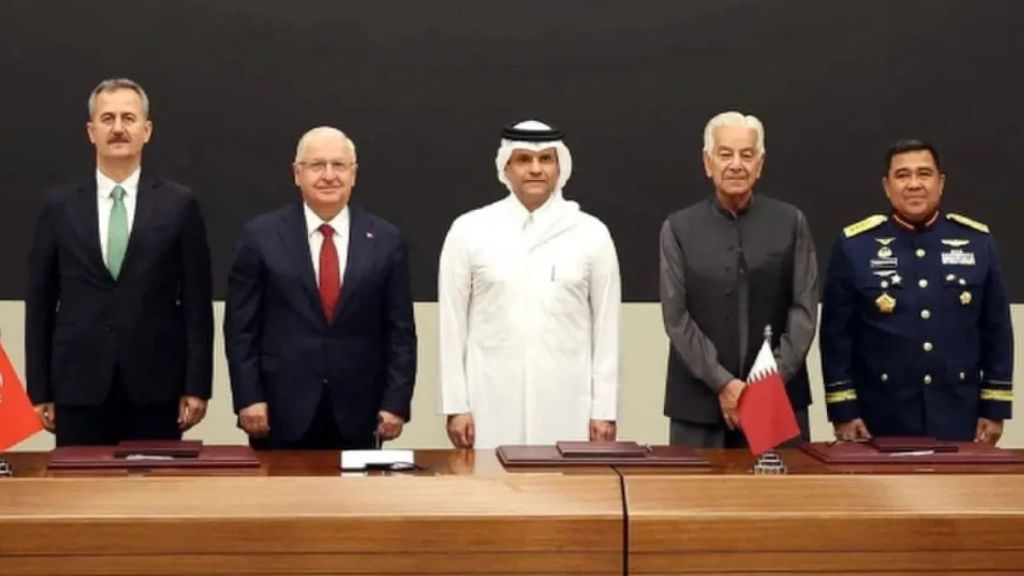

The signing of a new defence cooperation agreement between Pakistan, Turkey, Qatar and Indonesia has raised questions about its possible impact on India. The agreement, called the Badr Memorandum of Understanding (MoU), aims to strengthen defence manufacturing, military capabilities, training and research among the four countries.
Signed in Doha, Qatar, on October 21, the agreement comes at a time of growing security concerns in West Asia and efforts by countries in the region to reduce their dependence on foreign arms suppliers. The main concern for India is whether the agreement could help Pakistan modernise its armed forces, gain access to new military technologies and expand its defence partnerships. The Badr agreement is different from a formal military alliance. However, its focus on joint production and technology development could have long-term strategic implications for India.
What is the Badr Memorandum of Understanding?
The Badr MoU was signed by Pakistan, Turkey, Qatar and Indonesia to expand cooperation in defence manufacturing, strengthen military capabilities and promote collaboration in technical training, research and development.
The agreement was signed by Pakistani Defence Minister Khawaja Asif, Turkish Defence Minister Yasar Guler, Qatar’s Deputy Prime Minister and Minister of State for Defence Sheikh Saud bin Abdulrahman, and Indonesian Deputy Defence Minister Yusuf Jauhari. Haluk Gorgun, chairman of Turkey’s Defence Industry Presidency, also attended the signing ceremony.
The agreement seeks to combine the four countries’ military and industrial capabilities to develop, manufacture and maintain defence systems. It could also help establish integrated supply chains, allowing the participating countries to work together rather than depend entirely on ready-made weapons purchased from foreign suppliers.
The name Badr refers to the Battle of Badr in 624, one of the earliest battles in Islamic history. A joint statement by the four countries said, “Badr means ‘full moon ’-as the four participating nations complement one another through this pact, which holds significant military and economic importance.”
According to the Qatar defence ministry, the agreement aims to:
- Expand cooperation in defence manufacturing.
- Strengthen the military capabilities of the four countries.
- Promote technical defence training.
- Encourage joint research and development.
- Develop industries and technologies suited to modern defence requirements.
Turkey’s Defence Industry Presidency chairman Haluk Gorgun described the agreement as the foundation of a “strategic cooperation” to develop joint production and technology.
“We believe that the Badr Memorandum of Understanding will contribute to transforming the complementary capabilities of Qatar, Pakistan, Indonesia, and Turkey into concrete projects,” he added.
How will the four countries benefit?
Each country brings different strengths to the agreement. By combining their resources, they could reduce production costs, improve access to technology and strengthen their domestic defence industries.
Turkey has a well-developed defence industry, technological expertise and experience in producing modern military equipment. It also has a strong military and is a member of NATO.
Pakistan gives manufacturing capacity, a skilled workforce and a sizeable domestic market for defence equipment. Indonesia has experience in joint development and domestic production, while Qatar has the financial resources to invest in defence projects.
Defence industry analyst Arda Mevlutoglu, managing director of Mergen Analytical Strategies, told Al Jazeera that the four countries could “establish integrated supply chains, allowing these countries to jointly develop, manufacture and sustain defence systems”.
The arrangement could help Pakistan and Indonesia manufacture more equipment domestically while giving Turkish defence companies access to larger markets and longer-term orders. Qatar’s investment could support the development of joint projects.
The agreement is also expected to build on existing partnerships. Turkey already has defence manufacturing ties with all three countries.
Qatar and Turkey signed a bilateral defence industry memorandum in October 2025. Pakistan and Turkey have been working together on a naval manufacturing project involving four ships. Two are to be built in Istanbul and two at Karachi Shipyard.
Indonesia and Turkey are also jointly building a tank. According to defence experts, the Badr MoU could bring these separate projects under a more coordinated framework, helping the four countries develop stronger industrial links.
Why has the agreement been signed now?
The timing of the Badr MoU is significant because of growing security concerns in West Asia.
The prolonged US-Israel war with Iran, tensions involving Saudi Arabia and the Houthis, and concerns about the availability of American weapons have encouraged countries in the region to reconsider their defence arrangements.
Some countries are seeking to reduce their dependence on a limited number of foreign suppliers. Recent conflicts have highlighted the risks of supply chain disruptions, restrictions on technology transfers and shortages of military equipment.
Mevlutoglu told Al Jazeera, “Diversification is a major driver, particularly as recent conflicts have exposed vulnerabilities associated with dependence on foreign suppliers, technology restrictions and supply chain disruptions.”
Comments by US Ambassador to Turkey Tom Barrack may also have contributed to the push for greater regional cooperation. Speaking in Doha on October 20, Barrack said Washington was moving away from its role as a regional security guarantor. He argued that governments in West Asia needed to take greater responsibility for their own security and said US ground interventions had repeatedly failed.
The Badr agreement explains an effort by the participating countries to develop their own industrial capabilities and broaden their security partnerships.
However, this does not necessarily mean that they intend to abandon their existing relationships with the United States or other Western partners. Qatar, for example, is unlikely to give up its strategic relationship with Washington, while Turkey is seeking greater technological independence within NATO.
How will the Badr agreement work?
The agreement is expected to follow a process through which the four countries identify their defence needs and decide where their capabilities can complement one another.
According to a report by Middle East Eye, each country will first identify its requirements within its national security framework.
An executive board will then develop plans for joint production. These proposals will be sent to a strategic board, which will make the final decisions on budgets and production locations.
Joint production facilities are expected to be established in Turkey, which has extensive defence industry infrastructure.
The arrangement could allow the four countries to jointly develop and manufacture equipment, share industrial expertise and build systems that they can maintain over time.
The extent of cooperation will depend on the projects the countries approve and how much technology, funding and manufacturing capacity they are willing to contribute.
How is the Badr deal different from the Mecca defence pact?
The Badr agreement has drawn comparisons with the Mecca Joint Defence Agreement signed in August 2026 by Pakistan, Saudi Arabia and Turkey. However, the two arrangements have different objectives.
The Mecca pact provides for a mutual defence commitment. It states that an armed attack against one of the three countries would be treated as an attack against all of them.
The Badr MoU, in contrast, focuses on defence industry cooperation. Its stated objectives include joint production, military capability development, technical training and research.
The Mecca pact focuses on collective deterrence and military cooperation, while the Badr agreement focuses on building the industrial and technological capabilities that could support defence partnerships.
The two arrangements could complement each other if cooperation in defence manufacturing is accompanied by closer military coordination, intelligence-sharing and logistical support. However, the Badr MoU itself does not create a NATO-style collective defence commitment.
Turkey has also submitted the Mecca agreement to its parliament for ratification. The deployment of Turkish troops abroad would require separate parliamentary approval.
Why is the agreement a concern for India?
The main concern for India is that Pakistan could use the Badr agreement to strengthen its military capabilities through partnerships beyond China. Pakistan currently relies heavily on China for military equipment. During Operation Sindoor last year, Pakistan deployed several Chinese-made weapons, including HQ-9P air defence systems, J-10C and JF-17 fighter aircraft, and PL-15 long-range air-to-air missiles.
The Badr agreement could give Pakistan opportunities to diversify its sources of military technology and equipment. It could also help Islamabad strengthen its domestic defence industry and reduce its dependence on imported weapons. Turkey is particularly important in this context because of its experience in drones, electronic warfare, naval platforms and other defence systems.
Closer cooperation could improve Pakistan’s ability to develop, manufacture and maintain military equipment. Joint production could also make it easier for Pakistan to obtain long-term technical support and build industrial expertise. The potential impact on India is therefore not limited to the number of weapons Pakistan might acquire. It also concerns whether Pakistan could develop a more capable defence industry and maintain its military equipment more effectively.
The agreement does not automatically mean that Pakistan will receive every technology developed by the other participating countries. The extent of access will depend on the specific projects, agreements and safeguards put in place.
Could Turkey help Pakistan strengthen its drone and naval capabilities?
Turkey’s defence industry is one of the most important factors for India to watch. Turkey has developed capabilities in unmanned aerial systems, electronic warfare and naval platforms. Greater cooperation between Ankara and Islamabad could create opportunities for Pakistan to improve its capabilities in these areas.
The Badr MoU could also support joint development, domestic production and closer integration between the participating countries’ defence industries.If such projects move forward, Pakistan could benefit not only from the equipment produced but also from the expertise needed to manufacture, operate and maintain it.
These developments could have implications for India’s defence planning, particularly if Pakistan becomes better equipped to sustain its military capabilities over the long term. However, the agreement is a framework for cooperation. Its actual impact will depend on the projects approved, the technology shared and the pace at which production begins.
Could India’s defence deals with Indonesia be affected?
Another concern is whether Indonesia’s participation in the Badr agreement could affect India’s own defence partnerships with Jakarta. In July, India and Indonesia announced a $630 million deal under which India would supply BrahMos cruise missiles and Astra air-to-air missiles to Indonesia. The concern is whether Indonesia could share information about Indian weapons with the other Badr participants, including Pakistan, potentially giving Islamabad access to sensitive technical knowledge.
However, Indian defence experts have argued that safeguards are in place to protect sensitive technology. Sudhir Kumar Mishra, DRDO chair emeritus and former director general, CEO and managing director of BrahMos Aerospace, said that India’s defence agreements with Indonesia had been structured with adequate safeguards. “Defence agreements with Indonesia have been done with enough safeguards and that only the user manual, not the technology of transfer manual, will be shared with Jakarta,” he told The Times of India.
Group Captain Ajay Ahlawat (retired), a senior fellow at the Centre for Aerospace Power and Strategic Studies, also argued that the agreement should not be treated as a military alliance. “An MoU is not equal to a military alliance. The wording suggests that Badr MoU is just a work-share agreement. India also shares good relations with Qatar and Indonesia,” he wrote on X.
These assessments indicate that Indonesia’s participation in the Badr agreement does not automatically put India’s defence agreements with Jakarta at risk. The key issue will be whether the Badr framework leads to any sharing of sensitive information beyond what Indonesia is authorised to access under its agreements with India. India will need to continue monitoring the implementation of the agreement while protecting its defence technology and maintaining its existing partnerships.
Does the Badr agreement indicate a new defence bloc?
The agreement brings together four countries with different capabilities and strategic interests. It could strengthen their defence industries and create a more connected network of military and industrial partnerships extending from the Gulf to South and Southeast Asia.
However, it is too early to describe the arrangement as a unified military bloc. Defence analyst Arda Mevlutoglu told Al Jazeera, “We may be witnessing the emergence of an interconnected network of defence and security arrangements extending from the Gulf to South and Southeast Asia, rather than a single formal alliance.”
The distinction is important. The Badr MoU establishes a framework for cooperation, but it does not require the four countries to fight together if one of them comes under attack. Its long-term significance will depend on whether the participants move beyond the memorandum and establish joint production facilities, share technology and coordinate their defence industries more closely. The agreement also shows effort by some countries to build stronger defence relationships with partners in the Global South and with fellow Muslim-majority countries, while maintaining their existing international partnerships.
What should India watch next?
The signing of the Badr MoU is a development worth monitoring, but its immediate implications should not be overstated. The agreement could help Pakistan diversify its military partnerships, strengthen domestic production and gain access to additional defence expertise. Turkey’s capabilities in drones, electronic warfare and naval systems make its role particularly relevant to India’s security calculations.
At the same time, the Badr agreement does not establish a mutual defence commitment, and the signing alone does not prove that sensitive Indian military technology will be shared with Pakistan.
India should closely watch the projects approved under the agreement, the establishment of joint production facilities, the extent of technology sharing and any new military capabilities developed by Pakistan through these partnerships.
New Delhi will also need to assess the Badr arrangement alongside the separate Mecca defence pact between Pakistan, Turkey and Saudi Arabia.
The two agreements could become more significant if industrial cooperation develops alongside deeper military coordination. For now, the most important question is whether the Badr MoU translates into concrete projects that materially strengthen Pakistan’s military capabilities.
The agreement is therefore not an immediate military alliance against India. Its potential significance lies in the possibility that it could help Pakistan build a more diversified, better-supported and increasingly self-reliant defence industry over time.