


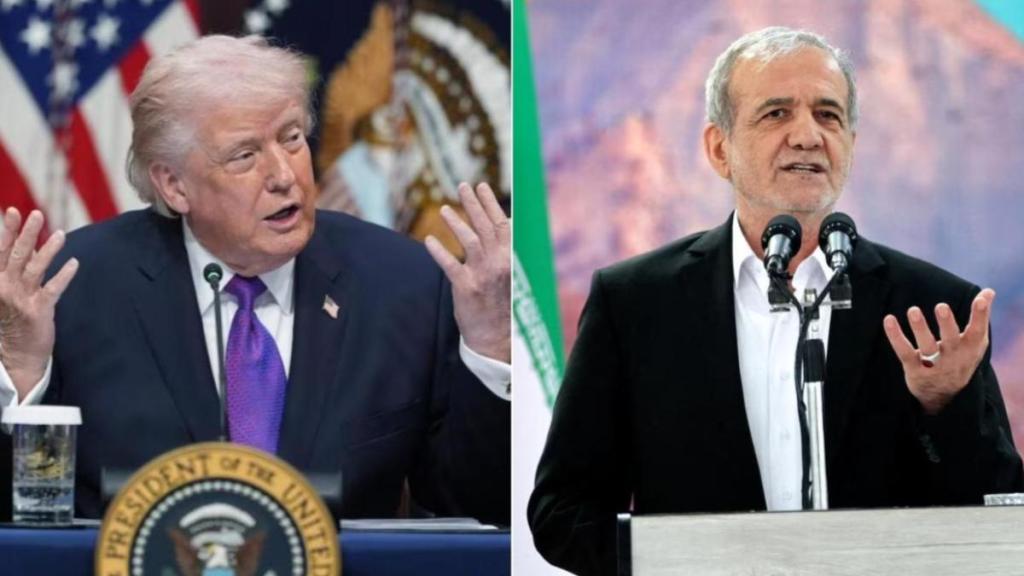

Just days after the United States and Iran agreed to a ceasefire, tensions have flared up again in the Strait of Hormuz. Iran attacked a commercial cargo ship, prompting the US to launch military strikes on Iranian targets near the strategic waterway.
Trump earlier warned that Iran could face consequences for breaking the ceasefire, saying he was unhappy with Tehran’s actions. “You will find out,” Trump told reporters when asked if Iran would face consequences.
“I don’t like the fact that they took a shot yesterday, actually, four. We knocked down three… A very expensive ship took a little beating. They shouldn’t be doing that,” he added.
In response, Tehran targeted some US bases and warned that any further aggression could have severe consequences.
— Rapid Response 47 (@RapidResponse47) June 26, 2026
US strikes Iranian military sites
The US military’s Central Command (CENTCOM) said its forces carried out strikes on June 26 against Iranian missile and drone storage sites, along with coastal radar positions near the Strait of Hormuz.
According to CENTCOM, the strikes were a direct response to Iran’s drone attack on the Singapore-flagged cargo ship M/V Ever Lovely on June 25.
The vessel was sailing out of the Strait of Hormuz along the Omani coast when it was hit by a one-way attack drone launched by Iran. CENTCOM called the strikes a “powerful response” to an “unwarranted aggression” against commercial shipping.
The US military said Iran’s actions clearly violated the ceasefire agreement and also threatened freedom of navigation through one of the world’s busiest and most important trade routes.
The statement added that CENTCOM continues to help commercial ships pass safely through the strait and remains “present and vigilant to ensure all aspects of the agreement with Iran are adhered to, obeyed, and in full force and effect.”
https://t.co/W4zjNqnmCt
— U.S. Central Command (@CENTCOM) June 26, 2026
‘Foolish violation of our Ceasefire Agreement’
The latest operation marks the first US military strikes against Iranian targets since both sides signed a memorandum of understanding (MOU) last week that formally ended the conflict. Earlier on Friday, Trump wrote on Truth Social that Iran’s drone attack was “a foolish violation of our Ceasefire Agreement.” US Vice President JD Vance, who played a key role in the ceasefire negotiations, also issued a strong warning.
“Iran signed a ceasefire agreement. We have honoured it. If they have disagreements about how the MOU is being applied, they can pick up the phone. But violence will be met with violence,” Vance wrote on X.
Iran hits back with warning
Iran strongly condemned the US strikes. The Islamic Revolutionary Guard Corps (IRGC) accused Washington of breaking its commitments by launching airstrikes on Iran’s coastline.
“A few hours ago, the treaty-breaking American regime violated its obligations as always and launched an airstrike on the coasts of the Islamic Republic of Iran under various pretexts,” the IRGC said in a statement.
The IRGC claimed its navy responded by targeting locations where US forces are deployed in the region. It also said it had repelled an attack near Sirik Island, close to the Strait of Hormuz.
Warning of further action, the IRGC said, “If the aggression is repeated, our response will be more extensive.”
Iranian lawmaker warns Gulf nations
Ebrahim Azizi, a member of Iran’s Islamic Consultative Assembly, also issued a warning to Gulf Cooperation Council (GCC) countries in a post on X.
“Warning for GCC leaders: outsourcing your security has made you less secure. You have seen how US military bases in your countries have turned into a source of threat instead of providing security. Our missile and drone power, as well as the management of the Strait of Hormuz, are Iran’s serious red lines. The only reliable path to regional security is to distance yourselves from the US,” he wrote.
The oil market jitters
Oil prices had surged during the earlier conflict but eased back to near pre-war levels after the ceasefire reduced tensions. That calm may not last for long. If the fighting intensifies and the ceasefire collapses, oil prices could rise again. Any threat to shipping through the Strait of Hormuz usually pushes up costs as insurers raise premiums, ships take longer routes, or cargo movement slows. After months of uncertainty in the region, it may not take much to unsettle the markets once again.