


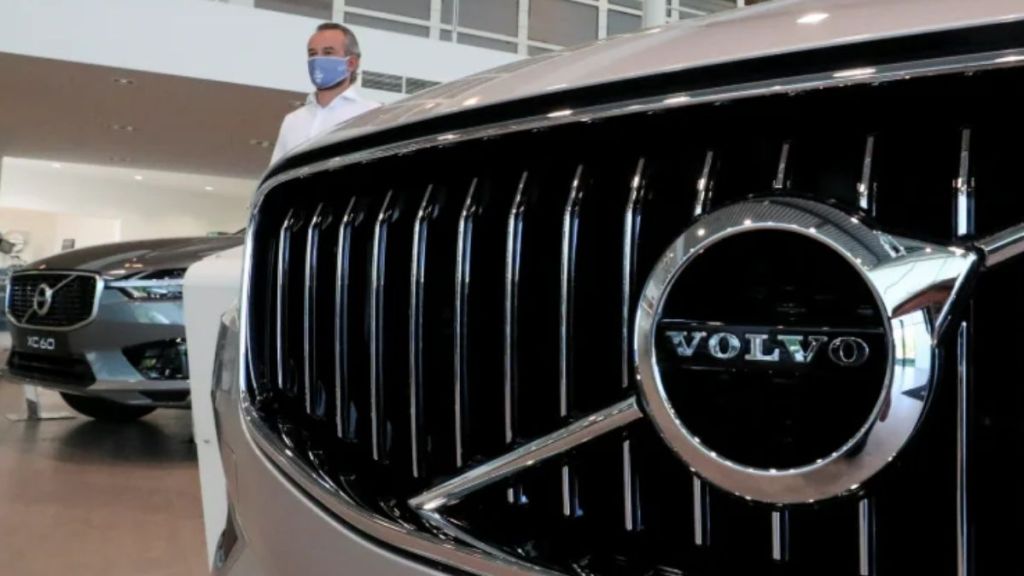

Friday alone sounded the alarm on multiple company layoffs. One was at U.S. credit card giant American Express; the other brought bad news for employees at Swedish automaker Volvo Cars. The company owned by China’s Geely Holding laid out a plan to cut about 6% of its global workforce, or an additional 2,500 jobs, after already cutting 3,000 roles earlier this year.
The decision to shed even more jobs this year in hopes of reducing costs by about $504.5 million, on top of previous savings prompted by layoffs, made headlines as the carmaker posted a staggering third-quarter operating loss. As the company doubled its cash burn year-on-year, its shares hit another record low, slumping by 24.2% at the trading session’s close.
Of the forthcoming 2,500 global job eliminations, 2,000 are based in Sweden. The company’s announcement took centre stage as its revenues dropped almost 50% year-on-year while premium brands face “hypercompetition” from new Chinese competitors, deepening the pressure on how models are priced.
The company further noted that unbalanced demand for electric vehicles and tariff pressures further dampened its growth in the United States.
Volvo CEO addresses job cuts
Chief executive Hakan Samuelsson, who returned from retirement last year, told Reuters that the thousands of additional layoffs will be completed by mid-2027. Moreover, he didn’t rule out the possibility of further such measures in the future.
“The third quarter of 2026 was very disappointing and reflects a year that has become far more challenging than originally anticipated. Our ongoing turnaround plan therefore needs a decisive reinforcement,” CEO Hakan Samuelsson said, as quoted by Reuters.
Samuelsson came back on a two-year contract to turn the company around. Despite aggressive restructuring plans, the carmaker continues to face added pressure, which will especially become even more palpable for former Skoda boss Klaus Zellmer, who is set to take on the Volvo CEO mantle next year.
Also speaking to CNBC on ‘Squawk Box Europe,’ the current Volvo boss blamed the prevailing conditions of the Chinese market.
“It’s really a lot about the Chinese market, of course, where the change has come faster than we thought, and really now we can see that selling global cars developed in Europe and China will not work, and then this is affecting all the Western players in China,” he told CNBC on Friday.
He went on to establish that Chinese customers are now eyeing “domestic alternatives,” which are on the rise on the competition scale. “We need a new strategy in China… it has to be a more regional structure, a more empowered region, and we need regionally adapted cars,” he added.
Asserting the need for a “leaner central administration,” Samuelsson told CNBC that costs must stay competitive, while Volvo must join forces with its Chinese parent company and develop key software in the Asian country, including infotainment and driver-assistance systems. He stressed that without such these at their disposal, it will become impossible to sell cars in China.
Samuelsson also added that “weak performance in the US and China” meant that half of their business was “not contributing to profitability.”
Volvo recently mapped out a new plan to strengthen growth and boost profitability. This included launches of 13 new models by the end of the decade. Three of them will be revealed next year, including one in Europe and two new China-tailored cars.
Layoffs at other carmaking companies
Beyond Volvo’s descent, German carmakers BMW and Volkswagen also approved plans to shed jobs amid surging competition.
In late September, it was reported that BMW had plans to cut 20% of its management roles by mid-2027, months after reports suggested that the company was cutting as many as 8,000 jobs under pressure from China rivals.
Meanwhile, Volkswagen’s board greenlit cutting an additional 50,000 jobs as part of the biggest restructuring in its almost 9-decade history. A previous round in March had also revealed the company was eliminating 50,000 roles.