


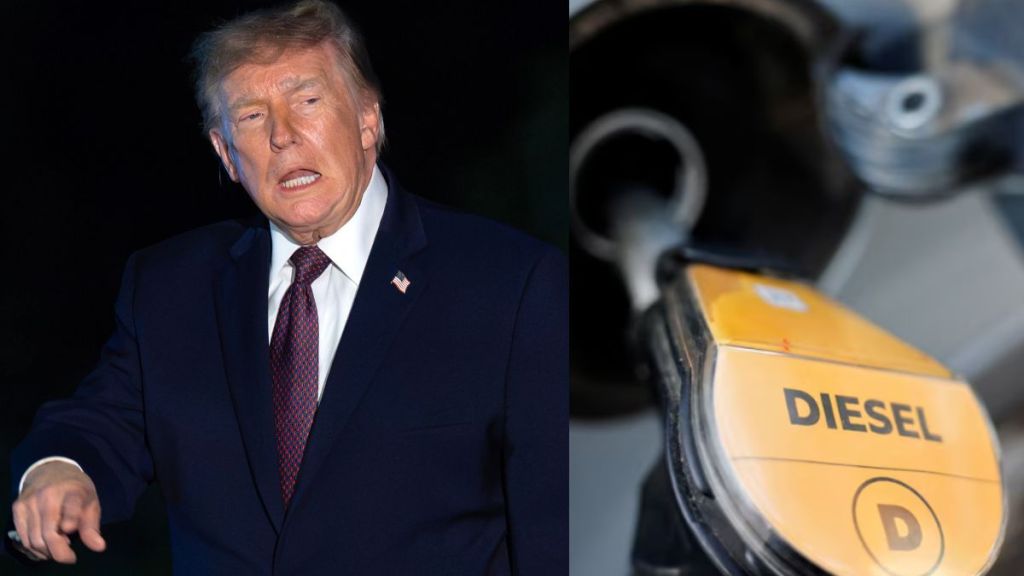

US President Donald Trump backtracked from his threat to ban diesel exports as the Group of Seven (G7) countries, including the United States, agreed to release 100 million barrels of oil and diesel. The major decision aims to ease supply pressures as prices continue to surge alarmingly while multiple critical maritime routes face closures amid several ongoing global conflicts.
Having pledged to refrain from energy export restrictions, the G7 (France, Canada, Germany, Italy, Japan, the United Kingdom and the United States) issued a joint statement on Friday (US time), saying they will deploy millions of barrels of reserves over the next four months “with a frontloaded substantial diesel release within the first 20 days.”
The G7 added in the statement, “Taking into account commitments that have already been fulfilled, we will implement our commitments with a coordinated release through the IEA of 100 million barrels.”
It comes after the ongoing Iran war inspired a historic emergency stock release of 400 million barrels in March. Earlier this week, International Energy Agency Executive Director Fatih Birol said that members had already released about two-thirds of the agreement.
Trump retracts diesel export ban threat
“Europe has just agreed to release a massive amount of their heavily stocked Diesel Oil. The process will begin immediately,” Donald Trump wrote on Truth Social.
US Treasury Scott Bessent also said Thursday that “American farmers, truckers, and businesses should not be left carrying the burden of a global diesel shortage” due to the wars in West Asia and Eastern Europe.
According to the International Energy Agency, the United States supplied around half of the European Union’s diesel imports in August. In the meantime, the Trump administration has been mounting its pressure campaign on the EU to draw down emergency diesel inventories to help ease global price hikes. The MAGA leader previously warned that the US could impose a diesel export ban if the EU fails to comply.
However, he has since cooled down on the pressure, telling reporters at the White House that the export ban was “never really on the table” despite his multiple reiterations over the past two weeks.
“Europe has a lot of diesel, and they’re going to be making a major world contribution, and so are we,” Trump told reporters before leaving for Alabama. “And we’re not going to be doing the export ban. We’re going to be doing what we’re supposed to do.”
Mounting pressure on Trump to cool fuel prices
Trump is aggressively pushing for measures that could help bring down the surging fuel prices as he continues to face backlash for his handling of the economy in his second term. In the wake of the late February decision that saw the US and Israel launch a joint military action against Iran, the Republican president has repeatedly witnessed his popularity among American voters dissipate.
These developments are hard to ignore, especially as Trump’s Republican Party hopes to retain its dominance, even if slightly, in the upcoming midterm elections, slated for the first week of November.
As a growing majority of Americans continue to blame the MAGA leader for the persistently high cost of living, he saw his approval rating on the economy slump to another all-time low of 26% in a new Associated Press-NORC Center for Public Affairs research poll. The survey, conducted among 2,140 US adults on September 24-28, found that just 17% approved his handling of the cost of living issue, while 65% blame him for high costs.
His overall job approval rating settled at 31% with a 38% disapproval rating.
Simultaneously, the latest Quinnipiac poll of 1,032 registered voters surveyed September 24-27 recorded a 34% approval rating and a 61% disapproval rating. It also found this approval rating on the economy dipped to 31%, an all-time low for both terms. Meanwhile, he earned just a 28% approval rating on his handling of the Iran situation, tying with the all-time low he hit on this front in a July 29 Quinnipiac poll.
Where do oil prices stand?
Crude oil prices rose sharply Thursday (US time) following a Wall Street Journal report, indicating the US is sending a third aircraft carrier strike group to the Middle East. Consequently, Brent crude jumped 4.4% to close at $102.31 per barrel, while US West Texas Intermediate futures jumped 2.7% to $92.87 a barrel, CNBC reported.
After the G7 joint statement on the release of reserves, Brent crude lost 6 cents and closed at $102.25 per barrel on Friday, with US West Texas Intermediate crude coming down $1.76 to $91.11 per barrel.
Before the US-Israel attack on Iran in late February, Brent crude was trading at around $73.
Kpler’s director of commodities research, Matt Smitt, said oil has surged again due to renewed attacks between Saudi Arabia and the Iran-backed Houthis in Yemen.s
“Oil prices were selling off strongly due to the announcement of strategic stock releases in Europe, but they reversed course on rumours of Saudi Arabia planning an offensive into Yemen as it looks to re-establish a safe path via Bab-Al-Mandeb,” he said, as quoted by the BBC.
Regional and Western officials recently told Reuters that Saudi Arabia is planning to unleash an offensive against Houthi militants to break the Red Sea chokehold. While the outcome of the reported assault remains to be seen, various oil vessels continue to be targeted by unknown projectiles in the Strait of Hormuz.