



Winning an Olympic gold medal can bring global recognition, sponsorship deals and in some countries, a substantial financial reward. But the medal itself does not come with a cheque from the organisers.
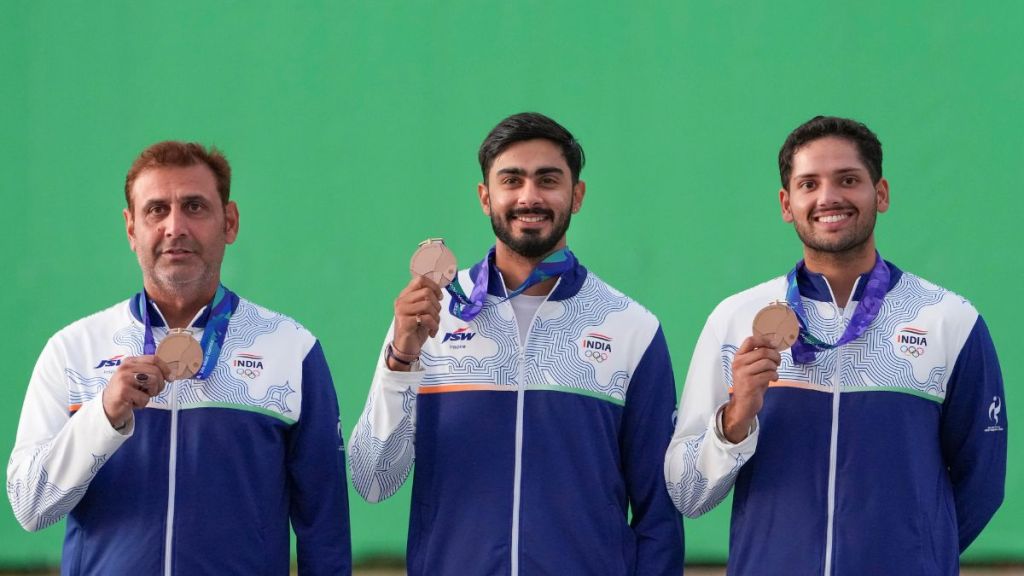
The same principle broadly applies to the Asian Games and Commonwealth Games. Athletes receive medals and official recognition for finishing on the podium, while any cash reward is generally determined separately by their country, national sports body or other sponsors. So even though the likes of Mirabai Chanu or Rudrankksh Patil managed managed to bag a medal at the ongoing Asian Games, it did not come with a share of financial reward.
It is pertinent to note that these events are not structured like professional tournaments in which organisers announce a fixed prize purse and distribute it among the winners.
At the Asian Games, for example, the Olympic Council of Asia’s rules specify medals and diplomas as the prizes for the first three finishers. The Olympic system follows a similar model.
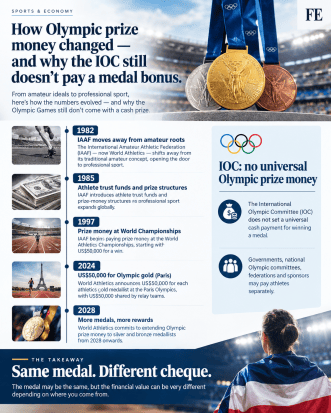
The International Olympic Committee (IOC) does not set a universal cash payment for winning a gold, silver or bronze medal. Instead, athletes can receive financial support through their national Olympic committees, governments, sports federations and sponsors.
The IOC also distributes revenue from broadcasting, sponsorship and other commercial programmes to national Olympic committees and international federations, rather than operating a conventional medal prize purse.
No cash prize doesn’t necessarily mean no monetary benefit for athletes
The current setup does not mean that Olympic or Asian Games athletes receive no money.
The financial rewards vary considerably from one country to another. Uzbekistan, for example, announced state-funded rewards of $10,000 for a gold medal, $5,000 for silver and $2,500 for bronze at the 2022 Asian Games in Hangzhou. In fact, Uzbekistan routinely ranks among the top countries globally for state-sponsored performance incentives. For comparison, the state vastly increased these numbers for the Paris Olympics in 2024, awarding its champions $200,000 in cash, a luxury vehicle and a multi-story home.
Singapore’s medal awards scheme also covers the Olympic, Asian Games and Commonwealth Games, with payments linked to the event and medal won. Singapore has one of the more generous medal reward systems for its athletes.
Under its Major Games Award Programme (MAP), athletes who win medals at major international competitions can receive substantial cash payouts. The scheme covers the Olympics, Asian Games, Commonwealth Games and SEA Games. For an individual gold medal, the payout is $1 million at the Olympics, $200,000 at the Asian Games, $100,000 at the Commonwealth Games and $10,000 at the SEA Games.
There are, however, limits on how many gold medals an athlete can be rewarded for at a single event. The money also comes with conditions. The awards are fully taxable, and athletes must return 20% of their prize money to their respective National Sports Association. The money is intended to support future training and athlete development.
The system also takes team events into account. Payouts are structured differently for team events and team sports, allowing the athletes who contribute to a medal-winning performance to receive rewards as well.
Thailand has a similar system, with cash rewards for athletes who win medals at major international events. The programme is managed by the government-backed National Sports Development Fund, with the amount varying according to the event and the medal won.
At the Olympics, an individual gold medal can bring a maximum reward of 12 million baht (about $365,000). Silver is worth 7.2 million baht, while bronze carries a reward of 4.8 million baht. The payouts are lower at regional competitions. An individual gold at the Asian Games earns 2 million baht (about $60,000), while a gold at the SEA Games brings 300,000 baht (about $9,500).
There is also a key difference from Singapore’s system: Thailand’s medal rewards are treated as tax-free gifts, rather than taxable income. Thailand also gives Olympic medallists an option over how they receive their money.
For example, a gold medallist can choose a 10 million baht lump-sum payment or opt for the full 12 million baht reward. Under the latter arrangement, half is paid upfront, while the other half is distributed through monthly payments over four years. The idea behind the staggered option is to give athletes a longer-term source of financial support after their competition careers.
So why leave the prize money to individual countries?
One reason is the structure of the Games themselves. The Olympics, Asian Games and Commonwealth Games bring together athletes representing different countries, sports and sporting systems. Their preparation and funding can look very different from one nation to another.
The IOC’s funding model reflects this structure. Revenue generated by the Olympic movement is distributed among national Olympic committees, international sports federations and other parts of the sporting system. The IOC says this support helps countries and athletes with training, development and participation in the Games.
Historical reason for no cash prize
There is also a historical reason.
The modern Olympic movement was originally built around the idea of amateur sport, with monetary rewards for Olympic performance explicitly prohibited. That principle has changed dramatically over time: professional athletes are now allowed to compete and elite sport has become heavily commercialised. But the IOC has retained the distinction between winning an Olympic medal and receiving a cash prize from the Games themselves.
The system is not completely static, however.
In recent years, some international sports federations have begun introducing their own prize money. World Athletics, for example, became the first international federation to announce direct prize money for Olympic gold medallists, illustrating the growing debate over how much of the revenue generated by major sporting events should reach athletes.
Gold winners in all 48 track and field events at the 2024 Paris Olympics received US$50,000 (roughly ₹41.6 lakh). The US$50,000 prize for relay events was shared equally among team members.
For athletes, though, an Olympic, Asian Games or Commonwealth Games medal can have a very different financial value depending on where they come from. The medal could be the same but the cheque that follows may not be of the same value.