


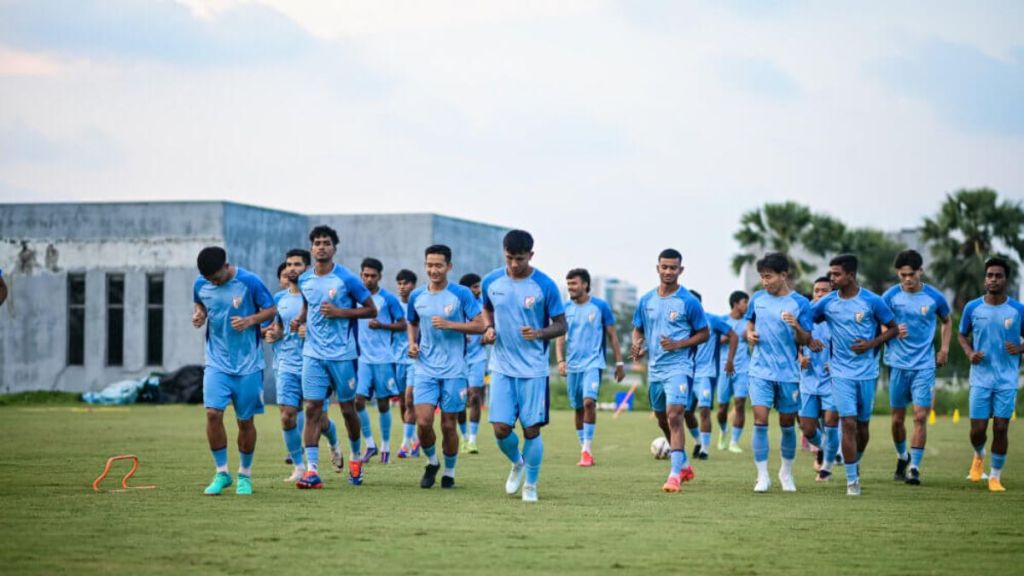

Naushad Moosa spent 14 months building something.
He watched more than 100 players. He picked 29 of them. He took them to Dushanbe to play Tajikistan, flew them to Malaysia for friendlies, then sent them to Jakarta for a double header against Indonesia at the Gelora Bung Karno Madya Stadium. Names like Vibin Mohanan, Dippendu Biswas and Bikash Yumnam started sounding familiar to people who track Indian football closely.
All of it was building toward one date. September 19, 2026. The Asian Games in Aichi-Nagoya, Japan. None of these players will go.
Not because they lost a match. Not because a rival team was simply better on the pitch. India’s men’s under-23 team qualified fair and square for the 2026 AFC U-23 Asian Cup pathway, one of 15 nations that made the continental cut
The women’s senior team did the same, punching their ticket to the 2026 AFC Women’s Asian Cup in Perth as one of 11 qualifying sides.
They earned their seats at the table. Then the government took the seats away.
A memo that changed everything
Here is the twist that makes this story sting. India’s football teams were blocked by their own country, not by an opponent.
A five page directive from the Ministry of Youth Affairs and Sports, dated September 24, 2025, set a simple rule. If a team sport wants government clearance and funding for the Asian Games, it needs to be ranked in Asia’s top 8. That ranking comes straight from the FIFA world rankings over the previous 12 months.
The men’s team sits 26th in Asia, somewhere between 138th and 141st globally. The women sit 13th in Asia, 67th in the world. Both numbers, respectable by India’s own recent standards, fall well short of the government’s line in the sand.
So a federation with 40 national sports bodies under it looked at football and simply said no.
“There are some rules of the government based on which they depute teams for the Asian Games,” said M. Satyanarayan, Deputy Secretary General of the All India Football Federation, in comments to Outlook India. “We have 40 national federations, not all of them send teams. In football, we are not among the top eight in Asia.”
No anger in that quote. No fight left in it either. Just an official reading out a rule he cannot change.
Why the rule exists in the first place
To understand why New Delhi drew this hard line, you have to go back to Hangzhou in 2023, where India picked up 107 medals at the Asian Games, its best haul ever.
That success created its own pressure. Officials did not want a repeat of what critics called “exposure trips,” where athletes travel abroad, lose early and come home with a participation certificate and not much else.
So a 15 member Unified Oversight Committee was formed, co-chaired by Sports Secretary and Indian Olympic Association President PT Usha. Alongside it came a new funding scheme called Target Asian Games Group, built for athletes who have a real shot at a medal but do not qualify for the more elite Olympic scheme.
Sports Minister Mansukh Mandaviya capped India’s entire Asian Games contingent at 600 athletes and made his message blunt, as reported by The Pioneer and Rediff Sports.
“Asian Games is not an exposure tour, it is a platform for athletes to make the country proud with their best performance,” Mandaviya said. “So, as I have repeatedly stated, only those who can deliver will travel. Exposure can be gained elsewhere. Anyone looking to secure jobs through participation certificates will not be cleared.”
There is even a rule blocking federations from sneaking players in through private sponsors at “no cost to the government.” The door is shut, full stop, no side entrance either.
You can see the logic. A country spending public money wants medals, not memories. But logic on a spreadsheet feels very different when you are the player who trained for 14 months and just found out you are not going anywhere.
This has happened before
India footballers know this heartbreak. It is not new.
Go back to 1951, and football and the Asian Games were basically the same story. Coach Syed Abdul Rahim led India to gold in the very first edition of the Games, held in New Delhi. In 1962 in Jakarta, India beat South Korea 2-1 in the final, playing through injuries and a tense political atmosphere in the host city.
By 1970 in Bangkok, India still had enough left for a bronze. That remains the last time an Indian football team stood on an Asian Games podium.
Then the wins stopped coming, and so did the exemptions.
In 2018, at Jakarta-Palembang, the top-8 ranking rule was applied for the first time in its modern form, and both Indian teams were kept out despite pleas from football administrators.
In 2023, the same fate looked certain, until then-head coach Igor Stimac took the unusual step of appealing directly to Prime Minister Narendra Modi and Sports Minister Anurag Thakur, according to reports in NDTV and The Indian Express. It worked. The government relaxed the rule at the last minute and let both teams travel.
But that win came with a catch nobody talks about enough. Indian Super League clubs refused to release their best players because the Asian Games tournament falls outside the official FIFA match calendar, and clubs are under no obligation to let players go.
India ended up sending a weakened, underprepared squad to Hangzhou, and it showed on the scoreline.
This time, in 2026, there was no phone call to the Prime Minister that changed anything. The rule held. By July, when the official tournament draws were locked in, replacement nations had already filled the group stages. The door was closed for good.
The club versus country problem, in rupees and players
This is where the story stops being just about rankings and starts being about money, and who controls it.
The Asian Games football tournament runs on under-23 rosters, with a small allowance for three overage players. Because the tournament sits outside the FIFA international window, Indian Super League clubs are not required to release their contracted players for it. Many simply don’t.
Put yourself in a club owner’s shoes for a second. You have paid good money for a 21 year old striker. He is your team’s best asset heading into the ISL season. The national team wants him for three weeks, for a tournament that carries no FIFA points and no real financial upside for your club. Do you let him go and risk an injury, or do you keep him and protect your investment?
Most clubs choose the second option. Every time. That is not disloyalty to the country. That is a business decision, and a fairly ordinary one in professional sport anywhere in the world. But it leaves the national federation stuck, unable to guarantee its best available team even when it wants to.
Government officials have quietly pointed to exactly this pattern as one reason they were less willing to grant an exemption this time. Why bend the rules for a team that domestic clubs won’t even fully release?
Where does the money actually go
The All India Football Federation is not a poor organisation on paper. Its 2023-24 budget touched roughly Rs 134 crore, backed by a Rs 50-crore commercial guarantee from Football Sports Development Limited plus central government grants, figures reported by The Hindustan Times and Khel Now.
But look closer at where that money flows, and a familiar story in Indian sport repeats itself.
For the 2025-26 season, the federation set a nine month combined revenue target of Rs 84.18 crore across its national setups. The women’s national team operates on a joint pool of about Rs 2.74 crore from the AIFF and Rs 2.25 crore from the Sports Authority of India.
The I-League, India’s second tier professional competition, runs on Rs 6.37 crore. Youth elite leagues get Rs 1.35 crore.
Now the number that tells the real story. The I-League 2nd Division gets Rs 1.27 crore. The I-League 3, the entry point for a lot of young talent, survives on just Rs 86 lakh.
Rs 86 lakh, for an entire tier of a national football pyramid in a country of more than 1.4 billion people.
That is not a rounding error. That is a policy choice, and it explains, in cold financial terms, why India struggles to consistently produce enough quality players to crack Asia’s top 8. You cannot build a deep talent pool on a shoestring budget at the grassroots while spending most of the money higher up the pyramid.
The players who paid the real price
Numbers on a budget sheet don’t train in the monsoon heat or sit through video analysis sessions at 6 in the morning. People do.
For the women’s team, the disappointment cuts differently. They had just come off a SAFF Championship win and carried real momentum into the AFC Women’s Asian Cup group stage in Perth, facing Japan, Vietnam and Chinese Taipei.
Against Chinese Taipei at CommBank Stadium, winger Manisha Kalyan scored in the 39th minute. Goalkeeper Panthoi Chanu and defender Sweety Devi Ngangbam both had strong tournaments. These were not players making up the numbers. These were players building something.
The Asian Games would have been the next step, more matches against strong Asian opposition, more experience banked before the next World Cup qualification cycle. Instead, that door closed too.
What has to change, and who has to change it
Football administrators in India are not short on ideas for fixing this. They are short on time and, frankly, short on leverage.
The AIFF, the ISL and its commercial partner FSDL need to sit down and actually build release clauses into player contracts for continental tournaments like this one, so club interest and country interest stop working against each other.
The senior team needs a calendar built around FIFA windows specifically to chase ranking points, not just to play friendlies for the sake of playing them.
And that Rs 86 lakh I-League 3 budget needs a serious second look, because a talent pipeline cannot run on fumes forever.
There is also a governance cloud hanging over all of this. On June 20, 2026, the AIFF’s Special General Body Meeting adopted a revised constitution to fall in line with the new National Sports Governance Act, 2025, and even floated renaming the federation the Football Federation of Bharat.
Around the same time, administrator Ranjit Bajaj filed a petition in the Delhi High Court accusing the sitting executive committee, led by President Kalyan Chaubey, of delaying elections under cover of state association alignment.
Add it up and you get a federation fighting legal battles at home while its national teams sit out the biggest continental stage available to them.
Back to Naushad Moosa’s list of 29 names
Somewhere on a phone or a laptop, there is still a spreadsheet with those 29 players Moosa built his Asian Games squad around. Vibin Mohanan. Dippendu Biswas. Parthib Sundar Gogoi. Korou Singh. Mohammed Sanan. Bikash Yumnam. Names that were supposed to mean something at Aichi-Nagoya this September.
They will still play football, somewhere, for someone. The ISL season goes on. Club football does not stop for a missed Asian Games. But that specific 14 month journey, built for one tournament, one goal, one shot at representing India on a continental stage, simply will not happen now.
A ranking chart decided that, not a football match.
And until the money, the calendar and the governance in Indian football all start pointing in the same direction, this is a story India’s footballers may end up living through again, four years from now, at the next Asian Games.