
There was something almost improbable about the deal. In November 2010, a family-run Indian business better known for chicken, poultry feed and pharmaceuticals completed the purchase of one of English football’s oldest clubs.
The club was Blackburn Rovers. The buyer was Venkateshwara Hatcheries, better known as Venky’s.
For the first time, an Indian company owned a club playing in the Premier League. The acquisition was announced as a way to take an Indian business into a global sport and turn Blackburn into an international brand.
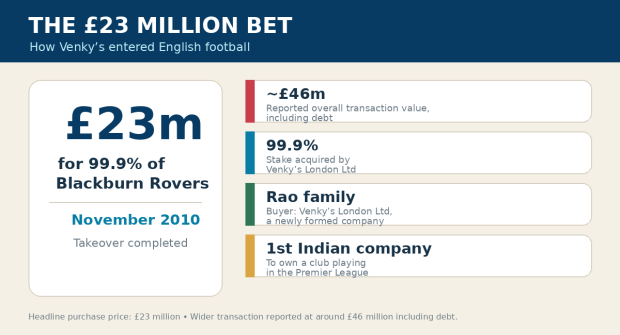
The transaction was worth £23 million for 99.9% of the club, according to the announcement made by Blackburn’s board. The buyer was Venky’s London Ltd, a newly formed company owned by the Rao family.
It was a landmark moment for Indian business in sport. But the financial logic behind the acquisition was bigger than simply owning a football club. The Premier League was becoming one of the world’s most powerful sports properties. Its clubs were attracting overseas owners, international sponsors and global audiences.
For Venky’s, Blackburn offered a route into that ecosystem. Sixteen years later, the experiment is still running. The difference is that Blackburn are no longer in the Premier League.
Why did a Pune poultry company want a Premier League club?
To understand the Blackburn deal, it helps to understand what Venky’s was trying to become.
Venkateshwara Hatcheries was founded in 1971 by Dr B.V. Rao and his wife Uttaradevi. Over the following decades, the business expanded beyond poultry into animal health, pharmaceuticals and related businesses.
By 2010, the group was looking outside India for growth. Football offered something that poultry could not easily provide: global brand visibility. Anuradha Desai, who was then chairperson of the group, explained the thinking at the time. The company was expanding internationally, including in markets where football had a strong following, and the Premier League could give the business a global platform.
There was also a natural branding connection, at least from the group’s perspective. Venky’s described itself as a protein and health business. Sport provided another association with health and performance. But there was a more important commercial calculation. Blackburn already had a Premier League platform.
The club had won the league title in 1995, had a rebuilt Ewood Park and had an established training complex at Brockhall. It was not a startup. The Indian owners were buying into an existing sports asset with a global television audience.
They weren’t building a football business from scratch. They were buying access to one. The club was available because its previous owners wanted out Blackburn’s sale did not happen in a vacuum. The club had been controlled by the Jack Walker Trust, created after the death of local businessman and lifelong Blackburn supporter Jack Walker.
Walker had transformed the club. His money helped Blackburn return to the top flight in 1992 and then win the Premier League title in 1995 under Kenny Dalglish. But by the late 2000s, the club was no longer competing at the level of the richest Premier League sides.
The Walker Trust had put Blackburn up for sale and had been searching for a buyer for more than two years. The club’s chairman John Williams had been overseeing the process. Then Venky’s arrived. By October 2010, the prospective Indian owners had gone through due diligence and were in discussions with the Premier League. The club said both sides hoped to complete the transaction in November. The deal was eventually completed on 19 November 2010.
£23 million for the shares but the takeover was bigger
One of the most interesting aspects of the transaction is the difference between the headline purchase price and the overall financial commitment.
Venky’s London paid £23 million for 99.9% of Blackburn Rovers. But contemporary reports put the total value of the transaction, including debt, at around £46 million. Blackburn also had significant liabilities at the time.
The Indian company wasn’t simply writing a £23 million cheque for a football club. It was stepping into an existing football business, with its own wage bill, debt, transfer requirements, stadium costs and operating expenses. The economics of football were already different from those of a conventional manufacturing or consumer business.
Revenue could change dramatically depending on which division the team played in. And that would soon become the defining issue of Venky’s ownership.
The promise was to build a global brand
When the takeover was announced, Desai spoke about establishing Blackburn as a global brand. The new owners also committed to respecting the Jack Walker legacy and maintaining Blackburn’s identity as a professional football club.
The ambition was understandable. Premier League football gave Venky’s something few traditional advertising campaigns could buy: repeated exposure in multiple international markets. Every match meant television coverage and shirt carried the possibility of brand visibility.
Every overseas supporter represented a potential consumer. It was essentially a sports-marketing strategy wrapped inside an acquisition. But there was one problem. Football clubs don’t become global businesses simply because their owners are global. The product still has to perform.
The first season changed everything
Venky’s arrived with Blackburn in the Premier League. The club had finished 10th in the previous season. But the new era quickly became turbulent. Manager Sam Allardyce was dismissed in December 2010, only weeks after the takeover. Steve Kean was appointed.
Results remained inconsistent. Blackburn eventually survived relegation in the 2010-11 season, finishing 15th. The following season was much worse. Blackburn finished 19th in the Premier League and were relegated.
The club that had been bought as an international sports asset had lost the most valuable commercial platform in English football less than two years into Indian ownership.
Relegation was not just a football problem
This is where the Blackburn story becomes particularly relevant from a business perspective. A Premier League club has access to a different revenue ecosystem from a Championship club.
Broadcasting distributions are much higher. Commercial exposure is greater. Matchday revenues can be supported by the prestige of top-flight football. Relegation changes the economics almost overnight. Blackburn had entered the Venky’s era with Premier League revenues.
Now it had to operate with the financial consequences of being outside the division. And unlike a conventional company, the football club could not simply reduce production and wait for demand to return.
It still needed players, needed coaches, needed to compete. And it needed to win.
The fall went further
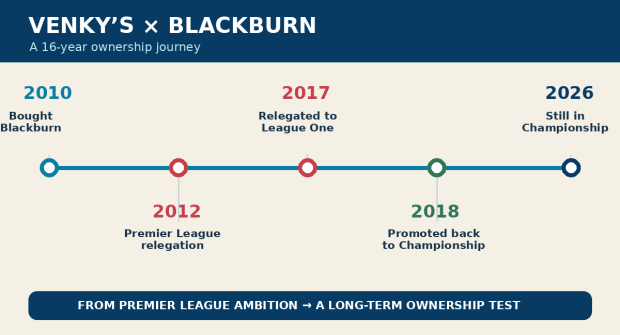
Blackburn did not immediately return to the Premier League. Instead, the club spent years in the Championship. Then, in 2017, it was relegated again- this time to League One, England’s third tier. For an organisation that had been Premier League champions in 1995, the fall was dramatic.
But the club eventually recovered. Blackburn returned to the Championship in 2018 after winning promotion from League One. And that is where the club has largely remained.
The Indian owners stayed
This is one part of the Venky’s story that often gets lost in the controversy around the club. The owners did not walk away after relegation. They did not sell Blackburn when the Premier League revenue disappeared. They continued to own the club.
Companies House records show Venky’s London Limited remains the controlling company of Blackburn Rovers, holding at least 75% of the voting rights and having the right to appoint or remove directors.
The same filing identifies Venky’s London Limited as the person with significant control of The Blackburn Rovers Football and Athletic Limited. And Venky’s London itself remains active. Companies House records show the company filed group accounts for the year ended March 2025 and made further share-capital allotments during 2025 and 2026.
So this is no longer a short-term experiment. It has become a 16-year ownership cycle. The chicken brand eventually became part of the football club. There was an interesting change in the original strategy. When Venky’s first arrived, Desai had spoken about using Blackburn’s global reach while keeping the football club independent.
Over time, however, the commercial relationship became much more visible. In 2023, Blackburn announced a five-year sponsorship agreement with Venkateshwara Hatcheries Group. The multi-million-pound package put the Venky’s brand on the men’s and women’s playing kits, academy shirts, travel wear and other club assets.
Blackburn said the agreement would generate vital revenue for the club while giving Venky’s greater international exposure. In other words, the original logic eventually came full circle.
The business bought the football club partly to build its international profile. More than a decade later, the football club was also becoming a commercial platform for the owner’s own brand. The owner and the football club became financially intertwined
Venky’s London Limited is not just a name attached to Blackburn. Companies House records show repeated injections of share capital into the company associated with the club. Blackburn’s filing history shows its share capital rising to more than £201.8 million after an allotment in December 2025.
Venky’s London itself has also recorded substantial increases in share capital, with the latest filing in August 2026 showing £257.36 million of share capital. These numbers should not be interpreted as the amount spent on the club or as the club’s valuation.
They are corporate share-capital figures. But they do illustrate something important about the ownership model: this has involved repeated capitalisation of the UK corporate structure over time, rather than a one-off purchase followed by an exit.
The parent business remains substantial
The football club is only one part of the wider Venky’s story. The Indian listed company Venky’s (India) Limited reported revenue from operations of ₹3,306.99 crore for FY2024-25, down from ₹3,738.15 crore the previous year.
Its profit before tax rose to ₹162.71 crore, from ₹109.42 crore, while profit after tax increased to ₹116.62 crore. The Blackburn investment is not the story of a tiny company trying to own a football club. It sits within a much larger Indian business group.
And that helps explain why the owners have been able to remain in the game despite the football club spending much of its ownership period outside the Premier League.
But the sporting ambition has remained difficult to deliver
The financial ability to own a club and the ability to make that club successful are two different things.
Blackburn’s record under Venky’s has included:
– Premier League relegation in 2012
-League One relegation in 2017
-Promotion back to the Championship in 2018
– Several seasons in the Championship without returning to the Premier League
The club finished 20th in the 2025-26 Championship, with 52 points from 46 matches. That meant another season spent fighting near the bottom rather than competing for promotion.
The club’s immediate priority has become much more basic: staying in the Championship.
The club’s current state: September 2026
The 2026-27 season has brought another reset.
Tony Mowbray returned as head coach in the summer of 2026 after Michael O’Neill’s temporary spell helped Blackburn secure Championship safety during the previous campaign. O’Neill oversaw five wins, five draws and five defeats across his 15-match spell before choosing to return his focus to Northern Ireland.
Mowbray is now back at Ewood Park. The club also appointed Steve Curwood as chief executive officer, with him joining on 1 July 2026. The club said his background included work at Fleetwood Town, the EFL Board and the Football Association.
On the pitch, Blackburn’s opening to the 2026-27 Championship season has been mixed.
After seven league matches, the club had eight points from two wins, two draws and three defeats, with a 3-1 win over Millwall its latest result before the September 19 trip to Portsmouth. The club remains in the Championship. And the Premier League is still the obvious financial prize.
What happened to the original global-brand plan?
This is where the Blackburn story becomes more complicated than simply saying the takeover failed. Venky’s did achieve something significant. It became the first Indian company to own a Premier League club.
It gave an Indian consumer brand an association with English football, created a commercial bridge between a Pune-based business and a historic English football institution. It also remained an owner for far longer than many overseas investors who entered English football around the same period.
But the sporting outcome is different. Blackburn have spent most of the ownership period outside the Premier League. The club that was supposed to become a stronger global brand has instead spent years trying to regain the division that made the original investment so attractive.
The owner can control the asset but the value of the asset is heavily influenced by where the team finishes every season.
The Premier League prize remains enormous
For Blackburn, promotion is not simply a sporting ambition. It is potentially a financial transformation. The gap between the Premier League and the Championship affects broadcasting distributions, commercial attractiveness, player recruitment, sponsorship and the club’s ability to attract global attention.
That is why the same club can look like two different businesses depending on its league position. Blackburn have experienced both sides. They were once a Premier League champion. They have also played in League One. Today they sit in the Championship.
The distance between those divisions is measured not only in football quality but in millions of pounds of annual revenue. The story that began with chicken and ended with football is still unfinished. When the Rao family bought Blackburn in 2010, the symbolism was almost as powerful as the transaction.
India was not yet a major force in English football ownership. Cricket dominated the Indian sports economy. The Premier League was increasingly global. And a Pune business saw an opportunity to take its brand into that world. The price of entry was £23 million for 99.9% of Blackburn.
The plan was to use football’s global reach to build a global business. Venky may still own the club but the business case has changed. The question is no longer whether an Indian company can own an English football club. That has already been answered. The bigger question is what an owner does with a club once the novelty of the acquisition disappears. At Blackburn, the answer is still being written.
The club has survived relegation battles, gone down to the third tier, returned to the Championship and remained under the same Indian ownership throughout. In 2026, it is still at Ewood Park, still in the Championship and still trying to get back to the Premier League.
The remarkable part of the Venky’s story is not simply that a poultry company bought a football club. It is that what began as an audacious international branding bet has turned into a 16-year test of whether an Indian family business can turn ownership of an English football institution into a sustainable sporting business.
For now, the chicken company is still in football. And the football club is still waiting for the Premier League return that would make the original bet look very different on the balance sheet.


