



India’s sportswear market is entering a more competitive phase.
Global brands are expanding their retail and digital footprints. Running is emerging as one of the industry’s most important growth categories. Athletes are moving beyond endorsements and taking equity in sports businesses. And manufacturers arbecoming increasingly important to the brands they once simply supplied.
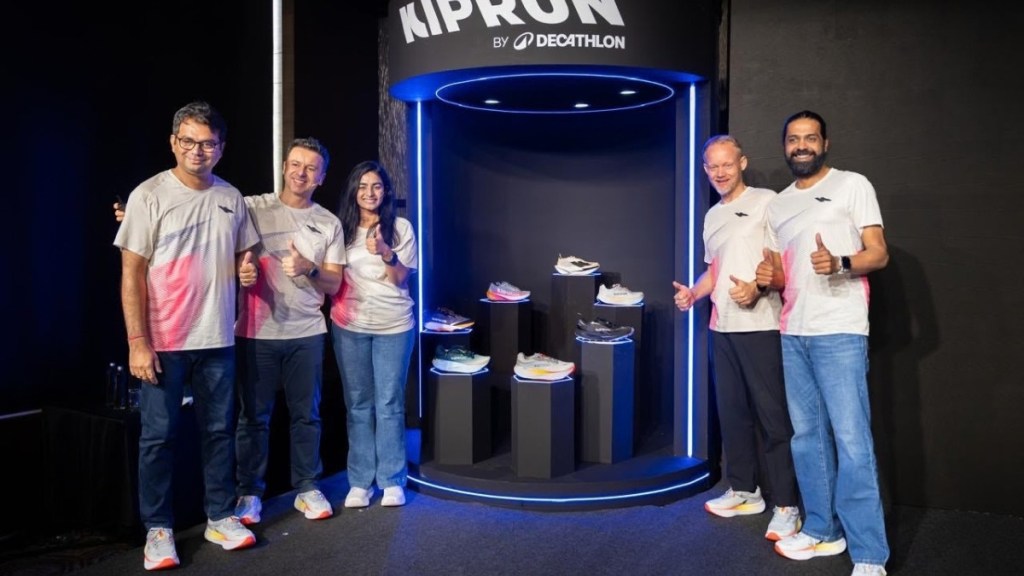
The latest bet comes from Decathlon. On September 25, the French sports retailer launched KIPRUN, its specialist running brand, in India with 35 new products, including 17 high-performance running shoes. The company is targeting more than ₹1,000 crore in running turnover by 2030 and wants to serve more than 5 million active runners.
For Decathlon, this is not simply another shoe launch. It is a bet that running in India is becoming large and sophisticated enough to support a specialist performance ecosystem.
“We are born from the crowd, built for the community,” Bruno Araujo, Decathlon’s brand manager, said while explaining KIPRUN’s origins at the launch event in New Delhi.
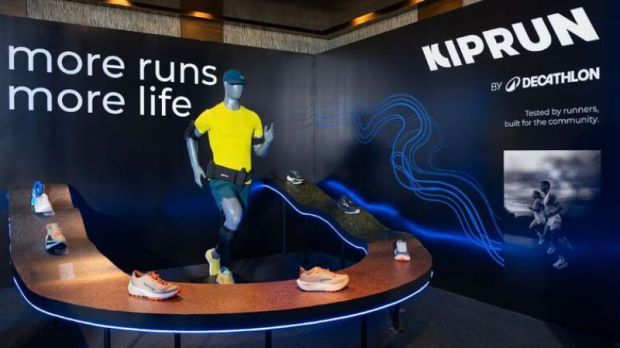
The name itself comes from the words “keep running”, which engineers associated with the crowds at the 2007 New York Marathon. Nearly two decades later, the brand is being brought to a market where running is increasingly becoming a community activity rather than an occasional fitness pursuit.
The sports economy is already big. Apparel is becoming more valuable
The running opportunity sits inside a much larger sports economy.
KPMG estimates India’s sports industry at around $19 billion, growing at 12-14% annually and potentially reaching more than $40 billion by 2030. Within that ecosystem, sports-goods manufacturing and apparel is estimated at about $6.7 billion, with the segment projected to reach around $10 billion by 2030.
More than merely the size of the market, it is the composition.
Athleisure has become a major part of sportswear consumption, while e-commerce has lowered the geographic barrier between specialist brands and consumers. KPMG estimates athleisure at roughly 60-65% of apparel sales, while e-commerce accounts for around 30-35%.
That creates room for several types of sportswear business to coexist. A consumer can buy a ₹999 entry-level running shoe from a mass sports retailer, a ₹10,000-plus carbon-plated shoe from a specialist brand, and a lifestyle sneaker from a global sports-fashion label.
Sportswear is consequently becoming less of a single category and more of a collection of overlapping markets: running, training, football, basketball, tennis, trail, gym, athleisure and recovery. Brands increasingly want to own several of those occasions.
Running is becoming a category of its own
Puma’s experience illustrates the change.
The company says its India business has grown roughly fourfold over the past decade and reached around ₹3,200 crore in FY26, with footwear sales of slightly under 11 million pairs. Running has become its largest category, accounting for almost 30% of sales in its retail stores.
That is not simply a story about more people buying running shoes. It reflects a more sophisticated consumer. The runner who once bought a generic sports shoe can now choose between an everyday trainer, a long-distance shoe, a race-day shoe, a carbon-plated model or trail footwear.
The shift is also being driven by a change in what consumers expect from the category. For years, affordability was a primary consideration in India’s sportswear market. Decathlon believes that equation is evolving.
“You have a population that is ready. India is showing a super high level of growth in terms of economy in the world. Also, we are more ready, which wasn’t necessarily the case five years ago. And maybe the market wasn’t fully ready either. It didn’t have the demand that it has today,” Hans Peter Jensen, Sports Director for Decathlon Sports India, said in an exclusive interaction with Financialexpress.com.
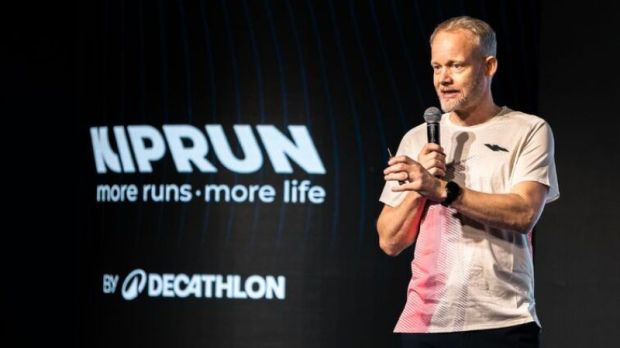
“The stars sort of aligned today, and I think the French team that has worked on the global range have done a remarkable job over the last two-three years. We have seen an increase in the technicity of the products. Running has to be one of the engines of the growth over the coming years,” he added.
For brands, this creates more potential purchase occasions and gives them opportunities to move consumers up the technology ladder. Decathlon is trying to do exactly that.
Its KIPRUN portfolio spans beginners to experienced runners, with the company planning to build beyond footwear into apparel, accessories, hydration, trail running and recovery.
The price architecture is deliberately broad. KIPRUN products will span ₹999 to ₹19,999. That is important because it places an entry-level consumer and a performance-focused runner within the same brand ecosystem.
Jensen said the pricing reflects local market feedback rather than a simple transfer of the global range to India.
“In the price range, there is definitely a tweak that has been made to cater to the Indian customers. Our local teammates have an obligation to give feedback to the basecamp, saying, ‘Hey, in these catchments in India, there is a need for this price range or technicity’. It is that feedback that explains this insane gap in pricing, with our shoes starting from ₹999 and a top-level range at ₹19,999. This price range comes from Indian insights,” he said.
The company is also looking to make advanced technology more accessible. Its Challenger model, for instance, is positioned as a carbon-plated shoe below ₹10,000.
The strategy is effectively to widen the performance market from both ends: more runners at the bottom, more technology at the top.
The specialist consumer is becoming the prize
The shift towards performance also changes the economics of sportswear. A consumer who buys one pair of sports shoes every few years offers limited recurring revenue.
A runner who trains regularly can buy different shoes for different purposes, along with apparel, socks, hydration products, accessories and recovery equipment. This is why the industry is increasingly talking about ecosystems rather than individual products.
Decathlon management says its KIPRUN strategy is not restricted to footwear. Apparel and accessories form part of the broader proposition, with the company seeking to serve runners across different stages of their journey.
The product cycle is also expected to become faster. Management said KIPRUN’s offer will continue to evolve, with new products such as a Tempo model and Elite Pro planned for future seasons.
For a technical category, that matters. A performance shoe cannot remain static if competitors are constantly changing foam compounds, shoe geometry, carbon plates and other technologies.
As Jensen put it, the company needs to keep updating its offer and strengthen its go-to-market alongside the product pipeline.
The battle is therefore moving from having a running category to continuously innovating within it.
Decathlon does not need to build KIPRUN from scratch
This is perhaps the most interesting part of the KIPRUN strategy.
Unlike a standalone sports brand entering India, Decathlon already has a physical and digital ecosystem.
The company’s broader India network currently stands at 132 stores, and it plans to take that to 200, giving the KIPRUN proposition a potentially much wider physical footprint. The company has claimed that this network gives it access to around 40% of India’s population.
It has not indicated an immediate plan to build a separate KIPRUN store network.
That gives Decathlon an advantage: it can build awareness for a specialist brand without first having to build an entirely new distribution infrastructure.
Management’s strategy is therefore not to create a parallel retail chain overnight. It is to use Decathlon’s existing network to establish KIPRUN, then expand the specialist proposition as the category develops.
The opportunity is moving beyond the big metros
Running’s growth is also changing geographically.
Delhi, Mumbai and Bengaluru remain major running hubs, but Decathlon management says smaller cities and towns are increasingly seeing running events, fitness-awareness programmes and community-led activity.
Schools are getting involved. Local running groups are growing. Smaller social and awareness runs are creating new entry points. The company does not currently have a hard percentage split for metro versus Tier-2 and Tier-3 running demand, but the qualitative change is becoming increasingly visible.
And there is another shift. Women are participating in greater numbers, while running itself is expanding beyond roads into trail and gravel. Decathlon plans to bring more trail and gravel products to India as these formats develop.
For sportswear companies, this means the addressable market is expanding in several directions at once: more cities, greater participation by women, more sports and more specialised products.
Nike, Adidas, Puma and Asics are fighting different battles
The competitive landscape is already crowded.
Nike India crossed the ₹1,000-crore revenue mark in FY25 based on the financial filings. The company has also changed its digital-commerce model in India, with Nykaa taking over management of Nike’s local digital-commerce operations from February 2026.
Adidas has used cricket as a powerful local bridge for a global brand through its Indian cricket partnership, while its Originals portfolio allows it to participate simultaneously in performance sportswear and fashion.
Puma has built a large Indian retail presence and is increasingly concentrating on categories such as running and training.
Asics, meanwhile, is pursuing a specialist performance strategy of its own. The company’s India business reported strong growth in recent years, with FY24 revenue reaching around ₹428 crore, according to the financial material supplied for this story.
Across these companies, the common thread is greater specialisation. The competition is no longer simply over who can put a logo on a shoe. It is over who can build credibility in a particular sport and then convert that credibility into a wider consumer relationship.
India’s manufacturing base is becoming a strategic asset
That competition is also changing what happens behind the retail shelf.
India has been a sporting-goods manufacturing base for decades, but international sports brands are increasingly treating the country as both a consumer market and a production location.
KPMG estimates sporting-goods exports at around ₹4,440 crore in FY2024-25, up about 4% from the previous year and growing at an 11% CAGR since 2017-18.
The manufacturing map is diverse. Jalandhar remains important for sporting equipment, Meerut for cricket and fitness products, while Tamil Nadu has emerged as an important hub for sports footwear and apparel.
International companies are deeply embedded in this ecosystem. And that creates an opportunity beyond simply replacing imports. If India can manufacture more technically advanced sportswear locally, brands can potentially combine domestic supply chains with local pricing and product development.
Decathlon is already increasing its local sourcing. The company says around 50% of the quantity sold in its Indian stores is Made in India, while it is investing in footwear manufacturing capabilities, technology and talent.
That makes local manufacturing part of the competitive proposition rather than merely a supply-chain decision.
Then there is Virat Kohli
Perhaps the clearest example of this change is happening outside the traditional global-brand model.
Virat Kohli’s One8 is now being developed within Agilitas Sports, the sports platform co-founded by former Puma India and Southeast Asia executive Abhishek Ganguly.
Agilitas acquired Mochiko Shoes in 2023, bringing a major Indian sports-footwear manufacturer into the group. Mochiko has supplied international brands including Adidas, Puma, New Balance, Skechers, Reebok, Asics and Decathlon.
That changes the proposition for an athlete-led brand. The traditional model is athlete endorsement and product. The emerging model brings together athlete equity, product development, manufacturing and distribution.
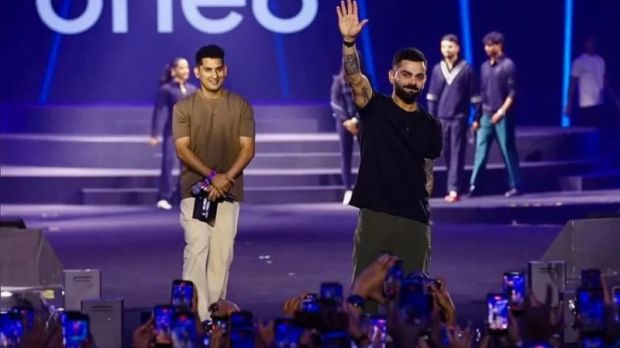
Kohli reportedly invested around ₹40 crore in Agilitas and holds a minority stake.
The economics are fundamentally different from an endorsement cheque. An endorsement pays an athlete for using his image. Equity gives the athlete exposure to the value created by the business.
The model has an obvious international precedent in Roger Federer’s involvement with On. But India has a potentially important advantage: a substantial sports-manufacturing ecosystem already exists.
The factory may become as important as the logo
Agilitas is attempting to control more of that value chain.
Rather than building another asset-light D2C sports label dependent entirely on third-party factories, it acquired a manufacturer and combined manufacturing with brands.
That matters in a market where price, product quality and supply-chain control can determine whether a celebrity-led brand becomes a repeat-purchase business.
One8’s first independent cricket range, launched in June, provides an early test.
The range includes specialist cricket spikes priced at ₹13,999, alongside lifestyle and training shoes at lower price points. The company has also moved towards direct-to-consumer distribution and is developing a wider retail proposition.
The question is no longer whether Kohli can sell shoes. The more difficult business question is whether that attention can be converted into repeat purchases, technical credibility and a scalable sportswear company.
Athletes are becoming investors, not just endorsers
Kohli’s involvement is part of a broader shift in the relationship between sport and commerce.
Agilitas has attracted institutional capital as well as investments from athletes, creating a cap table that combines financial investors and sporting personalities.
The significance is less about any individual investor and more about the structure.
Athletes have historically been one of the most powerful marketing assets in sportswear. Now some are seeking a share of the businesses they help build.
That potentially changes incentives. An athlete who owns equity has an interest in the product, manufacturing platform and distribution network—not simply the advertising campaign.
It also means the athlete takes on commercial risk that an ordinary endorsement contract largely transfers to the brand.
Whether that model works at scale will depend on factors that have little to do with celebrity reach: manufacturing economics, product development, distribution, pricing and repeat demand.
The women’s market could become the next battleground
The next frontier is also increasingly likely to be women.
Agilitas is developing women’s performance products under One8, while Decathlon management points to rising female participation in running.
That is commercially significant. Women’s activewear has increasingly become a category in its own right rather than simply an extension of men’s sportswear.
For brands, the challenge is to build products around women’s specific performance requirements rather than simply adapt existing men’s ranges.
For Indian manufacturers, the opportunity is similar: use domestic production to offer technically credible products at prices that can reach a broader consumer base.
The result could be another cycle of sportswear expansion, this time driven by participation rather than fashion alone.
From cricket economy to participation economy
India’s sports economy remains heavily dependent on cricket. But the sportswear opportunity is different. A cricket fan may buy a jersey because of a team or player. A runner buys because she runs.
That creates a different consumption cycle. Running groups, marathons, school events, fitness communities, trail running and everyday exercise create repeated occasions to spend on equipment and apparel.
That is why the KIPRUN launch matters beyond Decathlon. It is a bet that India’s sports economy is shifting from watching sport to participating in sport.
And participation creates a recurring sportswear market.
The race is moving down the value chain
India’s sportswear industry is consequently entering a more complicated phase.
Nike is strengthening its digital distribution.
Adidas is using cricket to deepen local relevance.
Puma is making running a major part of its retail business.
Asics is expanding its specialist performance footprint.
Decathlon is building specialist brands on top of an established multi-sport retail network.
And Agilitas is attempting something different: putting athletes, brands and manufacturing closer together.
The common thread is that India’s sportswear opportunity is no longer simply about selling a global logo to an Indian consumer. It is increasingly about controlling more of the journey from factory to foot.
That is the larger significance of KIPRUN.
The 17 high-performance shoes launched by Decathlon are only the visible part of the bet. Underneath them is a much larger wager that India will produce millions more runners, that those runners will become increasingly demanding consumers, and that companies able to combine technology, price, distribution and manufacturing will capture the next phase of sportswear growth.
For Decathlon, the target is ₹1,000 crore and 5 million runners by 2030. For Puma, running is already its largest retail category. For Nike, Adidas and Asics, the battle is increasingly about owning specialist consumers while retaining lifestyle relevance.
For Kohli and Agilitas, the ambition is broader: build the Indian sports brand rather than simply endorse one. The market is consequently moving beyond the question of who sells the most sportswear.