



A father in Moga once picked up a needle because he had no money for a proper cricket kit. He stitched two words onto a plain shirt for his daughter. “Good Batting.” That is roughly all the encouragement Harmanpreet Kaur had in a town where girls playing cricket was not really a thing people did, or at least not a thing people approved of.
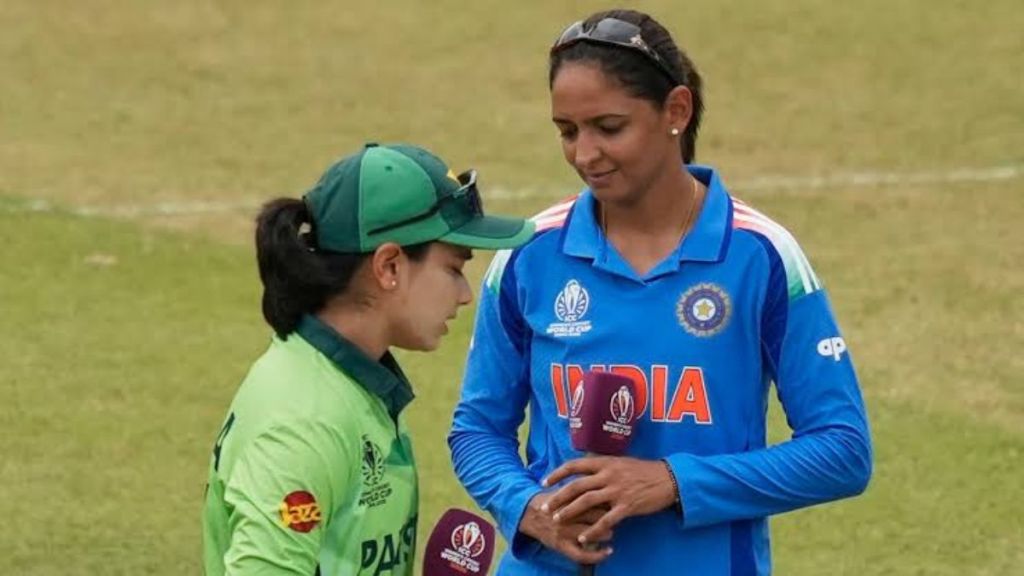
Years later, on September 5, 2026, she will walk out at the Dubai International Cricket Stadium as India’s captain, facing a Pakistan side led by Fatima Sana, and somewhere in that thirty-yard circle, two very different but strangely similar life stories will collide.
This is not just a cricket match. It rarely is, when it’s India versus Pakistan. But strip away the flags and the noise, and what’s left is two women who had to argue, quietly or loudly, for their own right to play.
A rivalry neither country can stage at home anymore
Bilateral cricket between India and Pakistan stopped happening a long time back. Politics did that, not sport. So now, whenever these two teams meet, it’s on neutral ground, mostly in the UAE and Dubai has become something like a rented living room where two families who don’t speak to each other are forced to sit for three hours.
That situation, strange as it sounds, has actually made the match more valuable, not less.
Ad slots during a men’s India-Pakistan World Cup game go for 30 to 40 lakh rupees for just 10 seconds, nearly 36,000 to 48,000 dollars. A regular international match, by comparison, sells that same 10 seconds for about 20 lakh.
The rivalry itself has become the product. Nobody is really selling cricket anymore. They’re selling this specific pair, together, unwilling to play at each other’s grounds, but unable to stay off each other’s screens.
The women’s version of this fixture used to be an afterthought. That changed on October 5, 2025, when India played Pakistan in the Women’s World Cup and the numbers came in far bigger than anyone at ICC or JioStar expected. 28.4 million viewers. 1.87 billion minutes watched.
The most-watched women’s international cricket match ever recorded, by a distance. Television reach for that tournament’s early rounds touched 72 million, a jump of 166 percent from 2022, according to BARC and ICC data.
So when these two captains lead their teams out in Dubai this September, they aren’t just playing for a regional trophy. They’re proof that a market exists. A big one.
Harmanpreet Kaur: The girl Moga wasn’t ready for
Harmanpreet grew up in a town that simply did not have the infrastructure, or frankly the appetite, for women’s cricket. Her father, Harmandar Singh Bhullar, worked as a clerk. Not a wealthy man. Not someone who could throw money at his daughter’s ambition.
What he did instead was defend her. Against neighbours who thought it strange. Against a system that offered girls almost nothing in the way of grounds, coaching or gear. When she couldn’t afford proper kit, he hand-stitched that shirt for her. She has spoken about it on national television, describing it as the one thing that kept her going when things felt hopeless early in her career.
She eventually got a job with Indian Railways in 2013 and moved to Mumbai, the kind of relocation many small-town athletes make not because they want to, but because there’s no other way to build a serious career.
Her real breakthrough came in 2017, an unbeaten 171 off 115 balls against Australia in a World Cup semifinal, an innings so ferocious it changed how corporate India looked at her overnight. A car came her way. So did the first wave of real endorsement calls.
Today her bat carries the CEAT Tyres logo, worth an estimated 40 to 50 lakh a year, purely because broadcasters know the camera finds her bat every single time she’s on strike. She earns 1.8 crore captaining Mumbai Indians in the WPL.
Punjab National Bank made her its first-ever female brand ambassador, using her face to sell financial products built specifically for women. None of that changes what she had to fight through to get here. It just means the fight eventually paid.
Fatima Sana: Leading from a place that gives even less room
Pakistan’s women cricketers operate under pressure that’s honestly hard for outsiders to fully picture. Facilities are thinner. Social approval is harder to earn.
The path from picking up a bat to captaining your national side runs through far more resistance than most fans realise, and Fatima Sana has walked that entire road to now stand as her country’s captain, at a tournament being played, again, on someone else’s soil, because her own board and India’s haven’t shared a cricket field bilaterally in years.
What she did before this tournament tells you something about how she thinks. Instead of running standard net sessions before facing India, Sana arranged full, competitive T20 matches at the National Cricket Academy camp in Lahore, against boys and men from the Abdul Qadir Cricket Academy. Real matches. Proper rules. Faster bowling than her squad would normally see.
It’s a small decision, but it says a lot. She wasn’t interested in her team feeling comfortable before Dubai. She wanted them to feel the pressure early, indoors, safely, so it hurt less when it arrived for real.
That’s not the instinct of someone playing it safe. That’s someone who has probably had to push back against a lot of “safe” in her own career just to get a team, a camp and an academy to say yes to her plan.
Two captains. Two very different countries. Both spent years convincing people around them that a woman standing at the crease, or leading a dressing room, wasn’t something to be embarrassed about.
The business quietly watching both of them
Here’s where the money enters, because it always does eventually.
One company, JioStar, formed through an 8.5 billion dollar merger between Reliance-backed Viacom18 and Disney’s Star India, now owns almost every major cricket broadcast right across South Asia. The IPL, the WPL, ICC events, ACC tournaments, BCCI’s home series, all of it sits under one roof.
That kind of consolidation changes viewing habits fast. JioStar has been steadily pushing audiences from free streaming toward paid tiers, starting around 149 rupees for mobile-only access and going up to 499 for ad-free viewing across devices.
Advertisers with real budgets have followed people onto Connected TV, the big screen at home, where reportedly rates have jumped 30 percent to roughly 650 to 850 rupees per thousand views, close to 8.5 lakh for a single 10-second spot.
The women’s Asia Cup itself still trades at a discount, 2 to 4 lakh rupees per 10-second slot, a fraction of what the men’s fixture pulls in. But five years back, this tournament barely had a rate card worth mentioning. The gap is closing, slowly, and every time Harmanpreet or Sana walks out for a India-Pakistan clash, that gap closes a little faster.
Equal pay on paper, not quite equal in practice
In October 2022, the BCCI made a call that got headlines everywhere. Women cricketers would now earn the exact same match fees as men. 15 lakh for a Test, 6 lakh for an ODI, 3 lakh for a T20I. Same numbers, same currency, finally.
It sounds like the gap closed completely. It hasn’t, not really. Annual central contracts still show the old imbalance. Grade A women, a group that includes Harmanpreet, get 50 lakh a year. Grade A+ men get 7 crore. Match day, they’re equals. Every other day of the year, they’re not quite.
Pakistan’s board runs on considerably tighter numbers still, which is part of why what Sana has built as captain matters more than a scoreline can show. She isn’t leading a side with WPL-style contracts sitting behind it. She’s leading a side where every camp, every net session, every decision to arrange real matches against male cricketers, has to be argued for, not assumed.
What September 5 actually is
Take away the ad rates and the merger and the CPMs for a second.
What’s actually happening on September 5 is that two women who were told, in different ways, in different countries, that this game wasn’t really theirs to lead, will walk out and lead it anyway.
One carries a bat with a tyre company’s logo on it because broadcasters worked out her strokeplay sells advertising. The other carries a dressing room that had to train against boys just to be ready for this moment, because nobody handed her team an easier route.
Somewhere in Moga, a shirt with two hand-stitched words probably doesn’t exist anymore. It doesn’t need to. Every time Harmanpreet Kaur reaches fifty, every camera cut to her bat, is that same sentence playing out again, just louder now, and paid for.
That’s the real story sitting underneath the broadcast numbers. Not the 28.4 million viewers. Not the 40 lakh rupee bat deal. Just two captains who had to be stubborn long before anyone was willing to sponsor them for it.