


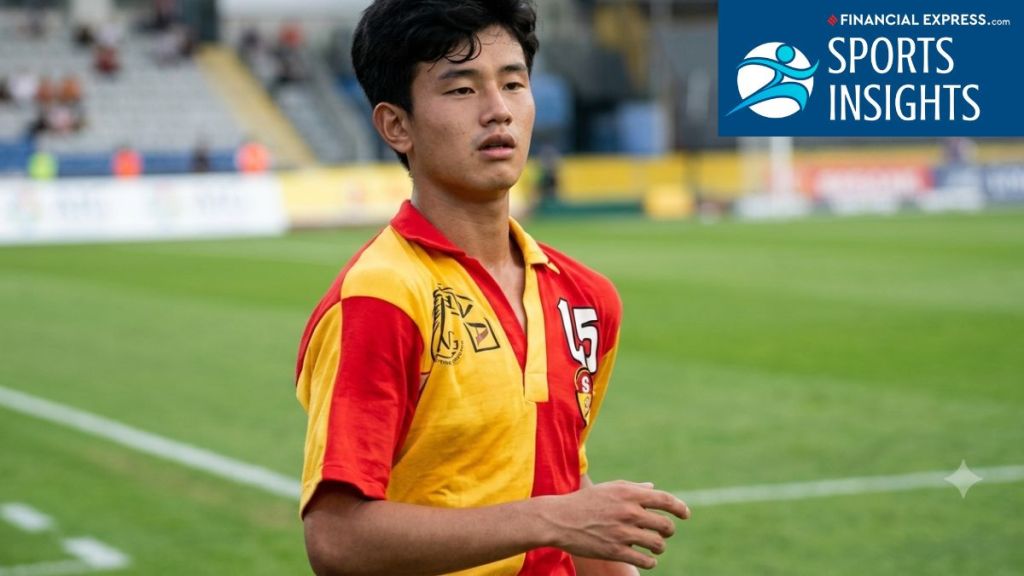

There is a photograph from 1997 that still does the rounds on Kolkata football forums. A skinny 20 year old in red and gold, arms spread wide, running toward a crowd of over 131,000 people who have just watched him score three goals against Mohun Bagan.
Bhaichung Bhutia was the first man to do that in a Kolkata Derby. He was also, at that point, a boy who had walked away from his ICSE board exams to chase a football trial.
Nobody in that stadium was thinking about balance sheets that day. Least of all Bhutia.
Almost three decades later, the same man’s name shows up in a different kind of document. Not a scoresheet, but an election affidavit filed in Sikkim in 2024. Gross assets: ₹127.23 crore. Liabilities: ₹3.84 crore. Net worth: roughly ₹123.40 crore.
Somewhere between the derby hat trick and that filing, the Sikkimese Sniper became something India’s sport had never really produced before, a genuine athlete-entrepreneur.
That transformation did not happen by accident, and it did not happen fast.
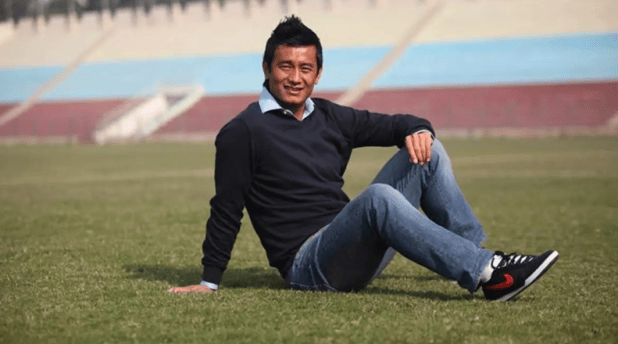
A boy from Tinkitam who never stopped calculating
Bhutia was born on December 15, 1976, in Tinkitam, a small village in South Sikkim, to Sonam Topden Bhutia, a farmer. There was no football academy down the road. What there was, instead, was a scholarship at age nine to the Tashi Namgyal Academy in Gangtok, where a local mentor named Karma Bhutia first noticed the boy could run circles around bigger kids.
He played badminton. He played basketball. He ran track. Football was one sport among several until 1992, when he won Best Player at the Subroto Cup and caught the eye of former India goalkeeper Bhaskar Ganguly. Ganguly pulled him into Kolkata’s football machine. A year later Bhutia signed his first professional contract, with East Bengal, at sixteen.
People often confuse him with cricket. He was never a cricketer. The confusion comes from a nickname the Indian press gave him in the 1990s: the Sachin Tendulkar of Indian football.
It was meant as flattery, a way of saying here is a man trying to drag an entire sport out of the shadow of cricket, more or less alone. He has since weighed in publicly on cricket matters, including backing Mahendra Singh Dhoni during selection debates and offering his views around the 2019 World Cup, but always as a fan and a public figure, never as a player.
By 1996-97, playing for JCT Mills Phagwara, he was top scorer and champion in India’s first National Football League season, and Player of the Year at twenty.
Then came 1999. Bhutia signed a three year contract with Bury FC in England’s Second Division, becoming the first Indian to sign professionally with a European club, only the second Indian ever to play pro football in Europe after Mohammed Salim decades earlier.
He debuted against Cardiff City on October 3, 1999. Scored his first English goal against Chesterfield the following April. Injuries and Bury’s later financial troubles cut the stint short. But something else happened during that time in England, something that would matter far more to his life after football than any goal he scored there.
He started watching how clubs were run.
What a broken English club taught an Indian footballer about business
Bury FC was not a giant. It was a modest Second Division side, and yet its academy structure, its coaching pipelines, its whole administrative machinery, ran on systems India simply did not have. Bhutia noticed this. He has said, in effect, that Indian football’s problem was never a shortage of talent. It was the absence of a pipeline to find and grow that talent.
That single observation became the seed of everything he built later.
He returned to India, played on for East Bengal and Mohun Bagan, captained the national team through SAFF Championship wins in 1997, 1999 and 2005, the 2002 LG Cup, and the 2008 AFC Challenge Cup, where India qualified for the Asian Cup for the first time in 27 years and Bhutia was named MVP.
He retired from international football in 2011 with 84 official caps and 27 goals, though some records put his appearances closer to 104. His farewell match, against Bayern Munich in Delhi in January 2012, drew the kind of crowd usually reserved for cricket.
Somewhere in the middle of all this, in 2011, he tried running a club of his own. United Sikkim FC. It did not go the way he hoped, and that failure taught him more than most of his trophies did.
The club that could not pay its own way
United Sikkim FC was Bhutia’s attempt to put North East India on the national football map. He co-owned it alongside Dubai based private equity firm Fidelis World, which took the majority stake, and musician Shankar Mahadevan. For its first top flight I-League season in 2012-13, reportedly, the club ran on an annual budget of about ₹3.5 crore.
Think about what that number actually meant on the ground. Tickets at Paljor Stadium ran from ₹80 to ₹300. Corporate boxes were leased at ₹40,000 for all 13 home games. Memberships ranged from ₹5,000 to ₹15,000. State Bank of India came in as a sponsor.
It was, on paper, a reasonable local sports economy, fans paying what they could afford, a bank lending its name for prestige, a stadium filling up on match days.
It still was not enough.
The club got promoted to the I-League within two years, which should have been the good news story. Instead, high running costs and thin regional sponsorship pulled the plug on it at the national level eventually.
Bhutia, who had by then also been running the club as co-owner, CEO, registered player, interim coach and match day organiser all at once, out of sheer necessity, walked away with a very specific lesson.
Owning a club for glory does not pay the bills. Building a system that scales might.
From one club to 25 cities
That lesson turned into Bhaichung Bhutia Football Schools, or BBFS, incorporated on October 1, 2010, under the entity Talent Invigoration and Sports Management Private Limited. Bhutia did not build this alone. He brought in Kishore Taid, an IIT Delhi and IIM Ahmedabad graduate, a former investment banker who had also served as the AIFF’s Chief Operating Officer, and Anurag Khilnani.
This is where the story stops being just about football and starts being about the unglamorous discipline of running a business at scale.
BBFS today operates in more than 25 Indian cities, with over 85 training centres, and has trained more than 20,000 children. Some of these are after school programmes for kids aged 5 to 23, run out of leased school grounds. Others are full residential academies, in Gurgaon, in Nashik at Barnes School, in Shillong, and in Hosur, where football training sits alongside regular schooling.
The company also built something India’s grassroots football had never really had, a proper technology layer. An app called enJogo delivers training drills, tracks performance, and notifies young players about trials. A companion tool called Dugout lets coaches manage centres and match schedules. Behind both sits an internal CRM handling subscriptions and multi city operations.
None of this happened out of charity. It happened because Bhutia understood, from watching Bury FC up close, that talent without a pipeline just disappears.
The money behind the mission
Here is where the business becomes visible in numbers, and where those numbers start to mean something because you already know the people behind them.
A local partner wanting to open a franchised BBFS centre needs a turf of at least 35 by 50 metres and an upfront investment of ₹10 lakh to ₹15 lakh. In return they get BBFS’s brand, its AIFF accredited curriculum, licensed coaches and the digital tools. It is a fairly classic franchise model, low capital risk for the local partner, brand strength and standardisation from the centre.
For the financial year ending March 31, 2025, Talent Invigoration and Sports Management reported annual revenue somewhere between ₹10 crore and ₹50 crore, according to corporate filings.
The company employs over 260 people directly and works with roughly 2,000 affiliated coaches across the country. That is 2,000 livelihoods connected, in some part, to a decision a retired footballer made about turning his old English club’s academy structure into an Indian one.
The founding team, Bhutia included, still holds 75.32 percent of the company. Angel investors hold the remaining 24.66 percent. The company also secured project financing worth ₹1.99 crore from the National Skill Development Corporation to help fund its expansion.
There is a social layer to this too, and it is not a footnote. BBFS mandates that between 20 and 30 percent of academy seats go to children from underprivileged backgrounds, fully subsidised.
That is not a marketing line. It is a structural commitment baked into how the academies are run, tracing back directly to Bhutia’s own childhood in Tinkitam, where a scholarship, not family money, was what got him into football in the first place.
BBFS even solved a problem most Indian academies never bother solving, what happens after a kid finishes training. The company took operational control of a Delhi club, Garhwal Heroes FC, giving its best academy graduates somewhere to actually play senior football.
Garhwal Heroes went on to win the Delhi Senior Division with nine BBFS graduates in the squad. That is the pipeline working exactly as designed.
The land, the loans, and the quiet second economy
Away from football schools, Bhutia’s wealth tells a more traditional Indian story, land.
His 2024 election affidavit for the Barfung constituency in Sikkim shows immovable property worth ₹124.18 crore, more than 97 percent of his total net worth. Some of this is inherited agricultural land in Rabong, Sangnath and Tinkitam in Sikkim, tracts his family has held for generations.
Some of it is land he bought himself, a plot in Tadong purchased back in 1988, long before anyone was calling him a businessman, and more recent acquisitions in North Bengal and a residential plot in Kasba, Kolkata, bought in 2009.
His movable assets are comparatively modest, ₹3.05 crore, spread across bank deposits, an LIC policy, an Audi and a Toyota Innova Crysta, some gold, and stakes in two companies. Financial Express has not independently verified these numbers.
His declared income has climbed steadily too, from ₹36.40 lakh in FY 2018-19 to ₹61.47 lakh in FY 2022-23, driven by a mix of sports business income, consulting, media appearances and returns from his ventures.
Compare that to his declared income of ₹34.80 lakh back in FY 2014-15, and you see a man whose earnings, unlike most retired athletes, kept growing after he stopped playing.
What Jhalak Dikhhla Jaa revealed about the man
One number in this whole story has nothing to do with football or business, and it might explain the rest of it better than any balance sheet.
In 2009, Bhutia won the reality dance show Jhalak Dikhhla Jaa, taking home a prize of ₹40 lakh. He gave half of it, ₹20 lakh, to his choreographer Sonia Jaffer, so she could start a charitable foundation for street children. He sent ₹1.5 lakh to the West Bengal Chief Minister’s relief fund for Cyclone Aila victims. The rest went toward rehabilitation programmes for injured athletes.
A year before that, in April 2008, he had refused to carry the Olympic torch through Delhi ahead of the Beijing Games, becoming the first Indian athlete to do so, in protest at China’s crackdown in Lhasa. As a Buddhist from Sikkim, he said he could not in good conscience stay quiet.
Neither of those decisions made him a rupee. Both of them tell you exactly why, when he finally built a business, he built one where nearly a third of the seats are free for kids who cannot pay.
The boy from Tinkitam, still calculating
Go back to that photograph from 1997, the skinny boy with his arms spread wide in front of 131,000 people. He did not know it then, but that instinct, run toward the goal, then figure out what comes next, would define everything he did after the whistle blew for the last time.
Bhutia never became the richest Indian athlete. He never chased the biggest endorsement deal or the flashiest ownership stake. What he built instead, slowly, through a failed club, a hard lesson in England, and a decision to trust a former investment banker with his football dreams, was a system that keeps producing footballers long after he himself stopped being one.
Somewhere in Gurugram or Shillong or Hosur right now, a child in a BBFS academy is running drills he will never quite understand are named after a nine year old boy who once got a scholarship out of a Sikkim village because somebody, once, decided he was worth the investment.
Editorial Note: This is an independent profile. Bhaichung Bhutia and their representatives were contacted but did not respond prior to the time of publication. In the absence of direct comment, this article was reported using publicly available records and regulatory filings, where applicable. This content was produced in accordance with FinancialExpress.com’s editorial guidelines.