


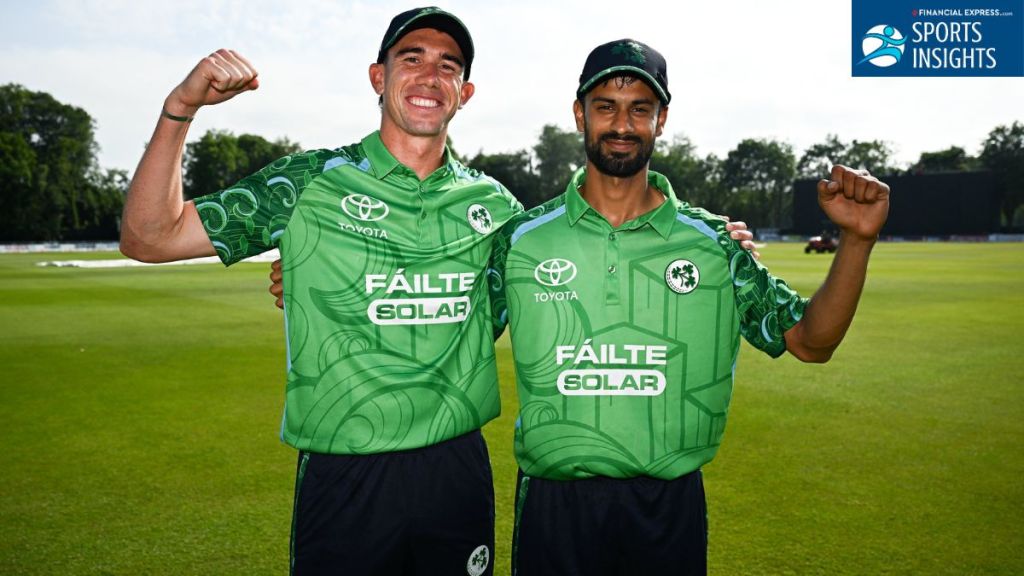

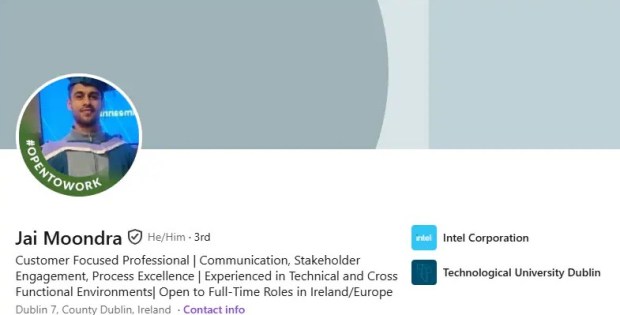
LinkedIn is a strange place for a hero to announce himself.
On the morning of June 29, 2026, cricket fans scrolling through the professional network found something that did not compute. The man who had just been named Player of the Series against India, the reigning T20 World Champions, was still wearing an “#OpenToWork” badge.
Jai Moondra, the 29-year-old left-arm pacer who had dismissed Sanju Samson with his very first international delivery, was actively seeking software engineering roles in Dublin and across Europe.
This was not a joke. This was the economy of associate-tier cricket.
While Indian broadcasters replayed his wickets in slow motion and his family danced in the dusty lanes of Tonk, Rajasthan, Moondra was updating his resume.
The same hands that had just claimed three wickets in a one-run victory were typing cover letters. The same shoulder that had generated 139 kmph of pace was now generating job applications.
The split screen tells you everything about modern cricket that the IPL does not.
The Tonk boy who bowled with a tennis ball
You want to understand Jai Moondra? Do not look at Stormont. Look at Tonk.
Small town. Rajasthan. Hot. Dusty. The kind of place where boys play cricket in gullies with taped tennis balls because leather balls are expensive and grounds are scarce. Moondra grew up on the same local grounds that produced Indian pacer Khaleel Ahmed. He trained under Imtiaz Ali, then moved to SS Cricket Club under Mohan Sir.
Here is the thing nobody tells you. At sixteen, Moondra was not a fast bowler. He was a batsman. A left-arm orthodox spinner. A kid who stood at the top of the mark and rolled his arm over. No pace. No threat. Just another club player in a country that produces millions of them.
Then he went to Chennai.
SRM Institute of Science and Technology. Electronics and Communications Engineering. The academic pressure was real. Professional club cricket was impossible. So Moondra did what engineering students do. He played tennis-ball cricket with his hostel mates.
A tennis ball is light. Bouncy. To make it move, to make it sting, you need violent shoulder rotation. You need to snap your arm like a whip. You need to generate pace that the ball itself cannot provide. Moondra developed this snap out of necessity. Out of boredom. Out of the simple human need to compete even when the stakes are zero.
When he finally picked up a leather ball again, something had changed. The shoulder snap was still there. The ball moved faster than it should. A left-arm spinner had accidentally built the mechanics of a left-arm pacer.
He never bowled spin again.
The intel job and the mathematics of risk
In 2021, Moondra landed in Dublin on a student visa. MSc in Electronics and Communications at Technological University Dublin. He was twenty-four. The plan was clear. Study. Work. Build a life in Europe. Cricket was a hobby. A memory. Something he did in Tonk before real life began.
After graduation, Intel hired him. Product development engineer. The kind of role that Indian parents dream about for their children. Health insurance. Pension. Corporate stock units. Visa stability. The middle-class contract with the universe, signed and sealed.
In June 2025, Moondra tore it up.
He resigned from Intel to play cricket full-time. Let that sink in. A man on a work visa, whose legal right to remain in Ireland was tied to his employer, walked away from that employer.
He joined Leinster Cricket Club. He started driving 170 kilometers from Dublin to Belfast for high-performance nets. He would train, then drive back late at night, then wake up and do it again.
The math was brutal. A non-contracted Irish T20I player earns $450 per match. No monthly salary. No health insurance from cricket. No pension. Just match fees and the hope of selection. Moondra was spending more on petrol than he was earning from cricket.
But he kept driving.
The night everything changed
June 26, 2026. Stormont, Belfast. Ireland versus India.
Ireland was missing five frontline players. Josh Little was injured. Mark Adair was injured. The bowling attack was a patchwork.
National selector Andrew White, a former Ireland captain himself, had to look deep into the domestic system. He found Moondra. He found Matt Hollard. He handed them both debuts.
Moondra’s first ball in international cricket was 139 kmph. Sanju Samson, one of India’s most destructive batsmen, was beaten on the inside edge. The ball crashed into off-stump. First ball. First wicket. Against the country of his birth.
His second wicket was a caught-and-bowled. Shivam Dube, a man who hits sixes for fun, pushes at it early.
Ireland won by 34 runs.
Two days later, the second T20I. Moondra had already taken three wickets. Samson again on the very first ball. Abhishek Sharma in the same over. Shreyas Iyer in the next over. Ireland won by one run. A 2-0 clean sweep against the T20 World Champions.
Moondra’s match fees for both games: $900 as per reports. His Player of the Series bonus: $1,500. Total earnings: $2,400. That is probably less than what he earned in three weeks at Intel.
The money that was never there
Cricket is not one sport. It is two.
On one side is India. The BCCI generates roughly $2 billion annually. Its ICC revenue share is $231 million per year. An Indian T20I player earns ₹3 lakh per match, approximately $3,762. An Indian ODI player earns ₹6 lakh, about $7,524. The board has no debt. Its cash reserves exceed $2.5 billion. It is a commercial empire that happens to play cricket.
On the other side is Ireland. Cricket Ireland’s annual budget is €17.45 million, roughly $18.8 million. Its ICC share is $14.5 million to $17.5 million annually. It carries $3.75 million in debt to the ICC itself. It has 25 central contracts, only 20 of them full-time. An Irish T20I player earns $450 per match. An Irish ODI player earns $1,100.
The BCCI’s annual revenue is more than one hundred times Cricket Ireland’s. This is not a gap. This is a chasm. And players like Moondra fall into it every day. The ICC’s revenue distribution model gives Full Members like India 38.5% of global earnings. The 96 Associate Members split 11% among themselves. That is $67.5 million divided by 96 nations. Some get crumbs. Others get nothing. Ireland, promoted to Full Member in 2017, gets more than most. But not enough to pay its players properly.
Cricket Ireland’s ICC allocation is $70 million over four years. But 40% of that is withheld until 2027. Active distributions are capped at $58 million. The board is building infrastructure, funding grassroots, trying to compete. It cannot afford to give every T20I debutant a salary.
So Moondra got $450 per game. And a LinkedIn profile that still said he was looking for work.
The small budget movie that beat the blockbuster
There is a Gujarati film called Laalo. Made on a tiny budget. No stars. No studio backing. No marketing blitz. It released quietly in 2025 and won the National Film Award for Best Feature Film. It beat movies that cost fifty times more. It beat movies with A-list actors and international premieres and promotional tours across twelve cities.
How? Because sometimes the story is enough. Because sometimes a small budget forces creativity. Because when you cannot buy spectacle, you have to build substance. Jai Moondra is the Laalo of cricket.
India’s cricket machine is a blockbuster franchise. IPL contracts worth crores. Central contracts worth lakhs per match. Sports scientists. Nutritionists. Psychologists. Entire departments dedicated to making players better. Ireland is the indie film. No budget. No stars. No safety net. Just a camera, a script, and the desperate hope that talent will find a way.
Moondra had no sports scientist. He had himself, his car, and a 170-kilometer drive. He had no nutritionist. He had whatever he could cook in his Dublin apartment between training sessions. He had no guaranteed contract. He had a LinkedIn badge and a dream that most people would call foolish. And yet he produced the performance of the series.
This is what small budgets do. They force resourcefulness. They force adaptation. They force you to find edges that big budgets miss. Moondra’s tennis-ball shoulder snap was not developed in a high-performance centre.
It was developed in a Chennai hostel because he had no other option. His death-over composure was not taught by a sports psychologist. It was built by the knowledge that every match could be his last, that every wicket was an audition for survival.
The blockbuster has insurance. The indie film has urgency. And urgency, sometimes, is the better coach.
The family watching from Tonk
Back in Rajasthan, the Moondra family gathered around a television that probably cost less than one IPL ticket. His mother, Vidya, watched her son dismiss Indian batsmen and felt something she could not name. Pride and sadness in the same breath. Her son was beating her country. Her son was honouring her family. Both things were true.
His younger sister, Mansi, had watched him balance engineering textbooks with cricket kit bags. His uncle, Kanhaiya Lal Moondra, had seen him leave for Ireland with a suitcase full of ambition and no guarantee of anything.
They knew the sacrifice. They knew the risk. They knew that while the world saw a hero, they were watching a boy from Tonk who had bet everything on a game that does not pay its soldiers equally.
When the final wicket fell and Ireland won by one run, the family danced in the street. Neighbours joined. Strangers joined. For one night, Tonk was the center of the cricket universe. Not Mumbai. Not London. Tonk.
The badge that is still there
Here is the ending nobody wants.
Moondra is still looking for work. His Player of the Series performance has put him on franchise scout radars. Maybe the Big Bash will call. Maybe the Hundred. Maybe Cricket Ireland will finally offer him a full-time central contract when the next cycle begins. Maybe.
But until then, he is a software engineer who bowls at 139 kmph. A citizen of Ireland who learned his craft in Chennai hostels. A man who gave up thousands of euros a year to earn $450 in match fees because he believed, against all evidence, that he could stand at the top of an international mark and make the world watch.
The LinkedIn badge is still there. #OpenToWork. It should say #OpenToDream.