



The International Tennis Hall of Fame in Newport, Rhode Island opened in 1954. For the next seventy years it inducted champions from the United States, Australia, Britain, France, Sweden, more or less every country that had ever taken tennis seriously.
Not one Asian man made it in. Whole careers rose and fell in that gap. A boy who was a toddler the year the Hall opened could, by the time it finally admitted an Asian man, have grandchildren of his own watching the ceremony on a phone.
On July 20, 2024, it happened.
Nobody in that room that afternoon was really thinking about a hospital ward in Madras in the 1950s. But that is where this actually starts.
A city that doesn’t do spectacle
Vijay Amritraj was born there in December 1953, to a mother, Maggie Amritraj, who was told by doctors to keep her chronically asthmatic son away from anything strenuous. She ignored that advice almost entirely. She handed him a racket instead.
It wasn’t meant to be sport, at first. It was breathing exercise dressed up as an afternoon outside. Two of his brothers, Anand and Ashok, got the same prescription. Nobody set out to build a tennis dynasty in that house — it just happened, three brothers deep, because one mother refused to accept what a doctor had written on a chart.
Anand was the golden junior early on. Vijay, meanwhile, kept growing, eventually reaching six foot four, a frame nobody in that hospital ward would have predicted for a child who struggled to make it down a corridor without stopping.
That height, and the serve-and-volley game that came with it, turned out to be exactly what fast grass courts rewarded. The lungs everyone had given up on carried him through five-set matches against the fittest men alive.
Here’s the part that tends to get skipped: the thing that was supposed to end his athletic life before it began is the same thing that built it. There was no academy behind this, no talent pathway. Just a court in Madras and a mother who wasn’t having it.
What the market thought he was worth
When Amritraj turned professional in 1970, international tennis still ran on a short list of trusted nationalities. Players from outside that circle were treated as curiosities — dangerous on a good day, not built to last a full tour. He spent the next 23 years quietly proving that wrong, finishing with 405 career singles wins, 15 ATP titles, and a career-high ranking of world No. 18.
But the number worth pausing on isn’t any of those. It’s five wins in eleven meetings against Jimmy Connors, who for much of that stretch was the best player on earth. Connors beat almost everybody. Amritraj beat Connors nearly as often as Connors beat him — a final in Bretton Woods in 1973, another in Newport in 1984, in the very town that would one day put him in its Hall of Fame.
He also got past Rod Laver at the 1973 US Open, pushed Björn Borg to five sets at Wimbledon in 1979 after leading two sets to one, and beat John McEnroe in Cincinnati in 1984 — a full decade after the Laver win. Three different eras of men’s tennis, and he kept turning up as the player nobody had priced in correctly.
His entire career prize money, across those 23 years, added up to $1,331,913 reportedly. Sit with that for a second next to another figure: Octopussy, the Bond film he starred in a decade into his career, made $187.5 million at the box office on a $27.5 million budget.
One supporting role in one film earned more than a hundred times what he made in an entire professional tennis career. That’s not a footnote. That’s basically the whole second half of his story.
The trophy he turned down
In 1974, a 20-year-old Amritraj and his 22-year-old brother Anand led India to its second Davis Cup final. It wasn’t a smooth road. India beat a defending-champion Australian team in Calcutta, in a tie that included a doubles rubber that ran 17-15, 6-8, 6-3, 16-18, 6-4 — one of the longest in the competition’s history — then got past the Soviet Union in the semifinal.
Waiting in the final was apartheid-era South Africa. South African officials, trying to keep the tie alive, offered the Indian delegation “Honorary White” status for the trip. Indira Gandhi’s government said no, and told the team to forfeit rather than dignify the arrangement by showing up at all.
Anand has said, more or less, that the team gave up its best real shot at a Davis Cup title that day, and honestly, he’s probably right. South Africa took the Cup by default — the only Davis Cup final ever decided that way.
Vijay tends to talk less about the trophy and more about what came after. Mexico refused to play South Africa the following year. Colombia did the same in 1976. A 20-year-old’s disappointment on a tennis court turned into one small piece of the pressure that eventually got apartheid-era South Africa frozen out of world sport altogether.
He never won that Davis Cup.
He helped end something bigger instead.
Cubby Broccoli, watching from the Royal Box
Every Wimbledon, Albert “Cubby” Broccoli, the man behind the James Bond franchise, sat in the Royal Box. Something about Amritraj on court caught his eye; the calm, the way he handled a crowd and Broccoli decided he wanted him for the thirteenth Bond film.
One problem: Amritraj wasn’t a member of the Screen Actors Guild. So Broccoli got him a guest spot on the American series Fantasy Island purely to fix the union paperwork, and kept British-Indian actor Albert Moses on standby in case it didn’t come through in time.
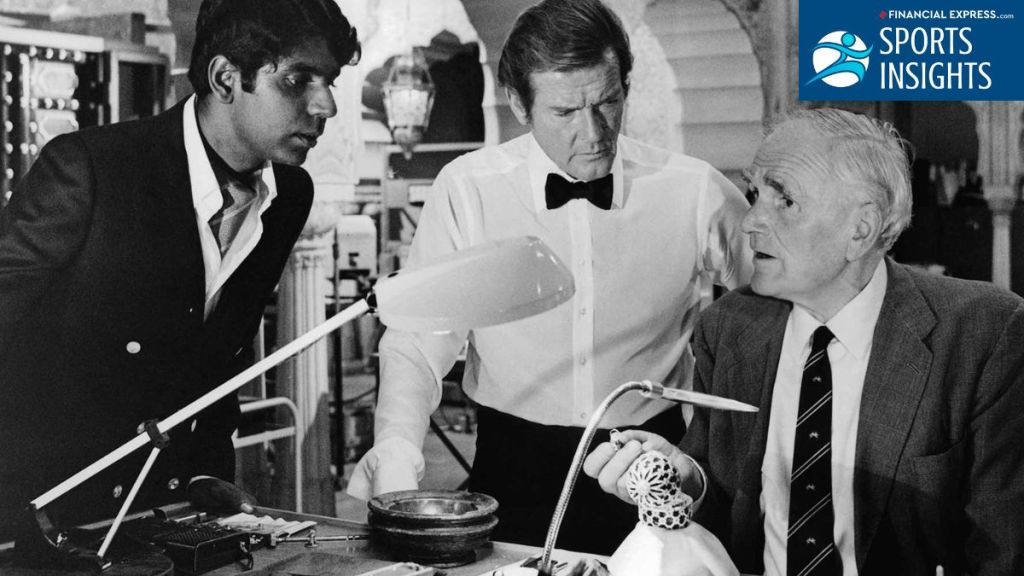
It came through. Amritraj played Vijay, Bond’s operative in India, in Octopussy. Roger Moore later recalled the production asking Udaipur for 5,000 extras for the bazaar chase and getting more than 10,000 instead, which left stunt coordinator Rémy Julienne routing vehicle stunts through a crowd nobody had planned for.
In one scene, Amritraj’s character fights off armed men with a Dunlop tennis racket while vaulting over a camel. It might be the only fight scene in Bond history built around a man’s actual day job.
He kept going after that — Star Trek IV, guest spots on American network television, and eventually his own interview show, Dimensions with Vijay Amritraj, on CNN-IBN, where he sat across from heads of state and studio bosses in the same season.
The deal nobody else’s has outlasted
Sometime in the late 1970s, Rolex signed Amritraj as a testimony alongside Björn Borg and Chris Evert. Most tennis endorsement deals last a few good years, tied to ranking. This one is still going, more than forty years later, one of the longest continuous individual sponsorships in sport.
When Rolex needed a face for its push into India and South Asia, it didn’t have to look. It already had one, and the arrangement more or less became the blueprint other Indian brand ambassadors, Priyanka Chopra Jonas among them, later followed.
He turned that same in-between status into consulting work. Western media companies expanding into India in the 1990s : IMG, Turner Broadcasting, ABC, ESPN — brought him in to help them understand a market they didn’t. It was, in a sense, the same skill that got him cast in a Bond film: being legible to two audiences that otherwise didn’t speak the same language.
What Newport was really applauding
When the Hall of Fame inducted Amritraj in the Contributor category in 2024, alongside fellow Indian player Leander Paes in the Player category, the two became the first Asian men ever admitted, and India became the institution’s 28th represented nation.
Seventy years of absence closed in one afternoon, in the same town where Amritraj had once beaten Jimmy Connors in a final of a different kind.
By then he had already spent over two decades as a United Nations Messenger of Peace, appointed by Kofi Annan in 2001 to work on HIV and AIDS awareness across South Asia and Africa.
He had started the Vijay Amritraj Foundation in 2006, which funds pediatric oncology and HIV care in India. He’d received the Padma Shri in 1983 and would go on to receive the Padma Bhushan in 2026.
None of that needed him to still be able to hit a serve.
He is six foot four. It’s a height his lungs, back in that hospital ward in Madras, were never supposed to fill.