


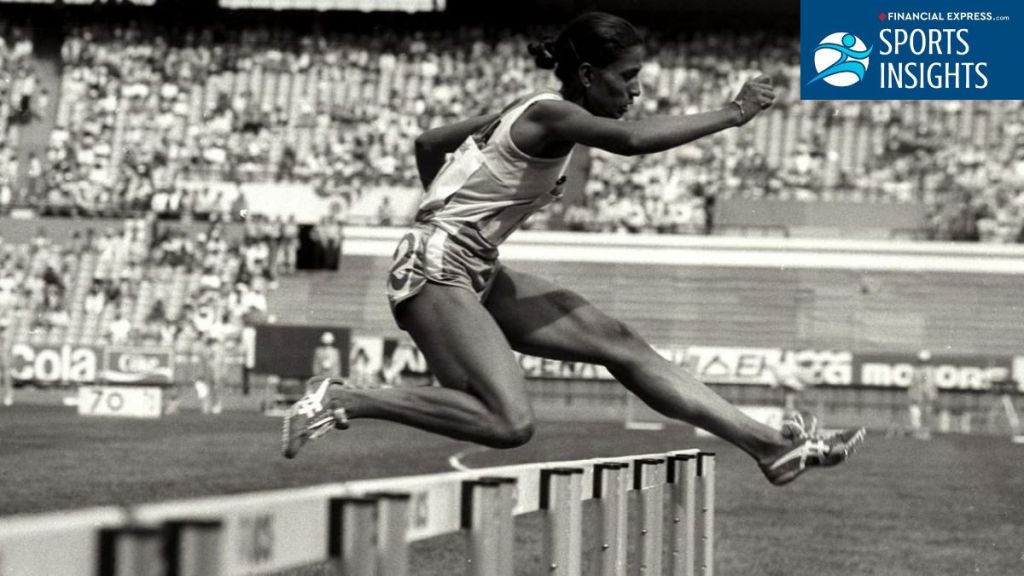

On the sand of Payyoli beach, a young girl runs against the tide, and her coach waits with an orange.
The coach is O.M. Nambiar, a former Indian Air Force physical instructor. The orange comes from his own hostel ration. He saves it for her, and he hands it over only after a hard session. There is no synthetic track here, no gym and no video analysis. There is just wet sand that pulls at her ankles with every step.
That was how India built a champion in the 1970s.
The girl was Pilavullakandi Thekkeparambil Usha, born on June 27, 1964 in Koothali near Perambra, Kozhikode district. Everyone knows her as P.T. Usha. In Class 4 she beat her school’s best runner, a student 3 years older, and the regional sports people noticed.
She was sent to the new sports division in Kannur, where she met Nambiar. He later became India’s first Dronacharya Award recipient.
Nambiar knew the money was not there, so he used what the coast offered. Running on soft dunes built up her ankles and her leg drive. It also gave her the name “The Payyoli Express”. He also stood between her and the doubts of a conservative society that was not sure girls should run at all.
The medal that slipped away
At 16, Usha ran at the 1980 Moscow Olympics, India’s youngest Olympic track sprinter. Two years later, at the 1982 Asian Games in New Delhi, she won silver in both the 100m and 200m. Doordarshan was starting colour broadcasts across the country at the same time, so millions of homes saw her run for the first time.
Then came Los Angeles in 1984.
She won her heat and her semi-final in the 400m hurdles, the 1st time an Indian woman had reached an Olympic track final. On August 8, she stood in Lane 5.
Reportedly, a false start forced everyone
back to the blocks, and by several accounts it broke her focus. Her second start was cautious. She still ran a smart race, cleared her hurdles cleanly and held her rhythm for 365 metres.
In the last 35 metres, her stride slowed a little.
Romania’s Cristieana Cojocaru crossed at almost the same moment. The camera decided it. Cojocaru took bronze in 55.41 seconds and Usha finished in 55.42. The gap was 0.01 seconds. Morocco’s Nawal El Moutawakel won gold in 54.61.
Ask what went wrong and the stopwatch is only part of the answer. There were no dedicated chefs, no sports dietitians and no familiar food. The Games Village served half-boiled chicken and baked potatoes, which Usha could not digest. As per the New Indian Express report, she lived mostly on plain rice porridge with kadu manga achar, a spiced green mango pickle her mother had packed. There was fruit now and then.
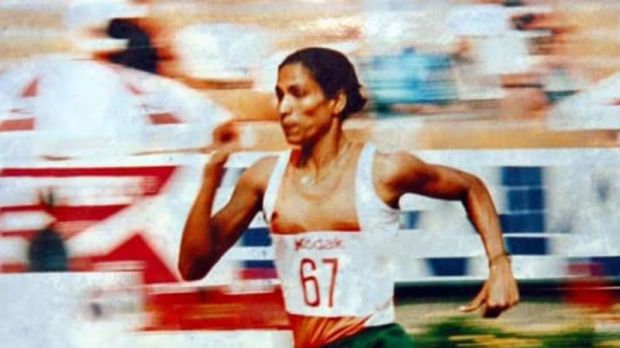
Consider what that means for a 400m hurdler. Too little protein means too little stored glycogen, the fuel muscles burn when a race gets hard. The tiredness showed up in the last 35 metres. Meanwhile Western rivals wore light spikes made for synthetic tracks. Usha had no custom shoes, no biomechanics team and no medical staff of her own.
So a country’s lack of preparation was measured in 0.01 seconds. The 55.42 became a national record that stood for nearly 4 decades, until Vithya Ramraj equalled and broke it at the Hangzhou Asian Games.
Seoul, and 70,000 voices
Two years later, Usha went to the 1986 Asian Games in Seoul and ran like someone with a debt to collect. In 6 days she entered 5 events and came home with 4 golds and a silver. Every gold was a Games record.
She won the 200m in 23.44, the 400m in 52.16, the 400m hurdles in 56.06 and the 4 x 400m relay in 3:34.58. The silver came in the 100m, in 11.67, behind Lydia de Vega of the Philippines.
Look at the schedule. On 1 afternoon she raced 3 times inside 110 minutes. Between heats and finals she took a quick shower, changed her kit and walked back out. No ice baths, no recovery team. India won only 5 golds in all sports at those Games, and Usha alone won 4 of them.
The crowd of 70,000 in the Seoul stadium kept chanting “Usha! Usha! Usha!” Back home, families across Kerala and southern India began naming their newborn daughters after her. Think about that for a moment. A running track had changed what parents wrote on birth certificates.
Who paid for all this speed?
Here is the part that surprises people. Before 1986, brands in India paid cricketers, and mostly only cricketers. Sunil Gavaskar and Kapil Dev had the endorsements. Everyone else lived on government patronage, small tournament allowances and jobs with Indian Railways, state electricity boards or the armed forces.
Track and field looked risky to marketing teams. Olympic sport came around every 4 years, and cricket was on the screen all year. Newspapers, magazines and Doordarshan‘s single channel were the only places to advertise. No sports management agencies existed, so athletes negotiated on their own, if they negotiated at all.
Seoul made brands look again. Boost, the malted drink then sold by HMM Ltd and later part of GlaxoSmithKline, had used only male cricketers. It made Usha its first female non-cricket ambassador and put her in print and television ads next to Kapil Dev. A woman sprinter selling stamina to the whole country was new.
Kerala public sector products, handloom boards and dairy cooperatives used her face too. So did government campaigns on national integration and youth fitness.
Still, nobody was handing her a fat cheque. In that era, athletes got gifts.
The car that drank too much
After Seoul, the Kerala government gave Usha a Standard 2000, and in 1986 that was a very big present. The car was made by Standard Motor Products of India in Chennai and based on Britain’s Rover SD1. It was the most expensive luxury car built in India then, with power steering, power windows and central locking. Its 2.0-litre engine made 75 hp.
The price tag was ₹2,25,000. A Hindustan Contessa cost ₹84,000 and a Maruti 800 cost ₹47,500. So her prize was worth about 4.7 Maruti 800s.
A state driver named Mani drove her and her parents from Thiruvananthapuram to Payyoli, and people stood along the National Highway to look at both the athlete and the car. Usha learned to drive in it and passed her test on the 1st attempt.
The car had trouble, though. It was advertised at 12 km per litre but gave less than 5 km/L on Kerala roads. Fan belts snapped along the coast. To cut fuel bills, she had the petrol engine swapped for a diesel one. In 1994 she sold the car to a buyer in Kozhikode and bought a Maruti 800 for daily use.
It was a lovely gift that a champion could barely afford to run. Even so, it showed something new. Winning in a non-cricket sport could bring a reward of real size in India.
Two badminton players and a very different bank balance
Compare her with the stars who came after. In 2012, Saina Nehwal signed a ₹40 crore management deal with Rhiti Sports. Usha had negotiated alone or through her coach. Saina had an agency.
After her silver medal at the 2016 Rio Olympics, P.V. Sindhu signed a multi-year deal with Chinese equipment maker Li-Ning worth about ₹50 crore, and added Bank of Baroda and Vizag Steel to her list. Baseline Ventures handles her portfolio. Her ads run on cable, billboards and social media. Usha’s ran in newspapers and on terrestrial television.
The gap is not only in money. Usha’s income depended on her job as an officer in Southern Railways. Sindhu works with physiotherapists, foreign coaches, strength trainers and sports scientists. Usha had none of that, which many believe cut her peak years short. Sindhu’s team is built to keep her competing, and earning, for longer.
Building the school she never had
Usha did not forget what she lacked. In 2002 she opened the Usha School of Athletics in Kinaloor, Kozhikode district. It is a residential academy that gives rural girls proper training, planned meals and coaching. Nobody there has to eat plain porridge before a big race.
One of its graduates, Tintu Luka, broke the national record in the women’s 800m with 1:59.17. She won silver at the 2014 Asian Games in Incheon and gold at the 2015 Asian Athletics Championships in Wuhan.
Usha then moved into public life. In July 2022 she was nominated to the Rajya Sabha and later joined the panel of Vice-Chairpersons, the first nominated member to chair the House. In December 2022 she was elected unopposed as President of the Indian Olympic Association. She was the first woman and the first elite track Olympian in that chair.
Back to the beach
Think again of that girl on the sand, and that orange from a coach’s own ration.
The business of Indian sport today, with its agencies, sponsors, crore-rupee deals and physios, sits on top of people like her. She ran on porridge, lost a medal by 0.01 seconds and took home a car she could hardly afford to drive. Yet the country learned from it that women who run fast can also sell, inspire and lead.
Somewhere in Kinaloor today, a girl is finishing a hard session on a proper track. There is a meal waiting for her, planned by someone whose job is to plan it.
The orange has become a whole kitchen.