



It was July 2013, and Bengaluru FC had scheduled its first open practice session. The club was new. The coach was English. The players were mostly unknown. The marketing team had sent invitations, posted on social media, and hoped for a crowd.
Twelve people came.
There were more than twenty players on the pitch. More athletes than spectators. The ratio was humiliating. Most clubs would have shortened the session, packed the equipment, and sent everyone home.
Ashley Westwood, the head coach, did not. He told his players to run every drill at full intensity. Every sprint. Every passing sequence. Every tactical shape. When the training ended, the players walked over to those twelve people. They signed autographs. They shook hands. They stood in the heat and talked for as long as anyone wanted.
That was the beginning. Not of a team. Of a culture.
The steel heir and the dirt pitch
Parth Jindal was twenty-six years old when he tore his knee on a football ground in rural West Bengal. It was 2016. JSW had just shrunk a planned steel plant to a cement facility, and local farmers who had surrendered ancestral land were protesting in the streets. Jindal flew in from Mumbai to manage the crisis. His security detail told him to stay in the car.
He saw workers and villagers kicking a ball around instead. He insisted on joining.
The match was rough. Hard tackles on uneven dirt. A sliding challenge caught him below the knee. He went down. His guards rushed the pitch. He waved them off, limped back to his position, and finished the game.
That injury did something to him. He was limping on the same ground where men who earned a fraction of his salary played every evening with nothing. No boots. No medical kit. No one rushing to their side when they went down.
He looked at the bare feet and the torn jerseys and saw something the boardroom had never shown him. JSW had always talked about community. Now he understood what it actually meant to be part of one. The board mandated permanent shelters, schools, and medical facilities at every corporate site.
But it also showed Jindal something that no business school could teach. Football was not a luxury for the rich. It was a bridge between power and people. Between a $23 billion steel conglomerate and a community that had every reason to hate it.
Jindal had grown up watching his father, Sajjan Jindal, play evening tennis and squash at the club. Sajjan made one thing public and uncompromising. The next generation of wealth must be earned, not inherited.
Parth studied at Sevenoaks, Brown University, and Harvard Business School. He returned with an idea that sounded, to the JSW board, like a very expensive hobby.
In 2012, he partnered with Mahesh Bhupathi to start the Sports Excellence Programme, supporting individual athletes. But team sport was different. Team sport needed a city. It needed fans who came back even when the team lost. It needed a relationship that no billboard could buy.
The push, when it came, was pure instinct. Jindal had been an Arsenal fan since childhood, and somewhere along the way he realised that the best way to make an impact on Indian football was through a club, not a handful of sponsored athletes.
Around the same time, the AIFF was opening bids for a direct-entry spot in the I-League. Only two of three bidders would get in. Jindal decided he wanted to be one of them.
Bengaluru FC was born in July 2013. It was designed as a professional football club modelled on European operational systems. The word professional was not decorative. It was the entire point.
The empty market
Indian football in 2013 was not an industry. It was an arrangement.
The I-League was populated by institutional teams and political vanity projects. Clubs were run by government departments or local politicians who treated football as visibility rather than business. Training facilities were borrowed school grounds. Nutrition was theoretical. Medical support was a first-aid box. Fans were a budget line that nobody expected to spend.
All eleven other clubs had already signed the best domestic talent. The market was picked clean. The only prominent Indian player still available was Sunil Chhetri. Bengaluru FC got him. But one player, however famous, could not fix the deeper crisis. Indian football had names. It did not have systems.
The club coach Ashley Westwood understood the difference.
He had played under Sir Alex Ferguson at Manchester United. He knew that talent without structure was just potential waiting to expire. And he knew that you could not simply import British football culture into India. You had to build it from whatever materials were available.
He moved the entire squad into an apartment complex in a modest industrial pocket of Bellary. The media staff called the neighbourhood “the armpit of Bengaluru.” Westwood did not care about the view. He cared about proximity. He wanted the players living together, eating together, recovering together. No nightlife. No distractions. No excuses.
The kitchen rules
Kunaal Majgaonkar, who previously served as Head of Content and Social Media at JSW Sports, told The New Indian Express that Westwood took control of what the players ate.
The diet was not a suggestion. It was a mandate. Brown bread. Broccoli. Chicken breast. Brown rice. Every day. Every player. And Westwood applied the same diet to the corporate office staff. The accountants and marketing managers ate exactly what the players ate.
This was one organisation with one standard. The player and the accountant shared the same lunch. That is how you kill hierarchy.
The accountability came not from the coach with a whistle. It came from the teammates sitting next to them in the dressing room. That is how you know a culture has taken root. When the players begin to police themselves because they have something to protect.
And he did something no other I-League club was doing with any consistency. Every player had to attend open practice sessions for fans. Not as a favour. As a duty. The connection to the city was not optional. It was the job.
The phone call to Ferguson
The defining moment came before the first official match against Mohun Bagan.
Chhetri returned from national team duty carrying extra weight. His conditioning was below standard. Westwood had a choice. Start his marquee signing, the one name that might convince sceptics this new club was serious. Or stick to the principles he had spent weeks installing.
He called Sir Alex Ferguson.
Ferguson’s advice was direct. Drop the star. Explain it face to face. Make it clear that the system is bigger than any individual. Then let him earn his way back. Westwood benched Chhetri for the first two matches.
Chhetri did not complain to the press. He did not sulk in training. He worked. He ran extra sessions. He got his weight down. He got his fitness back. When he returned to the starting lineup, the entire squad had seen something no Indian football team had seen before.
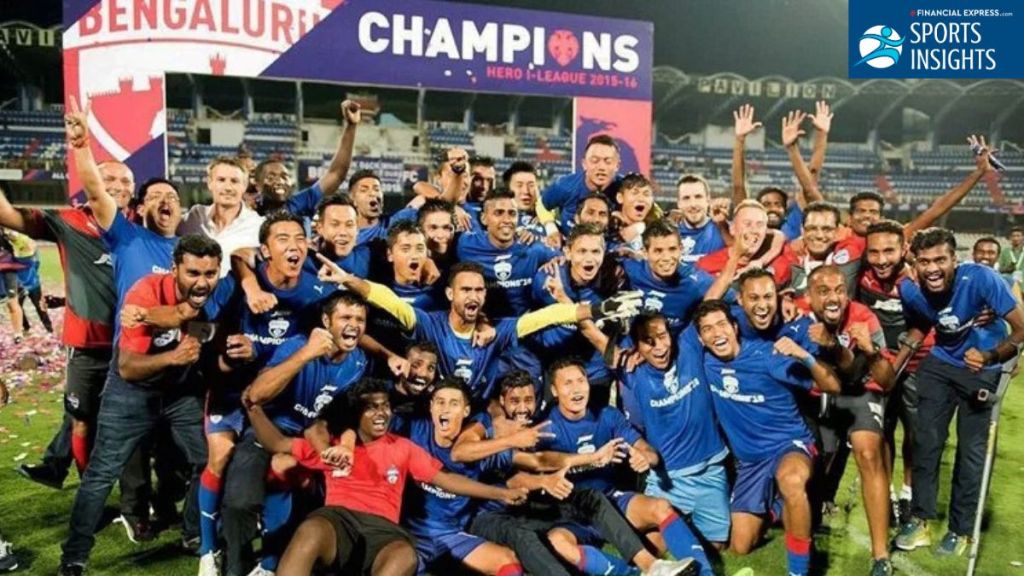
The biggest name in the country was not above the rules. The most famous player had to meet the same standard as the youngest player. Bengaluru FC won the I-League in its debut season.
Twelve fans and a stray dog
Those first twelve supporters did not stay twelve for long.
They told their friends. They posted on Facebook. They brought neighbours and cousins to the next open practice. By the end of the first season, over a thousand people were attending training sessions. The growth was not bought with television commercials or highway billboards. It was built one conversation at a time.
The club understood something about identity that money could not buy.
They found a stray dog living at the stadium. They named him Dimi. They gave him a social media presence. Photographs of him in the dressing room, on the team bus, sleeping in the dugout. A stray dog became the unofficial face of the club. It was not corporate. It was not polished. It was human. And it worked because it was true.
Fans do not trust polish. They trust truth.
The academy and the five thousand
In July 2016, three years after that first practice session, Bengaluru FC opened its residential academy in Vijayanagar, Bellary.
John Kila was appointed Head of Youth Development. He ran trials across five regions. Kerala. Mizoram. Punjab. Chandigarh. And beyond. Over five thousand young players were scouted, tested, and watched.
The academy offered something that did not exist in Indian football. A fully-funded corporate pipeline that bypassed the traditional state federations entirely.
This was where the business model became visible to the families who needed it most.
The families who paid first
At the grassroots level, parents paid Rs 40,000 per year for training fees. That money funded local coaching and basic equipment. At the intermediate level, families paid Rs 1,00,000 to Rs 1,20,000 for paying-guest accommodation near training centres.
Academic tuition at partner CBSE colleges cost another Rs 45,000 to Rs 60,000 annually. The families bore the cost while the talent was still unproven. They took the early risk. They sacrificed.
A father in Mizoram might skip a repair to his scooter to pay the training fee. A mother in Kerala might take an extra shift at a hospital to cover the hostel cost. They were not investors in a financial sense. But they were betting everything they had on a child’s ability to run faster than the other five thousand.
The Free Pass and the Federation Bypass
Once a player reached the elite academy level, everything changed.
Coaching became free. Nutrition became free. Housing became free. Education became free. One hundred percent funded by JSW Sports and corporate CSR partnerships. The corporation took over the financial burden precisely at the moment when the family burden had become unsustainable.
It was a risk-sharing arrangement dressed up as philanthropy. The family bet on the child until the child proved worth betting on. Then JSW doubled down.
The message to parents was clear. We will invest in your son, but only after your son has shown us something first. We are not a charity. We are a business. And we are looking for assets.
For decades, the state federations had controlled football. They ran selection trials. They allocated government funding. They decided who got coaching and who did not. The system was slow, political, and often openly corrupt. A talented boy in a remote district needed connections more than he needed ability.
BFC’s academy fed players directly into the first team and the national squad. No intermediary. No bureaucratic delay. No waiting for a state association to approve a trial or release a certificate.
A boy from Mizoram could be spotted by a BFC scout at age twelve, move to Bellary at fourteen, train under professional foreign coaches, and debut for the senior team without ever needing the permission of a local football official who might not even know his name.
Bengaluru FC is still building
The academy in Vijayanagar continues to scout. The first team continues to compete. The fans continue to fill the stands on match days. But the measure of what this club has done is not in trophies alone.
It is in the fact that Indian football now has a working template for professionalism that does not depend on government funding or federation goodwill. It is in the fact that a steel company proved that sport could be run with discipline and long-term thinking and respect for the people who actually play the game.
On that first open practice day in 2013, there was no way to know what those twelve people would start.
They were just twelve people standing on the edge of a training ground, watching a new club run drills in the afternoon heat. They had no precedent. No history to guide them. They stayed for two hours. They got autographs. They went home and told their friends that something different was happening in Bengaluru.
They were right.