


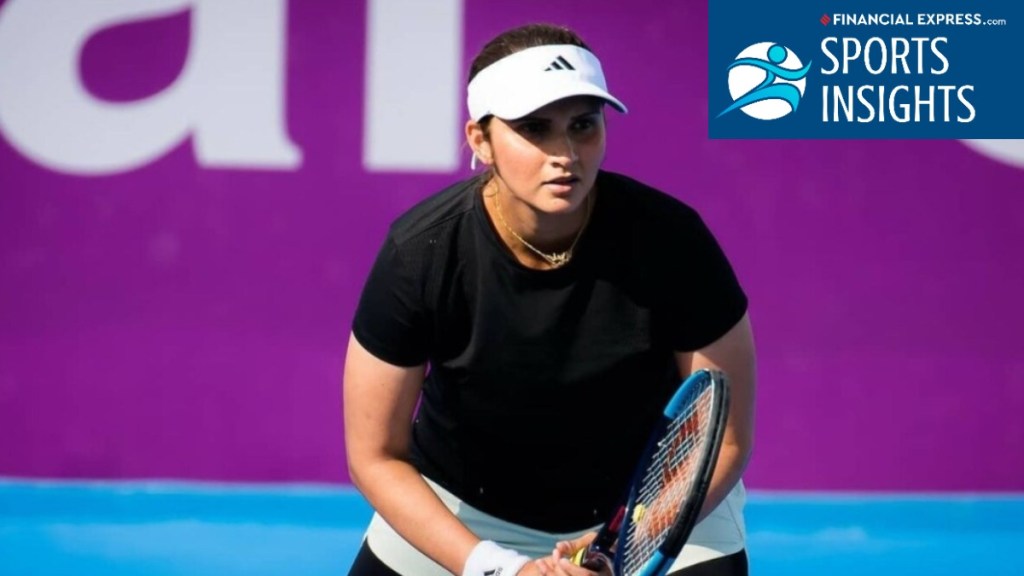

For years, the courts at Nizam Club in Hyderabad were not really courts at all. They were patches of packed cow dung, swept and rolled by hand, the closest thing a six-year-old girl could find to a tennis surface in a city that had not built proper ones for women.
There was no indoor academy, no sponsor, no talent scout watching. There was a father, Imran Mirza, a sports journalist with no coaching certificate and no spare money, who had made his daughter a promise that he would teach her the game, and who kept it on a surface meant for cattle, not children.
Relatives were not encouraging. In a conservative Hyderabad of the early 1990s, a young girl who wanted to spend her afternoons outdoors, in the sun, chasing a ball in front of men, was not the kind of daughter families bragged about at weddings.
She was warned, more than once, that playing outside would darken her skin and cost her a good marriage. She played anyway. At eight, she won an under-16 state tournament, years younger than her competition, and it was her school headmistress, not a coach or a federation official, who first told her parents that the girl had something worth building a life around.
What followed was not a clean rise. It was two decades of a body being pushed to its structural limits and repeatedly breaking down. Wrist injuries interrupted her singles career at the point it mattered most, forcing a pivot that most of Indian tennis read, at the time, as a quiet admission of defeat.
She was 18 when she walked out for her first Wimbledon in 2005, ranked among the top fifty in the world, wearing a plain T-shirt that read “Well-behaved women seldom make history.” It was not a marketing choice. Nobody at the All England Club asked her to wear it. It was closer to a diary entry that happened to be public.
In August 2026, more than two decades after that cow-dung court, she was named co-lead of two investment verticals, longevity and preventative health, and the athletic performance economy, at an alternative asset firm called Terra-Invest.
What nobody on those courts in the 1990s could have known was that the girl losing tennis balls in the dirt would one day sit across a boardroom table and decide, with somebody else’s capital, which Indian health and fitness companies deserved to exist.
The market misjudged her twice
Tennis made its first mistake early. At her career peak, Sania Mirza reached World No. 27 in singles, a genuinely fine ranking and the highest any Indian woman has managed, but not the kind of number that guarantees longevity.
The wrist injuries that followed seemed, to most observers, to confirm the obvious: she was gifted but combustible, and probably closer to finished than to her prime. She pivoted to doubles, a format many casual fans treat as tennis’s consolation prize.
She then spent 91 weeks as the world’s number one doubles player, a longer unbroken reign at the top of any ranking, singles or doubles, than any other Indian tennis player, man or woman, has ever held.
She won six Grand Slam titles in the process, three in women’s doubles alongside Martina Hingis, three in mixed doubles alongside Mahesh Bhupathi and Bruno Soares.
The exact weakness the market had priced her on, a body unsuited to singles’ physical demands, turned out to be the precise mechanism of her greatness. She simply built a second, longer career on the part of the game everyone else had undervalued.
Business made a version of the same mistake a second time. When she formally closed her Grand Slam career at the 2023 Australian Open, most of Indian sport assumed she would do what retired athletes are expected to do: sign a few ambassador deals, open a coaching clinic, ease into television commentary.
Instead she began buying in, one small equity stake at a time, until the stakes stopped being small.
What ₹216 crore actually looks like
Start with the headline number, because it is worth sitting with before breaking it apart. Sania Mirza’s net worth is estimated at $26 million, roughly ₹216 crore, with annual revenues of around ₹25 crore flowing in from endorsements, business interests and asset yields combined. Financial Express has not independently verified these numbers.
To put that first figure into some kind of human proportion, it is more than three times what she earned across an entire two-decade WTA career, during which her total tournament prize money came to $6,963,060, about ₹58 crore. In other words, tennis built the foundation. Everything since has been the second, larger building constructed on top of it.
The real estate tells its own geography. Her primary home is a villa in Hyderabad’s Film Nagar neighbourhood, valued at ₹13 crore, decorated in earthy beige and brown tones with custom woodwork and a trophy room where the Padma Shri and Padma Bhushan sit alongside her Grand Slam mementoes.
In Dubai, she owns a private-island waterfront bungalow with Mediterranean and Greek architectural touches, a property whose value runs into the multiple millions of dollars.
The choice of these two cities, one the city that raised her on dung courts, the other the Gulf hub where her tennis academy expanded, is not incidental. It is close to a map of her entire career.
Her garage adds another layer. Cars valued at more than ₹3 crore in total sit in it: a BMW 7-Series worth ₹1.70 crore, a Range Rover Evoque worth ₹72.09 lakh, a Jaguar XE worth ₹46.64 lakh, alongside additional Mercedes-Benz, Porsche and Audi models.
None of this reads as excess for its own sake. It reads more like the instinct of someone who spent twenty years being told her body was a depreciating asset, and decided, once the money arrived, to surround herself with things that hold their value.
The sponsors who paid for the racket before she owned the company
Long before Mirza became an investor, she was one of India’s most bankable endorsement faces, and that endorsement machine still runs underneath everything else.
Her corporate partnerships include long-standing associations with Nike and Adidas on the sportswear side, Hershey’s and Sprite in consumer packaged goods, Asian Paints and Lakmé outside the world of sport entirely, and Danube Properties, a real estate developer, in the Gulf.
Each of those deals represents a different kind of bet a company placed on her, not on her rankings alone but on the version of her that wore that Wimbledon T-shirt: outspoken, unwilling to be managed into blandness, still relevant to a consumer base that has watched her for over two decades.
It is worth noticing that almost none of these are the kind of glamour-only endorsements that fade the moment an athlete stops competing. A cosmetics brand and a paint company do not sponsor someone purely for match-day visibility. They are buying a household name that outlasted the sport she played it in.
Terra-Invest: from prize money to portfolio strategy
The August 2026 appointment at Terra-Invest is the clearest signal yet of where she wants the second half of her career to go.
This is not an ambassador role. She co-leads deal strategy and portfolio growth across two verticals, working with founding partners on deal origination, due diligence and value creation, the unglamorous mechanics of venture investing that never make it into a press release photo.
Her thesis, as described by the firm, rests on a simple but personally lived idea: Human performance and healthspan are converging into a single consumer market, and someone who has spent two decades managing her own body as a professional asset, through surgeries, rehabilitation and constant physical monitoring, is better placed than most to judge which diagnostics and recovery companies are real and which are marketing.
Under her leadership, Terra-Invest’s active portfolio includes four holdings, each a small human story in itself. Smashers Sports is building racket-sports infrastructure and commercial leagues, essentially institutionalising the exact gap Mirza herself fell into as a child in a city with no real courts.
Shookra is a consumer wellness and performance nutrition brand, the kind of company that exists because elite athletes have spent decades learning, expensively and privately, what ordinary consumers are only now being sold as a lifestyle category.
The 2100 Club is a private network built around physical optimisation and preventative health metrics, essentially formalising, for a paying membership, the kind of monitoring an athlete gets for free from a team physiotherapist.
Precision Diagnostics rounds out the portfolio with biomarker monitoring and personalised diagnostic infrastructure, the unglamorous plumbing behind the wellness trend everyone else sees only in advertising.
Boldfit: The equity stake with her own hands in it
In September 2025, Mirza joined the fast-growing Indian sports and fitness brand Boldfit, not as a paid face but as both brand athlete and equity investor, a distinction the company was careful to make.
This was never about the size of the cheque. It was about what the cheque bought her, a seat at the product table. That seat has a specific, unglamorous output.
Mirza has been directly involved in engineering tennis rackets and pickleball paddles designed for Indian body types, Indian climate and Indian playing surfaces, the kind of localisation that global sportswear brands, for all their marketing budgets, have rarely bothered to do.
It is the closest thing in her portfolio to a straight line back to her own childhood, when the equipment available to a young player in Hyderabad was whatever happened to be affordable, not whatever suited her.
Setu: The quiet first step into angel investing
Before Terra-Invest, before Boldfit, there was Setu, a preventative health and nutritional supplement startup, where Mirza made her formal entry into Indian angel investing in October 2023, joining an undisclosed Seed round alongside a cohort of other angel investors.
It rarely gets mentioned in coverage of her business career, overshadowed by the scale of what came later, but it marks the actual starting point, the moment she stopped simply lending her face to health and wellness brands and started putting her own money behind the thesis that would eventually define her work at Terra-Invest.
Ristretto: The coffee shop that came first of all
Her very first commercial venture predates all of this by more than a decade. In December 2012, while she was still an active professional player easing out of singles tennis, she partnered with Hyderabad businessman Seshu Reddy to open Ristretto Coffee Shop, a large-format coffee lounge conceived as a multi-city brand with planned expansions into Visakhapatnam, Mumbai and Delhi.
It is easy to read Ristretto now as a footnote, a hospitality experiment from an athlete still years away from her venture capital period. But it shows an instinct that predates the rest of her business career by a decade: an appetite for building physical, consumer-facing spaces rather than simply collecting appearance fees.
The academy that gives away what it charges
In March 2013, she built the infrastructure her own childhood never had. The Sania Mirza Tennis Academy sits on four acres in Chilkur, on Hyderabad’s outskirts: ten courts, four clay and six hard, fitted with professional LED lighting, an on-site high-performance gymnasium and video analysis equipment for frame-by-frame biomechanical review.
An international branch followed in Dubai. The academy charges up to ₹75,000 a month for its elite training modules, and it uses part of that revenue to fund a fully subsidised track for talented children whose families could never otherwise pay.
It has trained hundreds of nationally ranked juniors. In effect, the academy taxes Hyderabad’s wealthiest tennis parents to fund the training of children who remind her, whether anyone at SMTA says it out loud or not, of a six-year-old on a cow-dung court thirty years ago.
Hyderabad, and the family that built the whole thing twice
None of this happens without Hyderabad, a city that gave Indian tennis almost no structural support and gave Sania Mirza almost everything personally: her family, her first coach, her first tournament, and eventually her villa in Film Nagar.
Her mother, Naseema Mirza, managed logistics through the junior circuit years when there was no academy or agency to do it.
When Mirza returned to the WTA tour in 2020 after the birth of her son Izhaan, having shed more than 26 kilograms to get back to competitive fitness, and went on to win the Hobart International, it closed a loop that had started with her father’s promise on the dung courts three decades earlier: one generation builds the body, the next inherits the discipline, whether or not it ever picks up a racket itself.
The mentor’s job in a sport she never played
In February 2023, Royal Challengers Bengaluru brought her in as mentor for their inaugural Women’s Premier League cricket season, a franchise paying an individual-sport specialist to solve a team-sport problem.
What RCB wanted had little to do with technique. It had to do with what happens inside an athlete’s head in the ninety seconds before a match.
The entire country is watching, and with handling the specific, relentless scrutiny that comes from playing professional sport as a woman in India, something Mirza had absorbed since she was a teenager being warned about her skin and her marriage prospects.
Twenty years of walking out alone onto a Grand Slam court, with no teammate to share the blame or the credit, turned out to be strange but genuinely relevant preparation for coaching a cricket dressing room through pressure.
The advocacy that runs alongside the balance sheet
In November 2014, UN Women appointed her Regional Goodwill Ambassador for South Asia, making her the first South Asian woman to hold the position.
She used the platform to speak on female foeticide, India’s declining child sex ratio, pay equity in professional sport and the need for safer training environments for female athletes, and she served as the Indian government’s brand ambassador for its Save the Girl Child campaign.
During the COVID-19 pandemic, she led a relief effort that raised funds for free medical oxygen concentrators, hospital equipment and food supplies for vulnerable families across India.
None of this shows up in her net worth figure. It runs alongside it, on the same instinct that built the subsidised track at her own academy: use the surplus to fund the version of the story that almost didn’t happen.
A patch of dung, still there
The courts at Nizam Club still exist. Somewhere in Hyderabad, on subsidised time at her own academy, there is a child right now hitting a ball against a wall on a surface her family could never otherwise have afforded, funded quietly by a fee tier at the far end of the same campus that she will probably never meet the family paying it.
Nobody has told that child yet where the money for her free coaching actually comes from. She does not need to know. That was never really the point.
Editorial Note: This is an independent profile. Sania Mirza and their representatives were contacted but did not respond prior to the time of publication. In the absence of direct comment, this article was reported using publicly available records and regulatory filings, where applicable. This content was produced in accordance with FinancialExpress.com’s editorial guidelines.