


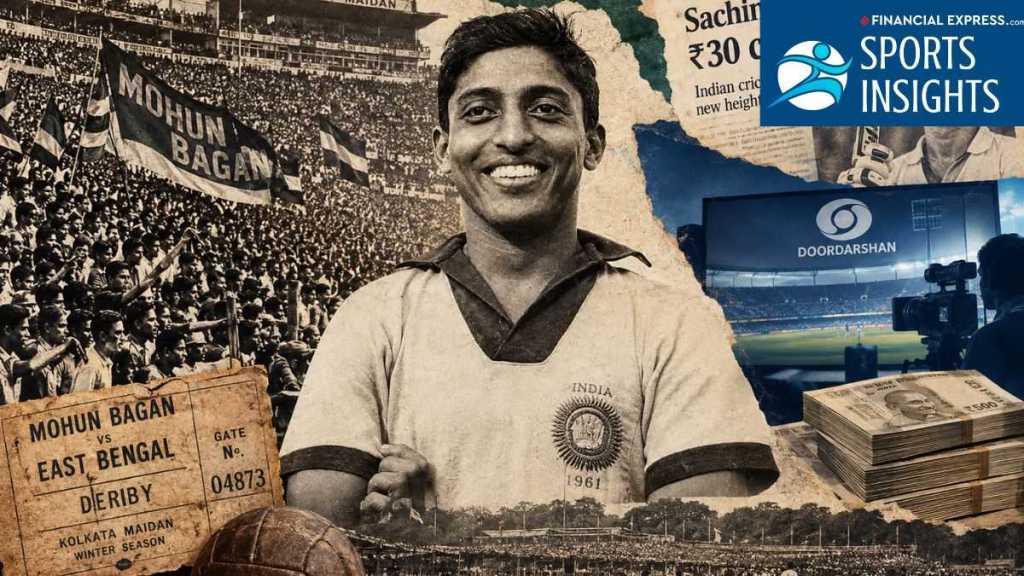

Before Sachin Tendulkar signed the ₹30 crore contract that changed Indian sports forever, there was a footballer who turned down Tottenham Hotspur and a Fiat car because he loved a Kolkata club more than money.
His name was Chuni Goswami. In the 1960s, he played in front of 100,000 screaming fans while cricketers played Ranji Trophy matches to empty chairs. This is the story of how Indian football out-earned cricket, and how it lost everything by missing one technological wave.
The 4 AM ticket queues
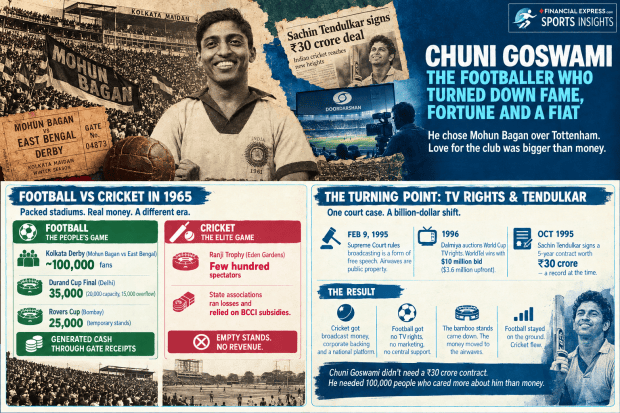
The bamboo stands went up every winter on the Kolkata Maidan. Temporary, rickety, and packed to the rafters with 100,000 people. The air smelled of bidis and roasted peanuts. The noise did not stop for 90 minutes.
On the other side of the city, at Eden Gardens, a Ranji Trophy match was happening. A few hundred men in white pants watched politely. The players earned nothing. The gate barely covered the tea costs.
This was Indian sports economics in 1965. Football was the giant. Cricket was the poor cousin.
The numbers tell the story. A Kolkata Derby between Mohun Bagan and East Bengal filled every seat. A Durand Cup final in Delhi stretched Ambedkar Stadium from its 20,000 capacity to 35,000 fans hanging off the fences. The Rovers Cup in Bombay built temporary wooden stands at Cooperage Ground that held 25,000 paying customers.
Cricket had the Ranji Trophy. Multi-day matches. Empty stands. State associations ran losses and begged the BCCI for subsidies.
Football had the Big Three. Mohun Bagan, East Bengal, Mohammedan Sporting. They did not need subsidies. They generated cash.
By the mid-1980s, Mohun Bagan operated on an annual budget of ₹25 lakhs. East Bengal ran on ₹22 lakhs. Mohammedan Sporting managed ₹16 lakhs. These were serious numbers for that time. Serious enough to fund player stipends, sign-on bonuses, and travel for visiting teams.
The engine was simple. Turnstiles. Pure, physical, turnstile money.
The Bank officer who was bigger than Tendulkar
Chuni Goswami did not get paid to play football. Not officially. The rules said players were amateurs. So the clubs found other ways.
Goswami joined the State Bank of India in 1960 as a probationary officer. His salary was higher than an IAS officer of the same age. He played for Mohun Bagan out of loyalty. No salary. No contract. Just love.
When he scored twice in the 1962 Asian Games semi-final against South Vietnam and was named Asia’s Best Striker, Tottenham Hotspur came calling. They wanted him for a trial. He said no. East Bengal offered him a Fiat car, a luxury beyond imagination in 1960s Kolkata. He said no.
He stayed because he was a one-club man. But also because the system worked for him. The bank gave him security. The club gave him glory. The fans gave him everything else.
His teammate PK Banerjee played for Eastern Railway and later Kolkata Port Trust. The PSU gave him a stable income, housing, healthcare. In exchange, he played football. This was the public sector feudalism model. It kept players fed. It kept clubs amateur. It worked until it didn’t.
Then there was Tulsidas Balaram. Born in poverty in Secunderabad. Played his early football in old police shoes modified by a local cobbler. National coach Syed Abdul Rahim gave him ₹1.25 per day to rent a bicycle so he could reach training. In 1957, East Bengal signed him for ₹3,500 per year, making him the highest-paid player in the country.
In 1963, he got pleurisy. A chest infection. Poor nutrition. No modern sports medicine. He retired at 27. He spent the rest of his life as a railway welfare officer in Uttarpara.
This was the deal. You gave your body to football. Football gave you a government job. No pensions. No royalties. No broadcast money. Just a job and a memory of 100,000 people chanting your name.
The hotels where players were hidden
The money was real. The business was dirty.
Because there was no formal transfer system, clubs poached players in the off-season. When Mohun Bagan or East Bengal wanted a player from another state, they did not send a contract. They sent a car.
Players were whisked away to remote hotels in Darjeeling, Puri, or around Chilika Lake. They were kept under guard. Fed well. Paid cash bonuses under the table. Hidden until the official transfer window opened.
In 1986, Nigerian striker Chima Okerie was locked inside the Mohammedan Sporting club mess for nearly 40 days. The club wanted to prevent Mohun Bagan and East Bengal from bidding for him. He ate club food. Slept on club beds. Waited.
This was the transfer market. No agents. No lawyers. Just cash, loyalty, and kidnapping.
The fans did not care. They packed the stands anyway. The DCM Trophy in Delhi invited teams from Ethiopia, Iran, and the Soviet Union, financed entirely by ticket sales. The Rovers Cup funded the Western India Football Association’s entire annual budget. The Durand Cup generated surpluses that kept the Delhi Football Association solvent for years.
Football was not just beating cricket. It was sustaining an entire sports ecosystem while cricket associations begged for handouts.
The Song that filled Delhi Stadiums
In 1967, two brothers named Ramana and Pappana played for Mohammedan Sporting in Delhi. Ramana played outside right. Pappana was the striker. The fans at Ambedkar Stadium near Delhi Gate loved them so much they adapted a Bollywood song from Ganga Jumna.
“Sawan ka Mahina, Ramana kare centre, Pappana kare score.”
The Prince of Nepal played for Mohammedan Sporting. The first Hindu player to represent the historic club. He travelled from Kathmandu to Delhi and Kolkata because the money and the fame were real.
This was football’s cultural peak. It owned the working class. It owned the streets. It owned the winter afternoons. Cricket owned the elite gymkhanas and little else.
The Court case that killed the party
February 9, 1995. The Supreme Court of India delivered a judgment that changed everything.
Jagmohan Dalmiya, then Secretary of the Cricket Association of Bengal, had challenged Doordarshan’s monopoly on sports broadcasting.
The government claimed airwaves were state property under the Indian Telegraph Act of 1885. The court disagreed. Airwaves were public property. Broadcasting was a form of free speech under Article 19(1)(a).
This ruling uncapped cricket’s ceiling.
In 1996, Dalmiya put the World Cup television rights up for auction. Mark Mascarenhas’s agency WorldTel won with a $10 million bid. $3.6 million paid upfront in cash. In October 1995, Mascarenhas signed 22-year-old Sachin Tendulkar to a five-year contract worth ₹30 crore.
Indian sports had never seen numbers like this. Football saw them and did nothing.
The AIFF launched the National Football League in 1996. They could not sell the broadcast rights. They had to pay Doordarshan to air matches. Or accept low-value production deals with terrible time slots. No central marketing. No star building. No auction.
While cricket built a scalable national product, football remained a regional gate-receipt business. The IFA Shield, Durand Cup, and Rovers Cup lost corporate backing. The PSUs started cutting sports budgets. The bamboo stands came down.
The 100,000 fans were still there. But the money had moved to the airwaves. And football had no signal.
The Lesson for Today’s ISL
The Indian Super League launched in 2014 with franchise fees, celebrity owners, and central broadcast deals. It tried to copy cricket’s 1996 playbook.
But the 1960s teach a different lesson.
Football’s golden era worked because it owned the matchday experience. The Derby was an event. The Durand Cup was a festival. The stands were full because the product was local, emotional, and affordable.
The ISL struggles because it relies too heavily on central broadcast distributions and not enough on building venue-based revenue. The 1960s model balanced gate receipts, local sponsorships, and tournament guarantees. Modern clubs need to rebuild that balance.
Chuni Goswami did not need a ₹30 crore contract. He needed 100,000 people who cared more about him than about money.
That is the asset football owned. And that is the asset it must reclaim.
The Empty Maidan
Today, the Kolkata Maidan hosts ISL matches in a modern stadium. The capacity is smaller. The tickets are more expensive. The noise is manufactured.
Chuni Goswami passed away in 2020. India Post released a commemorative stamp. Tulsidas Balaram died in 2023 in his small home in Uttarpara. PK Banerjee left us in 2020.
They played in an era when football paid better than cricket. When the turnstile was king. When a bank job and a Fiat car were the height of sports luxury.
Then the airwaves opened. Cricket flew. Football stayed on the ground.
The 100,000 fans are still out there. They are watching cricket on their phones.
But every winter, when the ISL schedules a Kolkata Derby, the old men remember. They remember the bamboo stands. They remember the smell of bidis. They remember when football was the richest game in the country. They remember when the money was real, and it belonged to them.