



The bus from Moga to Darapur used to leave at an ungodly hour. Harmanpreet Kaur would be on it, or sometimes on her cycle, covering thirty kilometres each way to reach a cricket academy that had no girls’ changing room, no proper nets, and absolutely no patience for the idea that a woman could bat like a storm.
Her father, Harmandar Singh, worked as a clerk in the local court. He also played a bit of basketball and volleyball. Not great, just enough to know what it felt like to want something badly.
When he bought his daughter a shirt that said “Good Batting” on it, the village probably laughed. Moga in the late 1990s was not a place for female cricketers. It was barely a place for female students who wanted to stay out after dark.
But here is the thing about small towns in Punjab. They produce stubborn people. Harmanpreet did not have a girls’ team to join, so she played with the boys. She did not have a proper coach initially, so she learned by getting hit and hitting back harder.
By the time Kamaldeesh Singh Sodhi saw her at Gian Jyoti School Academy, she was already something else. A fast bowler who could bat a bit, he thought. He was wrong. She was a batter who could bowl off-spin, and she was about to change how India viewed power hitting in women’s cricket.
The 171 not out that broke Australian hearts and Indian stereotypes
July 20, 2017. Derby. Semi-final against Australia. India were supposed to lose. Australia had won the World Cup so many times. India had never beaten them in a knockout game. Harmanpreet walked in with 91 balls faced in the entire tournament. That is a warm-up session. She was frustrated, angry even, and she took it out on the bowling.
What happened next has been written about a lot, but not always correctly. It was not just the 171 runs off 115 balls. It was not just the 20 fours or the 7 sixes. It was the context. Her legs were cramping so badly she could barely stand between overs. She was running on fumes and adrenaline.
When she reached her hundred, she threw her helmet down and shouted at Deepti Sharma for almost getting her run out. Then she hugged her.That moment, that raw, imperfect, human explosion of pressure and release, told you everything about what it meant to carry Indian women’s cricket on your shoulders for nearly a decade without anyone really watching.
The last 71 runs came off 25 balls. Virender Sehwag, her childhood idol, would have been proud. India made 281 for 4 in 42 overs. Australia fell short by 36 runs. But the real victory happened later, when the game went prime time in India, when sponsors started calling, when the BCCI realised they had a product that could fill stadiums.
The wait and the weight of almost
Between 2017 and 2025, Harmanpreet became the nearly woman of Indian cricket. Not personally. She kept scoring runs, kept leading from the front, kept being the most capped player in the history of the women’s team.
But the team kept falling short. Nine runs short against England in the 2017 final. A collapse against Australia at the MCG in 2020. Silver at the Commonwealth Games in 2022. It became a pattern. So close, yet so far. The kind of story that breaks lesser athletes.
She moved to Mumbai in 2014 to work for Indian Railways. Not because she wanted to leave Punjab, but because she needed the money. Women’s cricket did not pay then. The Railways job gave her stability. It let her keep playing.
Think about that for a second. The woman who would eventually captain India to a World Cup was working a government job while preparing for international tours. That is the reality of Indian women’s cricket before the WPL. That is what makes the 2025 triumph so much sweeter.
339 and the night India finally did it
October 2025. DY Patil Stadium, Navi Mumbai. Semi-final against Australia again. This time India were chasing 339. The highest successful chase in women’s World Cup history. No team had done it before. The pressure was enough to crush any side.
Harmanpreet made 89 off 88 balls. Not a century, but something better. A captain’s knock. She held the middle order together while the youngsters played around her. When the winning runs were hit, she did not throw her helmet this time.
She just stood there, probably thinking about all the buses from Moga, all the gully matches against boys who told her she did not belong, all the years of working a day job while playing for her country.
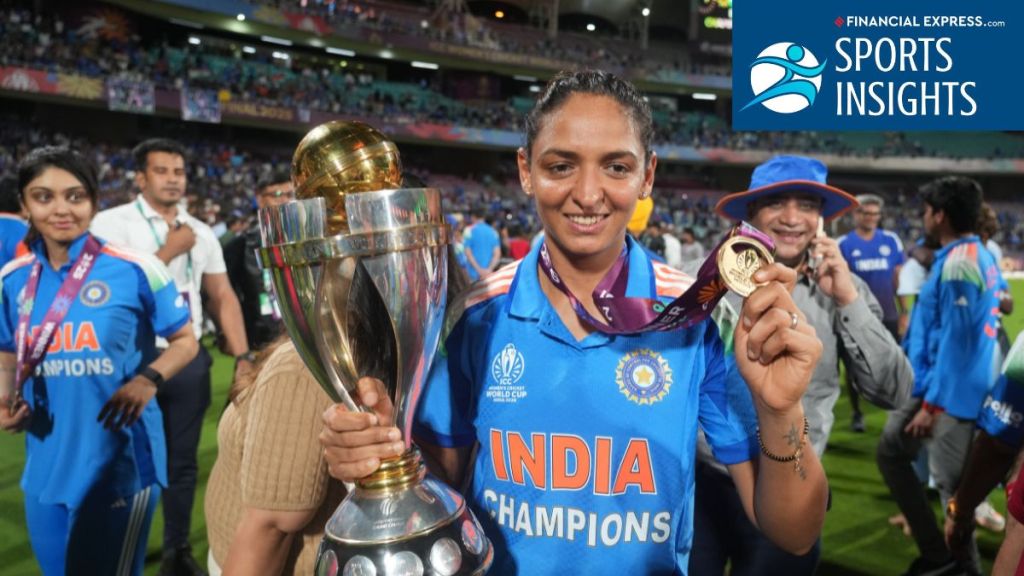
The final against South Africa was almost anti-climactic. 298 for 7. Then bowled them out for 246. A 52-run win. The first ICC trophy for Indian women’s cricket. Ever. The captain lifted the cup and the country finally saw what it had been missing for years.
I will say something slightly unfashionable here. That win was not only about her. It was about the equal match fees the BCCI brought in, the WPL that gave young girls a stage, the years of coaches, parents and a few stubborn officials. But somebody has to hold the cup, and it was right that it was her.
The numbers behind the myth
Let us talk stats for a bit. She debuted in the 2009 World Cup against Pakistan at Bowral, aged 20, and got her T20I cap against England a few months later. The Test debut came in August 2014. Today she is India’s most capped woman, with more than 360 international games and more than 9000 runs.
In ODIs she has 4,541 runs from 164 matches at an average of 37.22, with a best of 171 not out. In T20Is it is 4,346 runs in 210 games at a strike rate of 122.3. In the WPL, she crossed 1,000 runs at 146 strike rate, the first to do so.
She also became the first Indian woman to hit a T20I hundred, 103 off 51 balls against New Zealand in 2018. Add 75 international wickets with her off-spin. A best of 5 for 44 in Tests, 4 for 23 in T20Is
Then there is the franchise career. First Indian woman to play in the WBBL. Sydney Thunder. Player of the Tournament in 2021-22. Back home, she led Mumbai Indians to WPL titles in 2023 and 2025.
The Arjuna Award came in 2017, Wisden Cricketer of the Year in 2023, Time 100 Next and BBC 100 Women the same year, and the Padma Shri in 2026.
Awards are nice. I would still trade all of them for this one image. A girl in a small town somewhere in Punjab or Bihar or Assam, watching a woman from Moga hit a six, and quietly deciding she can try too.
Why now?
After the World Cup she led India to a 2nd Asian Games gold, in Aichi-Nagoya in September 2026. The BCCI held a review meeting in Guwahati, selectors spoke about building for the next World Cup cycle, and she announced her decision the next day.
Smriti Mandhana takes over in all formats.
There is a version of this story where the captain is pushed out and the board makes a mess of it. This does not look like that. She said she was at peace because the team was strong, and that without the burden of leadership she wants to play with pure joy.
Maybe that is a bit of a press-release line. But I have watched her bat for years and I think she means it. A player who has captained 211 international matches deserves some time to just hit the ball.
Her record as captain is no small thing either. Series win in England in 2022. A first win over Australia as captain in 2023. 3 Asia Cups, 2 Asian Games golds, 1 World Cup. And yes, that CWG silver, which she probably still thinks about at 2 in the morning.
What If she had been born in Mumbai?
Here is the what if scenario that keeps you up at night. What if Harmanpreet had been born in a metro city? What if she had access to proper facilities from day one, female coaches, sports science, nutritionists? Would she have been even better?
Probably. But then she would not have been Harmanpreet. The struggle made her. The 60 kilometre cycle rides built those legs that could hit sixes despite cramping. The gully cricket against boys gave her the audacity to take on Australia in a World Cup semi-final.
There is a lazy way to end this article, which is to say she changed Indian cricket forever. She did, but I would rather say something different.
She changed the game not just by playing well, but by existing. By being visible. By showing every girl in every small town in India that it was possible. The equal match fees from BCCI, the WPL, the packed stadiums for women’s matches. None of that happens without her 171 in Derby. None of it happens without seventeen years of showing up when nobody was watching.
The clerk’s daughter from Moga did more than win a World Cup. She made sure the next generation would not have to cycle 60 kilometres just to find a net.