



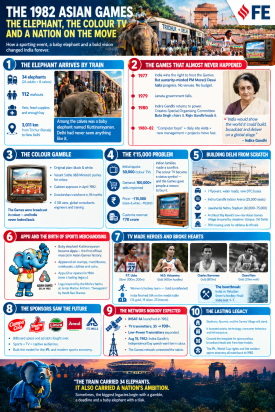
The elephant arrived by train.
Thirty-four of them, actually. Twenty-six adults and eight calves, packed into coaches that rolled 3,011 kilometres from Trichur in Kerala to New Delhi. One hundred and twelve mahouts came along. So did vets, feed supplies and enough hay to keep the animals calm through the journey.
Among the calves was a baby elephant named Kuttinarayanan. Delhi had never seen anything like it.
It was November 1982. India was hosting the Asian Games for the first time. The country was broke, the stadiums were barely finished, and the government had just done something no one thought possible. It had bet the nation’s pride on colour television.
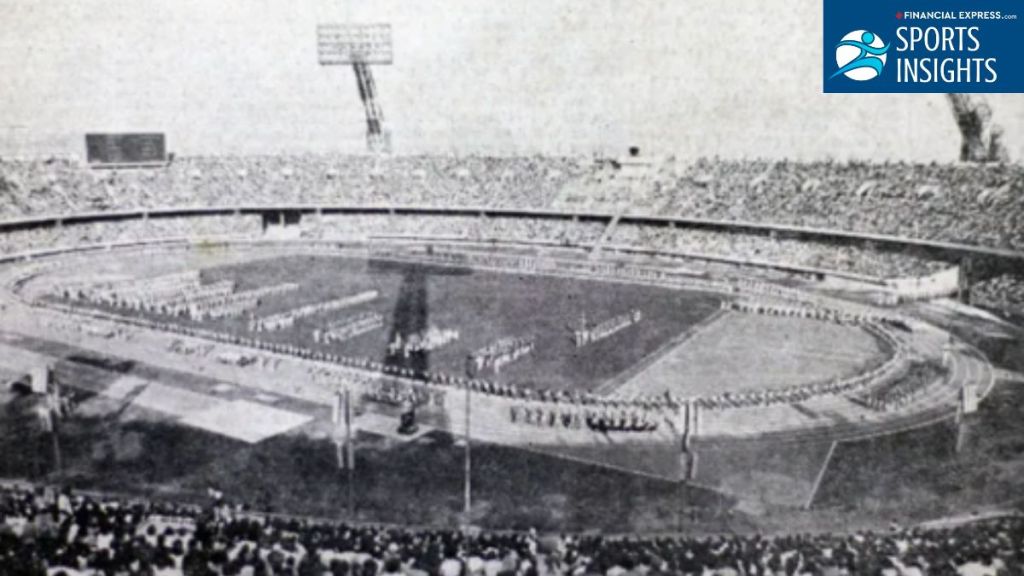
Most people watching the opening ceremony did not own a TV set. They crowded around single screens in neighbours’ homes, in market squares, in tea stalls with a set perched on a shelf. An estimated 80 to 100 million people watched Indira Gandhi declare the Games open. Many of them were seeing live colour pictures for the first time in their lives.
That moment changed everything.
The Games that almost never happened
Five years earlier, in 1977, India had won the rights to host the IX Asian Games. It should have been a proud moment. Instead, it became a political headache.
Morarji Desai was Prime Minister. His Janata Party government believed in austerity. Spending crores on sports stadiums while villages lacked roads and schools made no sense to them. The Games, they felt, were a bourgeois distraction. Between 1977 and mid-1979, nothing moved. No venues were built. No budgets were cleared. The event hung by a thread.
Then the Janata coalition collapsed. Indira Gandhi returned to power in January 1980. She saw the Games differently. Not as a luxury. As a statement.
India would show the world it could build, broadcast and deliver on a global stage.
The problem was time. Less than three years remained. So the government bypassed the usual slow channels and created a Special Organising Committee. Union Minister Buta Singh chaired it. A young MP named Rajiv Gandhi ran it.
Rajiv brought in corporate executives and young managers. People called them the “computer boys.” They used data tracking, daily site visits and hard deadlines. Delhi’s Lieutenant Governor Jagmohan walked construction sites with them every day. The message was simple. Finish on time or answer for it.
This was new for India. A government project that actually moved fast.
The colour gamble
The original plan was to broadcast the Games in black and white. Doordarshan had only ever done monochrome. That was the norm.
Vasant Sathe, the Information and Broadcasting Minister, disagreed. He had seen how the world had moved on. Colour TV was standard in developed countries. Showing the Asian Games in black and white would make India look backward. It would also hurt the sale of broadcast rights abroad.
The Cabinet approved the switch in April 1982. Doordarshan had roughly 18 months to transform itself.
Critics were furious. Colour television, they said, was a bourgeois luxury. Why should a poor country spend on this when farmers needed support? The debate was loud and angry.
The government pushed ahead. Four Outside Broadcasting vans were imported. They came with multi-camera control systems. Doordarshan engineers were sent abroad for training. Consultants from Germany and the UK worked alongside them. The OB vans were parked at the Jawaharlal Nehru Stadium, the Indira Gandhi Indoor Stadium and the Talkatora Swimming Pool.
But there was a bigger problem. Nobody in India owned a colour TV set.
The ₹15,000 problem
Domestic manufacturers like ECIL, Keltron, Weston and Crown could not produce enough colour sets in time. The government needed a quick fix.
It allowed Indians to import colour TVs as personal baggage or as gifts from non-resident relatives. A 190% concessional customs duty applied. The initial quota was 50,000 units.
Demand smashed through that quota.
Over 100,000 colour TV sets entered the country. Electronics markets in Hong Kong, Singapore and Dubai were cleaned out by Indian buyers. Each set cost around ₹15,000 at retail. A black and white set cost ₹8,000. The price did not matter. People found the money.
Reportedly, The government collected ₹70 crore in customs revenue. That money went back into building broadcast infrastructure.
Think about what this meant. A family spending ₹15,000 in 1982 was making a serious sacrifice. That was not pocket change. It was a statement. A aspiration. A belief that being part of this national moment mattered more than the money.
The colour TV became a status symbol. And the Asian Games gave people a reason to buy it.
Building Delhi from scratch
The Games needed venues. Delhi did not have them.
Southern Delhi was largely undeveloped. Swamps and open land surrounded Siri Fort. The area where the Jawaharlal Nehru Stadium now stands was empty ground. The city needed a complete overhaul.
Seven major flyovers were built. Roads were widened. New buses joined the DTC fleet. Underground telecom cables were laid. The Indira Gandhi Indoor Arena got 25,000 seats and full air conditioning. The main stadium held between 60,000 and 75,000 people.
Architect Raj Rewal designed the Asian Games Village on a 35-acre site in Siri Fort. He rejected the high-rise model used in Western Olympic villages. Instead, he looked to Jaisalmer, Udaipur and Old Delhi for inspiration. Low-rise buildings, two to four floors. Courtyards for natural ventilation. Pedestrian paths shaded from the sun. Cars pushed to a ring road on the outside.
700 housing units were built for athletes and officials. After the Games, they became premium residential property. South Delhi real estate never looked back.
Appu and the birth of sports merchandising
Kuttinarayanan the baby elephant became Appu. The mascot wore a tilak on his forehead and a medal around his neck. He was friendly, cartoonish and instantly loved.
Appu was the first official mascot in Asian Games history. The organisers wanted something that would soften the hard edges of a state project. Something children could connect with. It worked.
Appu’s face appeared on stamps, matchboxes, school notebooks, clothes and coins. This was India’s first experience of mass sports merchandising. The mascot was not just a symbol. It was a brand.
In 1984, Appu Ghar opened near Pragati Maidan. Rajiv Gandhi inaugurated it. It was India’s first major amusement park. It ran for over two decades. The lesson was clear. A well-designed character could make money long after the event ended.
The logo for the Games came from the Mishra Yantra at Jantar Mantar. Pandit Ravi Shankar composed the anthem, “Swaagatam.” The state was selling culture, science and sport in one package.
When TV made heroes and broke hearts
Before 1982, Indian athletes were famous in print but invisible in life. People read about Milkha Singh in newspapers. They heard races on All India Radio. They had never seen an Indian athlete run in real time.
Colour TV changed that.
P.T. Usha won silver in the 100m and 200m. Millions watched her sprint down the bright red track in real time. M.D. Valsamma won gold in the 400m hurdles, clocking 58.47 seconds. She became only the second Indian woman to win an individual Asian Games gold.
Charles Borromeo took gold in the 800m with a time of 1:46.81. Chand Ram won the 20km walk. The women’s hockey team went unbeaten and took gold.
These were not just results in a newspaper. They were living, breathing people on a screen in your living room. Or your neighbour’s living room. The connection was instant and permanent.
India finished fifth on the medal table with 13 gold, 19 silver and 25 bronze. China topped the table with 61 golds.
But the moment that cut deepest was the men’s hockey final.
India faced Pakistan at the Jawaharlal Nehru Stadium. A packed house. A massive TV audience. The whole country was watching.
India lost 1-7.
The humiliation was total and it was public. Live television did not just show victories. It broadcast defeat into every home simultaneously. The pain was collective. Nobody who watched forgot it.
The sponsors who saw the future
Companies noticed something during those 16 days. When millions of people watch the same screen at the same time, you can sell them things.
Doordarshan had made only modest money from static ads before 1982. The Games changed the game. Live sports meant captive audiences. Brands moved fast.
Pure Drinks and Parle fought for billboard space and ad slots. Campa Cola, Thums Up and Limca filled the gap left when Coca-Cola exited India in 1977. Amul ran topical campaigns that connected the brand to the national mood. ITC’s Wills brand saw the potential and invested early.
This was the template. Sports on TV plus corporate money equals a new economy. The model scaled up through the 1987 Reliance Cricket World Cup and kept growing until it became the IPL.
The network nobody could have predicted
INSAT-1A went up in 1982. It had problems later in its life, but during the Games it did its job. It linked regional broadcast centres into one national programme for the first time.
Vasant Sathe ordered a rapid expansion of Low-Power Transmitters. The number of TV transmitters in India jumped from 35 to over 100 in months. Small towns and rural areas came onto the grid.
On August 15, 1982, Indira Gandhi’s Independence Day speech went out live in colour. The system worked. By November 19, the network was ready.
A country that had 35 transmitters now had over 100. A country that watched in black and white now watched in colour. A country that consumed sports through print now consumed it live.
What Delhi 1982 really built
The stadiums still stand. The flyovers still carry traffic. The Asian Games Village is still a desirable address. Appu Ghar entertained families for over 20 years.
But the real legacy is harder to see.
The 1982 Games proved that a sporting event could drag a country forward. Not just in medals. In infrastructure, in technology, in consumer behaviour, in how people saw themselves.
The colour TV boom created the audience. The transmitter expansion created the reach. The sponsorship money created the business model. The athlete heroes created the emotional connection. Put together, they built the foundation for every sports broadcast deal, every sponsorship contract and every franchise valuation that followed.
The IPL, the World Cup TV rights wars, the celebrity athlete economy. All of it traces back to those 16 days in Delhi.
The elephant in the room
Kuttinarayanan went back to Kerala after the Games. But Appu stayed in the public imagination. On notebooks, on stamps, in the memories of children who grew up and told their own children about the time an elephant came to Delhi and the whole country watched in colour.
The train that carried those 34 elephants covered 3,011 kilometres. It carried more than animals. It carried the beginning of modern Indian sports commerce.
Nobody planned it that way. But then, the best business stories rarely start with a plan. They start with a gamble. A deadline. And a baby elephant with a tilak on his forehead.