


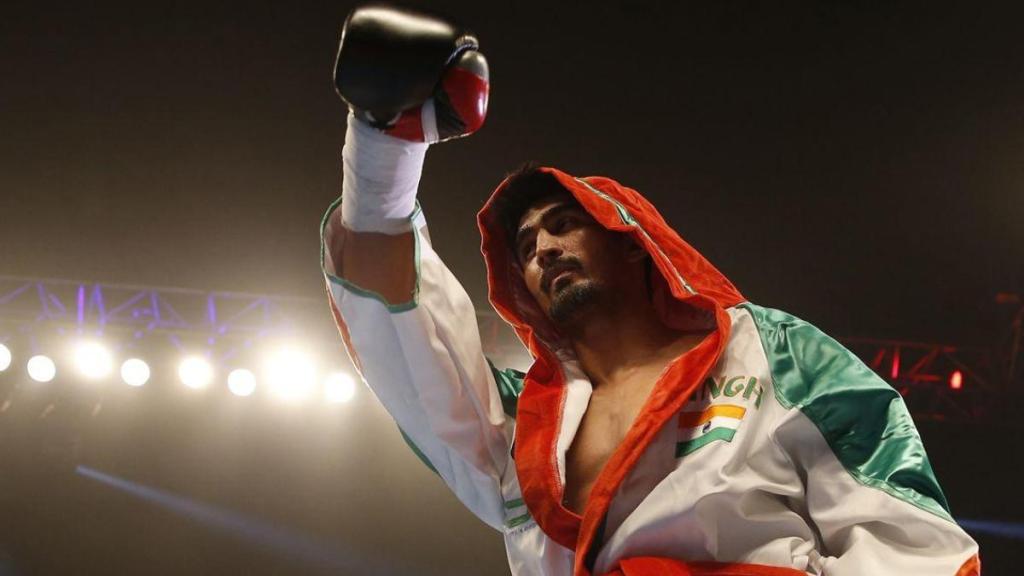

Think of Bhiwani at 5 in the morning, some winter in the early 2000s. A ring with patched canvas, a boy skipping rope with his breath showing, a coach calling out counts. Somewhere across town a Haryana Roadways driver is parking his bus after a night route. His salary keeps the house running, barely, and the boy at the ring eats a lot and outgrows his gloves.
I am imagining this scene, but the facts under it are real. Vijender Singh’s father drove a bus, money was tight, and boxing was the way out. What the boy did with the money that came later is a more unusual story than the medals.
Those gloves cost roughly ₹150 back in 1998. For a family surviving on a bus driver’s salary, that was a month’s savings. Vijender’s elder brother Manoj had just joined the Army through the sports quota, and his monthly cheque was the only reason Vijender could afford to train at the Bhiwani Boxing Club.
Without that Army money, there is no Olympic medal. Without that medal, there is no fortune. Without that fortune, there is no conversation about athlete rights in India.
This is not a story about boxing. This is a story about what happens when a poor kid from Kaluwas village learns to fight the system better than he fought in the ring.
A town that grows boxers
Kaluwas, his village, is in Bhiwani district. Farming land mostly, but over the years the district filled with boxing clubs and tiny academies, and people started calling it Little Cuba. Fathers there did not talk about cricket. They talked about an Army job, and a sports quota was the door.
His elder brother Manoj boxed his way into the Army. Vijender followed him to the Bhiwani Boxing Club and coach Jagdish Singh. He took small jobs and did some modelling to pay for diet and kit. His heroes were Ali and Tyson, and Rocky Balboa, which is a very ordinary thing to admit and I like him for it.
He boxed tight. High guard, careful distance, patience. If you go back and watch the old bouts, you see a man who would rather not be hit than hit someone hard. Hold on to that, because the same habit shows up in his bank details years later.
The Bronze That Broke the Dam
Beijing, August 2008. Vijender Singh steps into the ring against Carlos Góngora of Ecuador. The Indian contingent has never won an Olympic boxing medal. The commentators are not expecting much. India is a cricket country. Boxing is what you watch when the cable goes out.
Ten minutes later, history changes. Singh wins the quarterfinal. The bronze is secure. Back home in Bhiwani, his mother cries. His father tells the neighbours that his son has done what no Indian has done before. The phone starts ringing. It does not stop for years.
That single medal did something no government scheme could. It made boxing visible. It made boxers valuable. Within months, the Bhiwani Sports Authority of India center had a waiting list.
Kids who had never thrown a punch were begging their parents for gloves. The district that people once called backward became India’s Little Cuba. Five of India’s subsequent Olympic boxing medals have roots in that dusty Haryana soil.
The Medals That Followed
But the medal did something else. It proved that an Indian athlete who was not a cricketer could sell products, fill stadiums, and command respect. Singh did not just open a door. He kicked it down.
More followed. Bronze at the 2009 World Championships in Milan and the World No. 1 spot in his weight. Gold at the 2010 Asian Games in Guangzhou, bronze at the Delhi Commonwealth Games, the Padma Shri the same year. Silver at Glasgow in 2014 was his last big amateur medal.
Brands came running. Industry estimates, and I stress estimates because nobody has shown me a contract, say he could earn ₹75 lakh to ₹1 crore for year long endorsement. The names are not in doubt though. PepsiCo, Bajaj Allianz, Emami’s Mentho Plus with Mary Kom and Gautam Gambhir, Platinum Heavy Duty Cement.
Look at what each one was buying. The cement people wanted a body that does not crack. The insurer wanted a man who knows about protection. The balm company wanted someone who gets hit and gets up. He barely had to act.
The Contract That Changed Everything
By 2009, Singh was famous. He was also trapped. He had signed with Infinity Optimal Solutions, a sports management firm, early in his career. Now Percept D’Mark was offering him ₹9 crore. IOS said no. The contract says you stay with us.
Singh did what no Indian athlete had dared to do. He went to court.
The Delhi High Court case, Infinity Optimal Solutions Pvt. Ltd. v. Vijender Singh, became a landmark. The judges ruled that restrictive post-term exclusivity clauses violate Section 27 of the Indian Contract Act, 1872. An athlete cannot be owned. An athlete is not property.
The decision sent shockwaves through the sports management industry. Agents who had been locking young athletes into decade-long contracts suddenly found their paperwork worthless. Singh had won a victory not just for himself, but for every kid who would come after him. He had shown that the contract is not sacred. The athlete is.
He did not fight that case for money. He fought it because his brother could not fight it. His father could not fight it. Someone had to show them that we are not horses to be traded.
The Professional Gamble
In 2015, Singh did something that shocked the amateur boxing establishment. He turned professional. He gave up his chance to compete in the 2016 Rio Olympics. He signed with Queensberry Promotions in the UK and moved his training base to Manchester.
The purists were angry. The amateurs said he was betraying the country. The professionals said he was too old. Singh was 29. Most boxers turn pro at 21 or 22.
He won his first 12 fights. He won the WBO Asia Pacific Super Middleweight title in New Delhi in 2016, defeating Australia’s Kerry Hope before a screaming home crowd. He won the WBO Oriental title in Mumbai in 2017, beating China’s Zulpikar Maimaitiali in a unification bout.
Then he did something that had nothing to do with boxing. After the fight, with the Doklam border standoff fresh in the news, Singh took the microphone and offered the belt back to his Chinese opponent. He did not want tension on the border. It was a message of peace. That was more important than the title.
The crowd fell silent. Then they cheered. The belt stayed with Singh, but the gesture stayed with everyone else. Here was a boxer who understood that some things are bigger than the sport. Some things are bigger than the money.
What the Paperwork Says
Ask about Vijender Singh’s net worth and you will get different answers. Some websites claim ₹80 crore. Others say ₹50 crore. The number changes depending on who is counting and what they are counting.
The only reliable source is the Election Commission of India. When Singh contested the South Delhi Lok Sabha seat in 2019, he filed an affidavit. It showed assets of ₹8.62 crore. Movable assets worth ₹3.57 crore. Immovable property worth ₹5.05 crore. Annual income for FY 2017-18 was ₹45 lakh.
But even this number tells only part of the story. It does not capture the value of his brand. It does not capture the future earnings from his academy. It does not capture the appreciation of his real estate over the next decade.
The Endorsement Game
Singh has sold everything from fairness creams to online poker. Emami, Go Gas, PokerBaazi. The list is long and varied. Some critics say he has sold out. He says he is building a brand.
Muhammad Ali sold everything. Mike Tyson sold everything. If I do not sell, who will pay for the next kid’s gloves?
The endorsement money is not just personal income. It is proof of concept. When Singh signed with Emami in 2009, he was the first non-cricketer to front a major FMCG campaign. The agency heads said it would not work. The focus groups said cricket sells, not boxing. They were wrong. The campaign worked. Singh’s face moved product.
Since then, PV Sindhu, Neeraj Chopra, and dozens of others have signed similar deals. Singh did not just pave the way. He built the road.
He judged MTV Roadies X2 and appeared in the film Fugly too. Most athletes of his time went quiet between tournaments. Vijender seemed to understand that a boxer has maybe 10 or 12 earning years, and a face people stop seeing stops earning.
The Academy and the Next Generation
Vijender has a dream that goes beyond the ring: he wants to give something back to the sport that made him. Having won Olympic bronze for India, he now hopes to start coaching by building a boxing academy on his own land in Kaluwas, the small village in Bhiwani where his journey began.
Bhiwani has long been called the cradle of Indian boxing, so the choice feels natural. In an interview with PTI, he said he submitted his proposal to the Sports Ministry almost two years ago and is still waiting to hear back.
Officials say projects of this size take time to review, but Vijender remains hopeful. For a boxer who put his village on the national map in 2008, an academy at home would be a fitting next chapter.
The Farm, the Border, and the Son
In December 2020, Singh drove to the Singhu border. The farmers were protesting the new agricultural laws. Singh stood on a tractor and spoke to the crowd. He said he would return his Rajiv Gandhi Khel Ratna, India’s highest sporting honour, if the laws were not repealed.
The government was not happy. The boxing federation issued a warning. Singh did not care. His family are farmers. His cousins still work the land in Bhiwani. He was not going to stay silent while they suffered.
He is not a politician. He is a son of the soil. When the soil is in trouble, he stands with the soil.
During the COVID lockdown, he taught his son Abir gardening. Not boxing. Gardening. He wanted the boy to know where he came from. He wanted him to understand that the discipline of the ring comes from the discipline of the field.
The Philanthropy You Have Not Heard About
Off the field, Vijender Singh has made a point of using his name to help others. He founded the Vijender Singh Trust to support sustainable development in communities that need it most.
The trust works across several areas, including sports, education, and healthcare. On the sports side, it aims to set up training academies and hold youth camps in villages so that young talent gets noticed early and nurtured.
Its “Adopt-a-Student Initiative” helps underprivileged children with tuition, uniforms, and stationery, so that money doesn’t stand between them and the classroom. The trust also offers medical financial assistance, runs care clinics, and distributes food and relief supplies to families in distress.
His generosity has also reached fellow boxers in difficult moments. He has reportedly given direct financial help to an injured Indian boxer who needed major surgery. He also helped rally the boxing community to raise funds for Dingko Singh, the former Asian Games gold medallist, during his cancer treatment.
For someone who knows how demanding the sport can be, these gestures show a real sense of responsibility toward the boxing family.
This is not charity. This is duty. He believes that anyone who makes money from the people must give it back to the people. Not as a tax write-off. Not as a brand-building exercise. As a moral obligation.
The Counter-Puncher’s Portfolio
In the ring, Singh was a counter-puncher. He waited. He watched. He struck when the moment was right. His business strategy is the same.
He does not chase trends. He does not invest in startups that will be worthless in two years. He builds academies. He waits.
The exact size of his fortune is hard to pin down. The affidavits give us snapshots. The websites give us guesses. The truth is probably somewhere in between. But the trajectory is clear. From a bus driver’s son to a Olympics medal winner. From an athlete to an institution.
Singh is 40 now. His boxing career is winding down. His business career is just starting. He fought in the ring for 20 years. Now he fights outside the ring. Same rules. Same patience. Same result.
Back to the Gloves
Those old gloves in the glass case. The ones that cost ₹150. The ones that his brother’s Army salary paid for.
Yet Vijender still makes his son work the fields. Every summer. No excuses.
The gloves stay in the case. The legacy keeps growing.
Somewhere in Bhiwani tonight, a boy is wrapping his hands before dawn. His father is a labourer. His mother works as a maid. He has no shoes, but he has a dream.
He has seen Vijender Singh on television. He knows that a bus driver’s son can become a champion. He knows that a bronze medal can become property and businesses and loans to schools. He knows that the system can be beaten.
He wraps his hands tighter. He steps into the ring. He starts to move.
The gloves are old. The dream is new. The fight goes on.
Editorial Note: This is an independent profile. Vijender Singh and their representatives were contacted but did not respond prior to the time of publication. In the absence of direct comment, this article was reported using publicly available records and regulatory filings, where applicable. This content was produced in accordance with FinancialExpress.com’s editorial guidelines.