


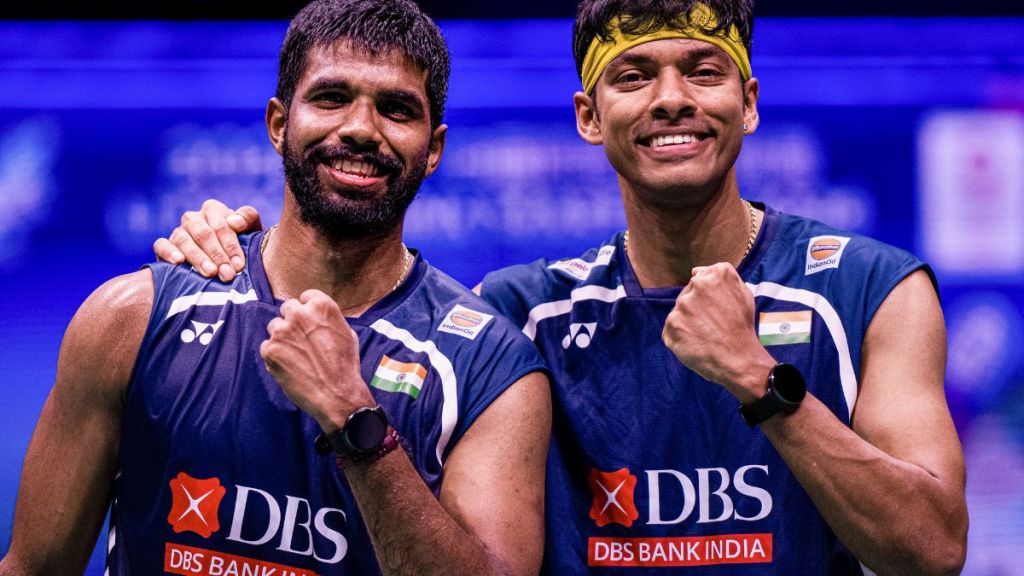

Satwiksairaj Rankireddy and Chirag Shetty have added $92,500 (approximately 87,40,371.25 Indian Rupee) to their career earnings after winning the China Masters Super 750 title in Shenzhen on Sunday.
The Indian pair defeated China’s He Ji Ting and Ren Xiang Yu 11-21, 21-13, 21-17 in the final to claim their first China Masters title. It was also a significant win for the pair after they had lost their previous two finals at the tournament.
The victory capped a week in which Satwik and Chirag won four consecutive three-game matches, repeatedly recovering from difficult positions before eventually finding a way through.
Satwik-Chirag turn around another slow start
The final initially looked like another difficult afternoon for the Indians. He and Ren came out aggressively, using their pace and deep pushes to put Satwik and Chirag under pressure. India fell 0-5 behind early and were eventually 5-11 down before losing the opening game 11-21.
But the second game brought a change in approach. Instead of trying to overpower the Chinese pair with their usual steep attacks, the Indians began using straighter shots and more controlled aggression.
“In the first game, aggression wasn’t lacking. But we weren’t playing the right strokes,” Chirag said after the match, according to the Badminton World Federation.
“In the second, we wanted to be aggressive but mindfully aggressive.” The adjustment worked. India levelled the match at 1-1 and the momentum shifted decisively in their favour.
The deciding game was closer but Satwik and Chirag held their nerve when it mattered. Satwik, in particular, made an impact at the net, picking up five points in the final game through his work on serve and receive.
A $92,500 payday
The China Masters is one of the biggest tournaments on the BWF World Tour, with the Super 750 category sitting just below the sport’s top-tier events.
The men’s doubles champions’ $92,500 prize money gives Satwik and Chirag another sizeable addition to their career earnings.
More importantly, the title comes at a time when the pair have been trying to solve a problem that has troubled them for much of the past two years- opponents repeatedly targeting Satwik’s serve.
The issue became particularly visible in the build-up to the Paris Olympics, when fast, flat-playing opponents began attacking the first three shots of rallies.
Satwik admitted the focus on his serve had affected his confidence.
“I practised services a lot. When I was injured also, I practised serve and receive,” he said. “But it’s just a feeling, mental thing — you need to believe your serve is good.” The Indians worked extensively with their coaching team on videos of opponents targeting Satwik’s serve and reception.
That work appeared to pay off in Shenzhen.
From technical problem to confidence boost
Satwik said the quarter-final against Denmark’s Kim Astrup and Anders Skaarup Rasmussen had given the pair confidence that they could win matches even when opponents managed to disrupt their preferred attacking game.
The final offered another test.
He and Ren repeatedly tried to exploit the space between the Indians and prevent them from establishing their attack. But once Satwik and Chirag began using the same straight, controlled pressure against the Chinese defence, the balance of the match changed.
“We didn’t panic much,” Satwik said. “Just served and played according to the shuttle.”
That may have been the most important takeaway from their title run.
For a pair whose success has traditionally been built around explosive attacking badminton, the China Masters showed another side of Satwik and Chirag — the ability to absorb pressure, change tactics and win without having everything go according to plan.
And for Satwik, who has dealt with injuries, the disappointment of the Paris Olympics and scrutiny away from the court, the $92,500 prize cheque is more than just another addition to the career earnings column.
It is also evidence that a problem which once seemed to be occupying too much space in his head is beginning to disappear from the court.