


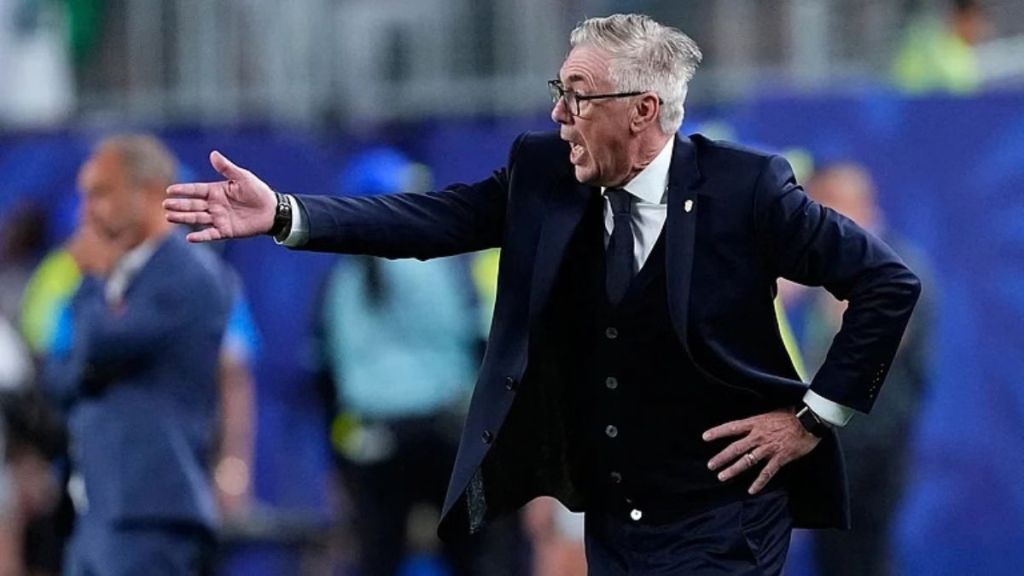

Carlo Ancelotti does not have to score a goal, make a tackle or sprint down the wing to command a salary of millions of euros. At 67, the Italian is being paid for something football’s biggest employers consider just as valuable: the ability to turn a collection of elite players into a winning team.
Ancelotti’s reported annual salary of €10 million (about €833,000 a month before tax, bonuses and other contractual adjustments) places him among the most highly paid managers in international football. Brazilian sports outlet Globo Esporte reported the figure when the Brazilian Football Confederation (CBF) appointed him in 2025. The report also said his contract included a €5 million bonus if Brazil won the 2026 World Cup. Globo Esporte reported the contract details in May 2025.
The CBF subsequently extended Ancelotti’s contract through the 2030 World Cup in May 2026. Brazilian news outlet UOL reported that the renewed deal retained an annual salary of about €10 million. The federation confirmed the extension, although its official announcement did not disclose the financial terms. UOL reported the salary and contract extension.
The distinction matters. The €10 million figure is a reported contractual salary, not a publicly audited statement of Ancelotti’s total earnings or take-home income. It also does not necessarily include performance bonuses or any separate commercial income.
But the larger question remains: why would a football federation commit so much money to one coach?
The answer lies in the business of modern football, where the person on the sidelines can influence sporting results, the value of a national team’s brand and the expectations of millions of supporters.
A track record that few can match
Ancelotti’s salary cannot be understood without considering his record.
He is among the most successful coach in European Cup and Champions League history, with five titles: two with AC Milan and three with Real Madrid. He has also won the competition with two different clubs, an achievement shared by only a small group of managers.
UEFA’s record of Champions League-winning coaches documents that record.
For an employer, such a history provides a measure of credibility. A federation hiring a coach with a record of succeeding at the highest level is buying more than tactical knowledge. It is acquiring experience of managing elite players, navigating high-pressure matches, handling dressing-room dynamics and making decisions when the margin for error is small.
That experience does not guarantee success. Football remains unpredictable and even the best managers can lose important matches. But a proven record can reduce the perceived risk of appointing someone to lead a high-profile team.
It also strengthens a coach’s negotiating position. When a candidate has a rare combination of experience, trophies and global recognition, the pool of credible alternatives may be limited.
In that market, age can be less important than the value an employer believes the individual can deliver.
What does Brazil expect in return?
Ancelotti’s appointment was not an ordinary managerial change. Brazil, a five-time men’s World Cup winner, hired one of the most decorated coaches in the game as it sought to return to the top of international football.
The CBF’s decision to extend his contract through 2030 is significant because it commits the federation to a longer-term project rather than making his future dependent solely on one tournament.
The federation said the extension reflected its confidence in the coach and its ambition to strengthen Brazil’s competitiveness. Ancelotti, in the federation’s announcement, said the two sides wanted to continue working towards taking Brazil back to the top.
The CBF’s May 2026 announcement confirms the length of the renewed agreement.
For the federation, the potential return is primarily sporting, but it sits within a much larger commercial ecosystem. The Brazilian national team is one of football’s most recognisable brands, with a global following, an established commercial identity and a history that attracts broadcasters, sponsors and supporters.
A competitive national team can strengthen that appeal. Strong performances can help sustain audience interest, support sponsor relationships and make the team’s matches more attractive to broadcasters and commercial partners.
However, it would be misleading to suggest that every euro spent on a coach translates directly into additional revenue. The financial returns depend on a range of factors, including sporting performance, commercial agreements, audience engagement and the federation’s ability to convert popularity into income.
Ancelotti’s salary is therefore better understood as a strategic expense: money spent in the expectation that his expertise will help deliver results that matter to the organisation.
The World Cup raises the stakes
The economics become clearer when viewed against the scale of international football’s biggest tournament.
FIFA announced in April 2026 that the total financial distribution to the 48 participating member associations at the 2026 World Cup would rise to nearly $900 million. Its stated distribution pool was $871 million, including $10 million in qualification money for each participating association, $2.5 million in preparation funding and additional contributions towards team costs and ticket allocations.
These figures were published by FIFA on April 28, 2026.
That money is distributed under FIFA’s tournament arrangements, not paid directly to national-team coaches. Nor does it mean that a coach’s salary is automatically recovered through World Cup participation.
The figures nevertheless illustrate the financial scale of the tournament in which national teams compete. For a federation, World Cup qualification, competitive performance and the ability to sustain international attention carry significance beyond the result of an individual match.
The coach is one part of that equation. Players, preparation, medical support, scouting, administration and commercial operations also matter. But the coach occupies a particularly visible position because sporting decisions and results are closely associated with the person leading the team.
For Brazil, Ancelotti’s experience is part of the federation’s attempt to convert its footballing resources into success on the international stage.
Why pay one person so much?
The economics of elite coaching also reflect scarcity.
There are thousands of qualified football coaches around the world. Far fewer have managed at the highest level, won major trophies and demonstrated an ability to work with some of the game’s most prominent players.
A coach with Ancelotti’s record competes in a global market where wealthy clubs and national federations seek a limited number of proven candidates. His salary reflects the price an employer is prepared to pay for that combination of experience, reputation and potential performance.
There is also a difference between paying for work measured in physical output and paying for decisions that affect the performance of an entire organisation.
A player can be assessed through goals, assists, defensive actions and minutes played. A coach’s contribution is harder to isolate. It includes team selection, tactics, training, communication, player management and the ability to respond to changing circumstances during a match.
Results are influenced by factors outside a coach’s control, including injuries, refereeing decisions and the quality of the opposition. This makes it difficult to assign a precise financial value to any one manager’s contribution.
Yet the potential consequences of those decisions are substantial. A tactical adjustment or a selection choice can change a match, while the ability to manage a squad over a long tournament can influence a team’s overall prospects.
That is why elite coaching is treated as a specialist executive role rather than simply an extension of playing football.
Is the salary worth it?
That is the question the CBF must ultimately answer through results.
Ancelotti’s reputation and trophy record help explain why Brazil was willing to pay a premium for his services. They do not, on their own, establish that the investment will produce a positive financial return.
The federation must weigh his compensation against its sporting ambitions, the resources required to support the national team and the uncertain benefits of success. It must also consider the opportunity cost: money committed to one coach cannot be spent on other priorities without trade-offs.
The extension through 2030 suggests that the CBF values continuity and believes Ancelotti can contribute to its longer-term ambitions. Whether that judgment proves correct will depend on performances, results and the team’s development over the contract period.
Ancelotti is not being paid to run faster than his players or score more goals than his strikers. He is being paid because Brazil believes his experience and decisions can help its most valuable football property compete at the highest level.
In elite sport, the biggest salaries are not always attached to the people who perform the most visible physical work. They often go to those whom employers believe can make the greatest difference to the outcome.