



When Brazil walk out against India at Kolkata’s Salt Lake Stadium on October 3, the biggest numbers around the match will not be on the scoreboard.
The five-time world champions’ first senior men’s international in India has become a sizeable commercial operation, involving appearance fees, chartered travel, ticket sales, sponsorships, hospitality and the wider spending generated by thousands of fans.
The match is being staged as part of India’s three-game international window against 2026 World Cup teams, with Uruguay due to play India in Kolkata three days later.
A ₹50 crore match before the wider Kolkata economy
The Brazil game alone is estimated to have a budget of around ₹50 crore, according to a Mint report citing an unidentified AIFF insider. Of that, ₹35-40 crore is reportedly the appearance fee for the Brazilian Football Confederation (CBF). The figures have not been publicly confirmed by either federation and should therefore be treated as reported estimates.
The cost does not end with the appearance fee.
The AIFF has reportedly spent close to ₹6 crore on a private charter flight to bring Brazil’s roughly 90-member delegation to Kolkata. The arrangement covers players, coach Carlo Ancelotti and officials, with business-class travel also planned for onward journeys after the match.
Brazil arrived in Kolkata on Thursday ahead of Saturday’s game, with Vinicius Jr among the stars drawing crowds outside the team hotel.
The economics of the fixture also extend to ticketing. Prices range from ₹999 to ₹15,000, with lower-priced categories selling rapidly after bookings opened. Financial Express earlier reported that tickets in the ₹1,000-₹5,000 range were largely taken within about 20 minutes.
The AIFF has also set aside more than 14,000 discounted tickets for supporters of Mohun Bagan, East Bengal and Mohammedan Sporting, reflecting an effort to connect the high-priced international fixture with Kolkata’s established football community.
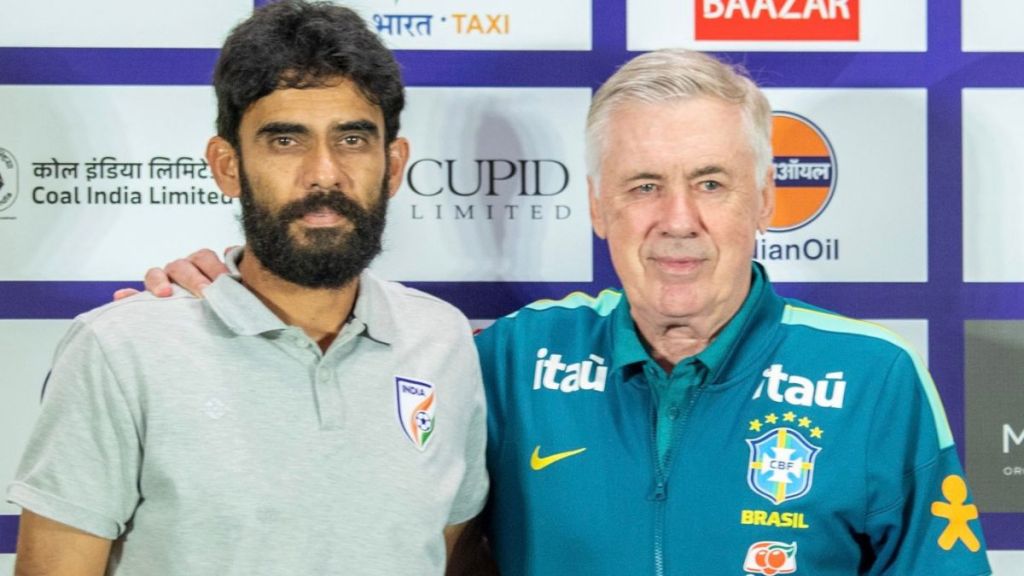
Brazil Head Coach Carlo Ancelotti on the warm reception in India and the game ahead. 🇮🇳🇧🇷
— Indian Football (@IndianFootball) October 2, 2026
📺 Watch the Pre Match Press Conference: https://t.co/CUZH0B3BeS#INDBRA #IndianFootball pic.twitter.com/ULlLrNzy6m
Hotels, transport and sponsors are part of the Brazil effect
The financial activity around the match is not confined to the stadium.
Brazil’s visit requires hotel accommodation, security, transport, catering and specialised logistical arrangements. The team is staying at a five-star hotel in Kolkata, where preparations have included detailed requirements around food, kitchen operations and security.
For Kolkata, the potential economic effect comes from the fans as much as the players.
Supporters travelling into the city can generate spending on hotels, restaurants, taxis, local transport, merchandise and other services. The effect is particularly relevant because Brazil will be followed by Uruguay, which faces India at the same stadium on October 6. The two fixtures create the possibility of a longer burst of sports-related spending, although the actual economic gain to the city will depend on how many visitors come from outside Kolkata and how much they spend.
The commercial interest has also attracted brands. Baazar Style Retail has been announced as principal partner for India’s matches against Brazil and Uruguay, adding a major sponsor to the football window.
Ticketing is another significant commercial channel. Moneycontrol reported that the ticketing arrangement for the three-match window involving Brazil, Uruguay and Panama was worth about ₹25 crore to the federation. That figure is reported rather than an officially disclosed AIFF financial statement.
Can marquee football pay for itself?
The Brazil fixture illustrates the financial gap between India’s domestic football market and the global value attached to elite international teams.
Bringing Brazil to India requires a large upfront commitment. The reported ₹35-40 crore appearance fee alone represents most of the estimated ₹50 crore budget for the match. That means ticketing and sponsorship revenue are important, but the organisers also have to account for hospitality, travel, venue operations, security and other costs.
For Kolkata’s businesses, however, the calculation is broader.
A packed stadium creates spending that does not necessarily appear in the match organiser’s accounts. A supporter who travels to Kolkata may pay for a hotel room, eat at restaurants, use local transport and buy merchandise. Businesses close to the venue can also benefit from the additional footfall.
That makes the Brazil game a sporting event with several layers of economic activity: the AIFF’s direct match costs, commercial revenues from tickets and sponsors, and indirect spending across Kolkata’s hospitality and services economy.
Whether that translates into a profitable match for the organisers is a separate question. The AIFF has not publicly released a complete revenue-and-cost statement for the Brazil fixture.
For Indian football, the more immediate experiment is whether the attention generated by Brazil can be converted into a sustainable commercial audience after the stars leave Kolkata.
The answer will depend less on one sold-out night than on what happens to ticket demand, sponsorship interest, broadcast audiences and football participation after the Brazil and Uruguay fixtures are over.