



Aishwarya Bajpai
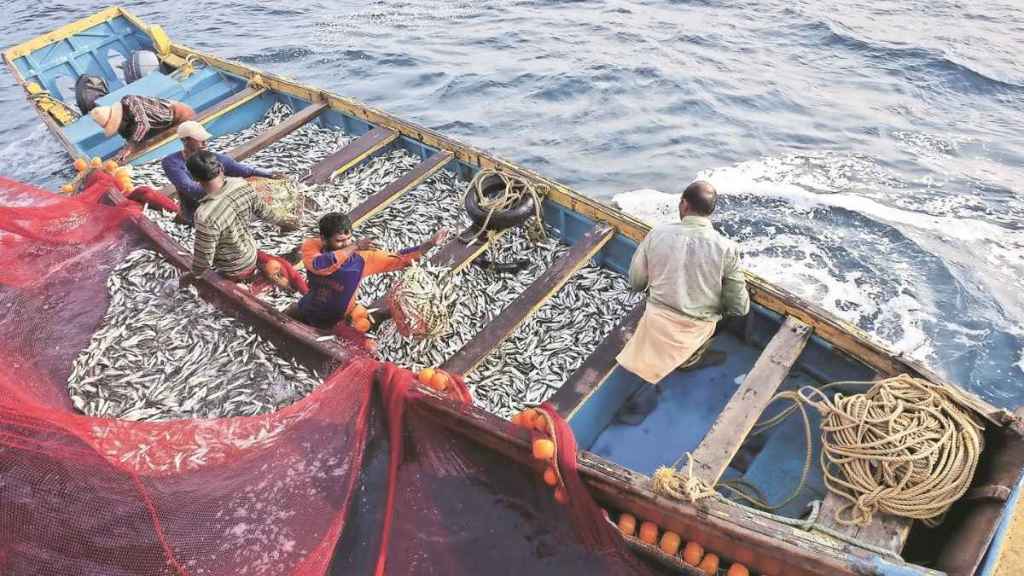
Mohammad Shafique has spent his life in Fort Kochi. For the last four years, he has worked with fishers, cleaning fish and delivering orders from the shore. He has watched fishing routines change with the weather, the sea and the availability of fish.
“Because of the climate, the timings have also changed of going and coming back from the sea,” he says. “We also go in the evening with a bigger boat and work in two shifts. So, it is 24 hours fishing right now.”
The decision to go out is increasingly tied to what the sea is doing that day.
“So we work according to the time, when to [lay out the] net and when not to. During the rainy season, the sea level also rises and then we don’t go,” Shafique says.
His observations come at a difficult time for the fishing community. Small boats continue to bring in tuna and other marine fish, but their availability has changed.
“The fish is now less, it also has become expensive because of the ban with no big catchers [trawlers] in the sea,” he says. The ban keeps around 5,000 trawlers off Kerala’s coast for 52 days each monsoon.
For Shafique, the changing sea is therefore not an abstract environmental issue. It determines when people can fish, what they can sell and how they organise their working day.
But how much of what fishers are observing can be attributed to climate change? And how can their knowledge help scientists understand what is happening at sea and policymakers decide how to respond?
These are important questions for Kerala’s fisheries. Fishers spend far more time observing the sea than most researchers can. Their knowledge could help identify changes that need further investigation, but it needs to be recorded systematically and tested against scientific evidence. Bringing these observations into fisheries monitoring and management could help the state make better-informed decisions about conservation, fishing regulations and climate adaptation.
The composition is changing
At the fish market, Shohib Iqbal has spent 35 years watching the catch come in. He buys fish from the auction at the harbour early every morning. “Catching has become too little [over the years] because of the trawlers,” he says.
The patterns have been changing too quickly in the last decade. It has become difficult to plan and predict. “Hoping that we will get a good catch after the ban this year,” he says with a forced smile.
The geography of Fort Kochi provides some opportunities for small-scale fishing. “If you come early morning, you can find a lot of them because this is a fresh water area because of the Alleppey river, the place where the river meets the sea,” says Sudhir, another fish worker.
Because the waters are shallow and connected, he says, fishers can sometimes work without travelling far offshore. During the ban, this becomes particularly important.
What fishers notice – and what science can prove
Sudhir says that the size has become smaller for some fish like silver pomfret and points to changes in marine animals.
“Lately, they are becoming too hard due to the acidification,” he says, referring to shells. “And their shells become weaker. This is true for most including shrimps.”
Have any scientists stress-tested these anecdotal findings?
Biju Kumar, Vice Chancellor of the Kerala University of Fisheries and Ocean Studies, says the evidence for increasing sea-surface temperatures in the Arabian Sea is strong. A study of satellite data from 1982 to 2019 found that marine heat waves in the southeastern Arabian Sea, close to the west coast of India, are increasing by about 20 days per decade. These waters are among the Arabian Sea’s major fishing zones, the authors note.
“What is not established is any proof of acidification,” Kumar says. “Acidification is a slow process, which is happening [on the] Indian coast. But… there is no scientific evidence to say that there is a larger variation in the pH, or acidity of water.”
So, “ocean acidification is a reality,” Kumar says, but there aren’t any specific studies on it in Indian waters.
One reconstruction put the Arabian Sea’s surface pH decline at roughly 0.014 to 0.015 units a decade. That is not the same as long-term local measurements.
When fishers say that a shrimp shell has weakened or that a crab tastes different, that observation can be important. But it needs to be investigated alongside measurements of temperature, pH, salinity, fishing pressure, pollution and ecosystem changes.
A smaller fish does not have one explanation
Fishers have reported smaller fish too, but Kumar says science has to account for several possible causes. “On sardine, there is a study done by CMFRI on the size reduction,” he says. “There are a couple of reasons.”
Fish growth depends partly on plankton and the survival of larvae. “But fishing itself can contribute to declining fish sizes,” Kumar says, pointing to the capture of young fish and the demand for small fish as “trash fish” for fishmeal and other uses. “Fishermen collect everything smaller,” he says. “Naturally, next year the [catch] will be less.”
The argument has played out in public. Kerala’s oil sardine landings fell from nearly 4 lakh tonnes in 2012 to 44,320 tonnes in 2019. When small sardines flooded the market in 2025, fishers blamed climate stress, while CMFRI scientists read the glut as healthy juvenile recruitment.
This is why a change in fish size cannot automatically be labelled a climate impact.
It also illustrates why local observations need to be considered alongside catch records, ecological research and information about fishing practices. Without that combination, it is difficult to distinguish a temporary fluctuation from a longer-term shift or identify the most appropriate response.
From observation to evidence
That uncertainty does not make fishers’ observations irrelevant. Kumar argues that they can be an important starting point.
A CMFRI-led survey of 905 fishers in Kerala found that they perceived, on average, six species as having disappeared from their usual catches, against one new species appearing. But Kumar advises caution in reading the results. “[With] one survey of fishermen, we cannot say that these are the species which disappeared,” he says. “But based on the survey, we can make an assessment that this may be the reason.”
Long-term monitoring is essential to test these observations and understand what is driving them. His own research offers an example.
“Indian turbot… is not appearing in the catch for the last 10 years, anywhere on the Kerala coast,” he says. There are catches in Andhra but not in Kerala coast.
But even here, he does not immediately attribute the disappearance to climate change. “This may be a classical example of over harvesting,” Kumar says. The species is bottom-dwelling, and Kumar points to “disturbance created by the trawlers at the sea bottom” as a possible explanation.
A published survey of flatfishes along Kerala’s coast, his own work, likewise noted the species’ absence from trawler bycatch and discards. He believes the observation can be correct even when the explanation is wrong or incomplete. That is precisely why it needs to be recorded and investigated.
What if fishers became part of the monitoring system?
At present, fishers spend far more time observing the sea than most researchers can. They notice changes in fishing grounds and catch sizes because those changes affect their income.
Kumar says the ocean needs to be understood “along with the communities.”
“Your future planning, conservation, everything depends upon the kind of data, which is happening in the field,” he says.
The gap is visible in Kerala’s own data. In the CMFRI survey, 91% of fishers said they had received no training on dealing with climate change. When INCOIS piloted a satellite-based advisory on where to find fish, many traditional fishers returned the handsets, calling them unhelpful and unable to identify species.
These examples point to a need to make scientific monitoring and advisory systems more responsive to the people expected to use them.
A better system could let fishers systematically record unusual catches, changes in species and fish size, while scientists simultaneously collect environmental data. Such records could be compared with information on sea temperatures, salinity, fishing effort and other ecological indicators to investigate emerging patterns.
The system would also need to close the loop. Fishers should be able to see what their observations reveal, understand how the information is being used and contribute to decisions informed by the findings. Researchers and fisheries authorities, in turn, would need to establish how the data are collected, validated and incorporated into management.
Such a system would not replace scientific research. It would allow the people working on the fishing grounds to help identify the questions scientists investigate.
A fishing ban that can respond to changing conditions
The same principle could apply to the seasonal trawling ban. “The trawling ban period need to be revisited again based on the kind of data available subsequently,” Kumar says.
The breeding periods of different species can vary, and the current system focuses primarily on trawling while other fishing operations continue.
For small-scale fishers, however, any change in regulation has consequences. During the ban, fish become harder to obtain and more expensive for shore-based workers like Shafique.
Revisiting the ban would therefore require evidence about breeding cycles, fish populations and fishing pressure, alongside an assessment of the effects on different fishing communities. It would also require the people affected by the regulations to be part of the discussion.
The broader question is whether fisheries management can move beyond fixed rules and respond more effectively as ecological conditions change. Better monitoring could help authorities assess whether existing measures are working, where additional safeguards may be needed and when regulations should be reviewed.
That would require coordination between fishers, researchers and fisheries authorities, as well as reliable long-term data. It would also require a clear process for translating new evidence into decisions.
The response starts with listening
Back on the Fort Kochi shore, the work of Shafique, Iqbal and Sudhir continues to follow the sea.
Their observations cannot, by themselves, tell us whether a change is caused by warming seas, rainfall, fishing pressure, pollution or some combination of factors. But they can tell scientists where to look.
Rather than treating fishers’ knowledge as anecdotal information outside scientific research, Kerala could build a system that records it, tests it and feeds the findings back into fisheries management.
Kumar’s recommendation is straightforward: “Understand the oceans, along with the communities.”
Climate change cannot be solved locally, he says. But local adaptation can be planned.
For Kerala’s fishing communities, that could mean a fisheries system that does not wait for a crisis before responding. It could mean monitoring the sea continuously, listening to the people who work in it every day and changing policy when the evidence changes.
The fishers already know that the sea is not static. The challenge is to ensure that the institutions managing it can respond just as effectively.
The piece is published in arrangement with Climate Action Live The piece is published in arrangement with Climate Action Live