


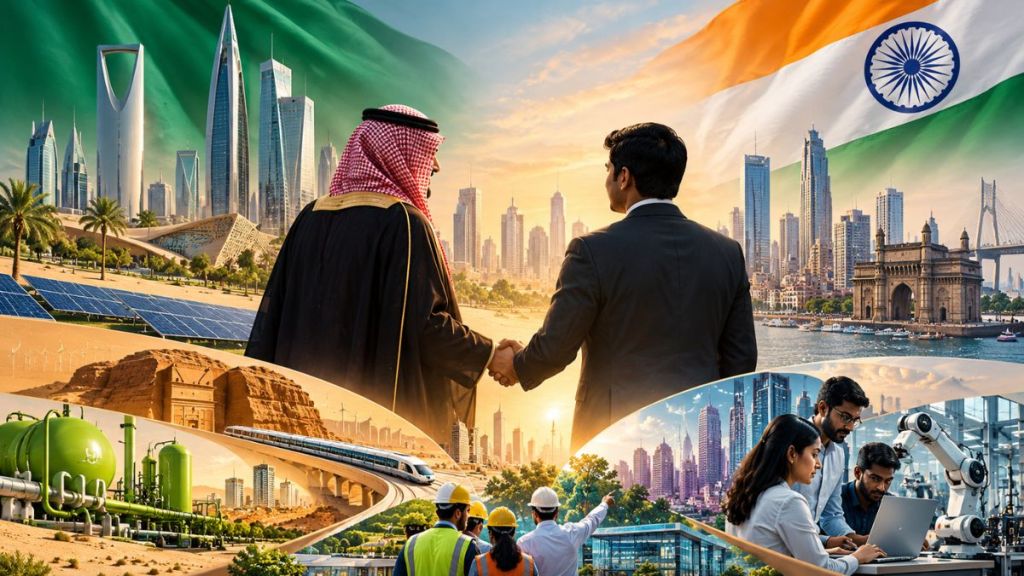

For decades, the India-Saudi Arabia relationship has been closely associated with oil. Saudi Arabia has been an important source of crude and liquefied petroleum gas for India. Indian workers, businesses and professionals have played an important role in the Saudi economy
Now, the economic relationship is expanding into infrastructure, manufacturing, technology, healthcare, pharmaceuticals, logistics, mining, financial markets, real estate and public-private partnerships. Defence, education, tourism and cultural exchanges are also becoming more important.
The change is taking place at a time when Saudi Arabia itself is trying to reduce its dependence on hydrocarbons. As reported by the Embassy of India, Riyadh, The Kingdom’s Vision 2030 programme has encouraged investment in sectors outside oil, while its sovereign wealth fund, the Public Investment Fund (PIF), is directing capital towards areas such as tourism, advanced manufacturing, technology, logistics and clean energy. This creates an opportunity to build a relationship with Saudi Arabia that is not based only on buying crude oil for India.
At the same time, the numbers show that oil remains deeply embedded in the relationship. The transition is therefore not from oil to a completely non-oil relationship. It is about adding several new economic pillars to an already important energy partnership.
Oil remains important, but the trade relationship is changing
The scale of the energy relationship explains why oil continues to matter. According to the Embassy of India in Riyadh, India imported 33.14 million metric tonnes of crude oil from Saudi Arabia in FY2024-25. This accounted for 13.58% of India’s total crude oil imports. India also imported 3.34 million metric tonnes of liquefied petroleum gas from Saudi Arabia, accounting for 14.99% of India’s total liquefied petroleum gas imports. The latest Rubix analysis, however, shows some diversification in India’s import basket.
Crude oil accounted for 68% of India’s imports from Saudi Arabia during April-July FY2026. Its share declined to 65% during April-July FY2027. Fertilisers increased from 6% to 7%, while aircraft and gold entered the top five import categories. Crude oil and natural gas together accounted for 68% of India’s imports from Saudi Arabia in April-July FY2027, compared with 74% a year earlier, as per Rubix India analysis.
The same pattern can be seen in exports. India’s exports to Saudi Arabia include engineering goods, rice, petroleum products, chemicals, textiles, food products and ceramic tiles, according to the Embassy of India. Saudi Arabia, meanwhile, exports crude oil, liquefied petroleum gas, fertilisers, chemicals and plastics to India. This means the relationship already has a wider trade base than the simple description of “India buys Saudi oil” suggests.
A bigger investment relationship is emerging
Investment is perhaps the clearest sign of how the relationship is changing. According to the Embassy of India, Saudi investment in India, including investments by PIF, Saudi companies and the Saudi-backed Vision Fund, has reached about $10 billion. Saudi investors have interests in areas including energy, steel, renewable energy, chemicals, food, automobiles and automobile solutions.
Indian companies are also investing in Saudi Arabia. Indian investment in the Kingdom had reached approximately $3 billion as of August 2023, covering sectors such as consultancy, construction, telecommunications, information technology, financial services, software development and pharmaceuticals. More than 6,000 Indian companies are registered in Saudi Arabia.
The two governments have also created mechanisms specifically to encourage investment. The High Level Task Force on Investment held meetings in July 2024 and April 2025. The first India-Saudi Investment Forum was also organised, with more than 50 business-to-business and business-to-government agreements and memoranda of understanding signed during the forum.
Saudi Arabia has also previously expressed an intention to invest about $100 billion in India. The sectors identified for this investment include petrochemicals, infrastructure, technology, manufacturing, healthcare and pharmaceuticals, as per Rubix analysis. This matters because investment creates a different kind of economic relationship from commodity trade.
An oil transaction is largely about buying and selling a commodity. Investments in factories, technology, healthcare or infrastructure can create longer-term business links, supply chains, employment and local production.
The investment treaty could give the relationship another push
A new area of cooperation is the investment protection framework. The Indian government has approved the Bilateral Investment Promotion and Protection Agreement with Saudi Arabia. According to sources cited by Financial Express, the agreement provides a two-year period for investors to exhaust domestic legal remedies before initiating international arbitration.
The provision is significant because India’s earlier framework had required investors to exhaust local remedies for five years. The Saudi agreement therefore represents a shorter route before an investor can seek international arbitration.
The agreement includes provisions relating to treatment of investments, non-discriminatory treatment, expropriation and free transfer of funds. An official told Financial Express, the agreement balances investor protection with the state’s right to regulate in the public interest.
For India and Saudi Arabia, the agreement is important because both sides already have substantial investments in each other’s markets.
A more predictable investment framework could support additional capital flows, particularly as Saudi Arabia looks for opportunities in India’s infrastructure and other sectors and Indian companies look for opportunities in the Saudi market.
Saudi Arabia is opening more parts of its economy to foreign capital
The change in India-Saudi economic relations is also connected to reforms inside Saudi Arabia. Rubix’s October 2026 country report says Saudi Arabia opened its stock exchange, Tadawul, to all categories of foreign investors from February 2026. Non-resident investors can directly invest in listed securities, while the earlier Qualified Foreign Investor framework was removed. The stated aim is to broaden the investor base and increase liquidity in the Saudi capital market.
Real estate is another area where the Kingdom has opened the door wider. A new law allowing non-Saudis to own real estate came into effect in January 2026, subject to specified conditions. The framework covers residents, non-residents and eligible non-Saudi companies. Rubix said the move could broaden foreign participation in the real estate market and support international business presence in the Kingdom.
These changes are relevant for Indian businesses because they create more routes for companies and investors to participate in the Saudi economy.
Privatisation is creating opportunities outside oil
Saudi Arabia’s diversification plans are also visible in its public-private partnership programme. In January 2026, Saudi Arabia announced its National Privatization Strategy. Rubix said the strategy targets SAR 240 billion, or about $64 billion, in private investment by 2030 through an expanded public-private partnership programme.
The programme is not limited to traditional energy and water projects. It covers healthcare, education, municipal services and defence. The strategy includes 42 initiatives and targets more than 220 public-private partnership contracts by 2030. This is important for Indian companies because many of these sectors are areas where Indian businesses already have experience. Healthcare, information technology, construction, engineering, education and pharmaceuticals are among the areas where Indian companies could potentially participate in the expanding Saudi market.
PIF is becoming a vehicle for diversification
The Public Investment Fund is central to Saudi Arabia’s economic transformation. Rubix said PIF’s 2026-2030 strategy places greater emphasis on domestic investment as part of the Kingdom’s effort to diversify beyond oil.
The report puts the fund’s size at about $925 billion and identifies six priority ecosystems: tourism, travel and entertainment; urban development and livability; advanced manufacturing and innovation; industrials and logistics; clean energy, water and renewable infrastructure; and NEOM.
The strategy is expected to create opportunities for private companies, local supply chains and international businesses across infrastructure, manufacturing, technology and logistics. The significance of this shift is that Saudi Arabia is not simply trying to replace oil with one new industry. It is building a group of industries around investment, infrastructure, services and technology. For India, this can create several points of engagement at the same time.
Mining is emerging as another major area
Mining is another sector Saudi Arabia wants to develop as part of its diversification plans. Rubix said the National Investment Strategy aims to increase mining investment to nearly SAR 92 billion during 2025-2030, compared with approximately SAR 45 billion in 2024.
The strategy also includes a push to increase foreign direct investment in mining. Rubix describes mining and critical minerals as important pillars of Saudi Arabia’s diversification strategy and says the sector could create opportunities for international investors, technology providers and mining-service companies. For India, mining cooperation could become relevant not only because of minerals but also because of the technology and services required to explore, process and transport them. This adds another layer to the economic relationship.
Trade is becoming more balanced across sectors, although oil still dominates. The overall trade numbers show both the progress and the limitations of diversification. India-Saudi bilateral trade stood at $41.07 billion in FY2025-26. India’s exports were $10.28 billion, while imports were $30.79 billion, according to the Embassy of India, as per Embassy of India.
Rubix puts FY2026 bilateral goods trade at about $41.1 billion. India’s exports to Saudi Arabia increased from $8.8 billion in FY2022 to $10.3 billion in FY2026. The export basket includes vehicles, rice, copper wire, refined petroleum products and other goods.
During April-July 2026, passenger vehicles remained an important export but their share declined from 12% to 10%. Copper wire increased from 6% to 10%. Bovine meat and refined petroleum products entered the leading export categories, while rice remained relatively stable. Rubix described this as a change in product composition rather than a broad contraction in India’s exports. The picture on the Saudi side is also changing, although at a slower pace.
Rubix said mineral fuels and oils accounted for 69% of Saudi Arabia’s exports in 2025. Plastics accounted for 6%, electrical machinery 5% and organic chemicals 3%.
Saudi Arabia’s imports are much more diversified. Machinery and mechanical appliances accounted for 15%, electrical machinery and equipment 14%, and automobiles and components 11%. Together, these three categories accounted for 40% of imports. Saudi Arabia remains heavily dependent on energy for its export earnings. Its import demand, however, increasingly shows an economy investing in machinery, technology, transportation and infrastructure.
India is becoming more important to Saudi Arabia’s trade
India’s position as a trading partner is also strengthening. According to the Rubix report, India was Saudi Arabia’s second-largest export destination during the second quarter of 2026, with a share of about 15%, moving ahead of Japan.
The report found that China, Japan, India and South Korea together accounted for 65% of Saudi Arabia’s export destinations during both the first and second quarters of 2026. The changes during the conflict period were therefore largely a redistribution within Saudi Arabia’s established Asian markets rather than a fundamental shift away from Asia.
The Rubix press release similarly said India-Saudi goods trade stood at $41.1 billion in FY2026 and was broadly flat at about $13.3 billion between April and July 2026. India’s growing importance to Saudi Arabia therefore comes at a time when the Kingdom is looking for markets, investment partners and suppliers beyond its traditional oil relationships.
Defence, technology and healthcare are widening the relationship
The economic relationship is not developing in isolation. India and Saudi Arabia have also expanded cooperation in defence, technology, healthcare and other areas.
The Embassy of India said the Strategic Partnership Council was expanded in 2025 to include four ministerial committees covering political and security cooperation, defence cooperation, economy and energy and investment and technology, and tourism and cultural cooperation. Four agreements in space, health, sports and postal cooperation were also signed during the 2025 visit of Prime Minister Narendra Modi to Saudi Arabia.
Defence cooperation has expanded through military exercises, training and institutional exchanges. The two countries have held naval exercises and a bilateral land force exercise. Indian naval ships have also made port calls in Saudi Arabia. These developments show that the relationship is becoming broader at the institutional level as well.
People remain an important part of the relationship
The relationship is also not only about governments and companies. The Embassy of India estimates that around 2.74 million Indians live in Saudi Arabia. The Indian community has contributed to the development of the Saudi economy and serves as an important link between the two countries.
Labour cooperation has therefore remained an important part of bilateral relations. India and Saudi Arabia have agreements covering domestic workers and general category workers, while a skill verification programme was signed in 2022.
Pilgrimage is another major link. The annual quota for Indian Haj pilgrims is 175,025, while an average of about 1.5 million Indians perform Umrah each year, according to the Embassy of India. India has also introduced digital systems to simplify parts of the Hajj process.
Cultural cooperation has also expanded under Saudi Arabia’s Vision 2030. India and Saudi Arabia have worked together on cultural festivals, yoga, Sanskrit programmes, films, music and research. A bilateral cultural cooperation agreement was signed in November 2025.
The energy relationship itself is being tested
The move beyond oil does not mean the energy relationship has become less important. The recent disruption to shipping routes shows why energy will remain a major part of India-Saudi ties.
Rubix said India’s crude imports from Saudi Arabia fell from $2.8 billion in April 2026 to $0.9 billion in June before recovering to $1.4 billion in July. Saudi Arabia’s East-West pipeline has provided an alternative route for moving crude to Yanbu on the Red Sea and bypassing the Strait of Hormuz. However, attacks around the Bab-el-Mandeb have created additional risks for shipments from the Red Sea. Press Release- Saudi Arabia
The disruption shows an important point about diversification. India and Saudi Arabia can expand cooperation in technology, manufacturing, healthcare, infrastructure and mining, but energy will remain a major part of the relationship for the foreseeable future.
The objective is therefore not to remove oil from the relationship. It is to ensure that oil is no longer the only major economic link.
The economic transition is still a work in progress
Saudi Arabia’s economic data shows why the diversification effort matters. Rubix, citing the International Monetary Fund, projects Saudi Arabia’s real GDP growth at 1.7% in 2026, down from 4.6% in 2025. The decline is linked to the impact of the West Asia conflict on oil production, shipping and economic activity.
The IMF expects growth to rebound to 5.5% in 2027 if regional conditions and maritime trade normalise. More importantly for diversification, the IMF expects non-oil growth to remain positive, at 4.5% in 2027, 4% in 2028 and 2029, and 3.8% in 2030. The report attributes this expected expansion to domestic consumption, government investment, infrastructure projects, international events and continued Vision 2030 reforms.
Foreign investment is another indicator of the direction of travel. Saudi Arabia received $32.6 billion in net foreign direct investment in 2025, up about 53% from $21.3 billion in 2024, according to UNCTAD data cited by Rubix. The Kingdom moved from 17th to 13th among the world’s largest recipients of foreign direct investment. These numbers do not mean that the transition away from oil is complete. They show that the Kingdom is attracting capital into a wider set of economic activities.
What this means for India
The first is investment. Saudi capital can support Indian infrastructure, manufacturing, healthcare, technology and other sectors.
The second is exports. Saudi Arabia’s demand for machinery, vehicles, technology, food products and services can create opportunities for Indian companies.
The third is manufacturing. Saudi Arabia’s push to develop domestic industries can create opportunities for Indian companies to establish partnerships, production facilities and supply chains in the Kingdom.
The fourth is technology. Saudi investment in digital services, advanced manufacturing and logistics creates room for Indian information technology and technology-enabled businesses.
The fifth is infrastructure. The Kingdom’s public-private partnership programme could create opportunities in healthcare, education, municipal services and other areas.
Mining provides another potential area for cooperation, particularly in technology and services. The Bilateral Investment Promotion and Protection Agreement can also provide a more structured framework for companies investing across the two markets.
A relationship being built on several pillars
The India-Saudi relationship is therefore entering a different phase. Oil remains its largest economic component. India’s energy needs and Saudi Arabia’s role as a major global oil producer ensure that crude will continue to matter.
The difference is that several other pillars are being built around it. Investment is expanding. Trade is becoming more diverse. Saudi Arabia is opening its capital markets and real estate sector to foreign participation. Public-private partnerships are moving into healthcare, education and municipal services. PIF is focusing on domestic sectors such as tourism, manufacturing, logistics and clean energy. Mining is being developed as a new investment area. Defence, technology, healthcare and cultural cooperation are also becoming part of the wider relationship.
The more important change is the direction of the relationship. The India-Saudi partnership is moving from a relationship where oil was the central economic link towards one where energy sits alongside investment, infrastructure, manufacturing, technology, healthcare, logistics, mining and services.