


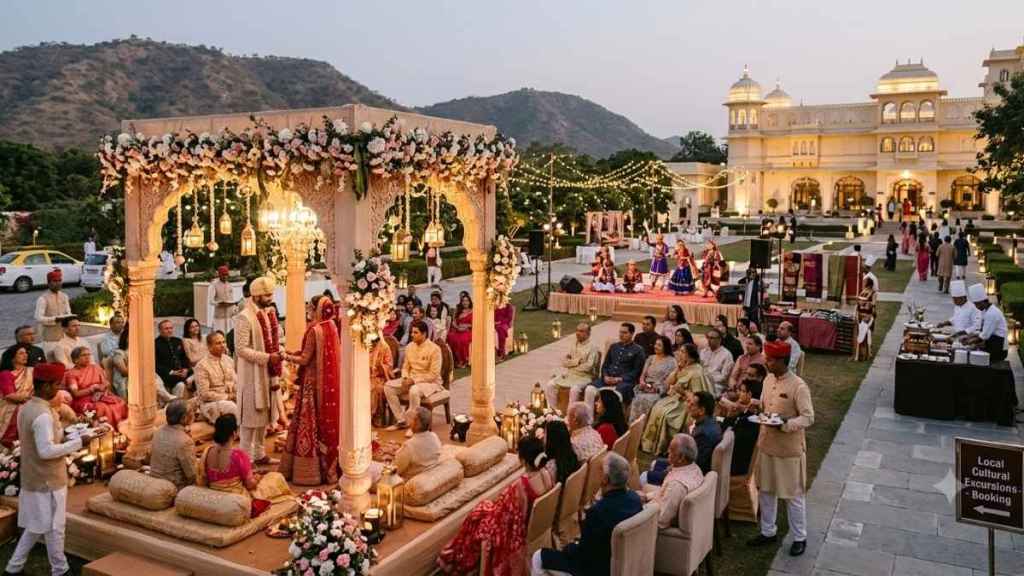

The Indian wedding is getting smaller in one respect and bigger in another. Guest lists are becoming more selective, but couples are spending more on the people they invite, on accommodation, food, entertainment and experiences spread over several days. That is changing the economics of the wedding. A destination celebration is increasingly a multi-day tourism business, generating revenue for hotels, transport operators, restaurants, entertainers and local service providers.
According to WedMeGood, over 60% of Indian weddings with budgets above Rs 1 crore are now destination weddings, while 89% of destination weddings take place within India. The wedding-planning platform estimates that the average wedding budget rose from Rs 36.5 lakh in 2024 to Rs 39.5 lakh in 2025-26.
“Destination weddings have moved from a luxury niche to a more mainstream format,” says Mehak Sagar, co-founder of WedMeGood. “The biggest shift is from spending purely on visual grandeur to spending on the overall experience,” Sagar says. Couples are investing in better rooms, welcome events, entertainment, pre-wedding trips, honeymoons and personalised details, rather than simply expanding the guest list. “F&B, guest hospitality, entertainment and experiential elements are becoming part of the ‘wedding product’ rather than add-ons,” she adds.
The broader economic stakes are considerable. KPMG’s 2026 report on the socio-economic impact of India’s events and experiences industry estimates wedding-linked household expenditure at around Rs 6.5 lakh crore in 2025. The figure includes spending on jewellery, apparel, catering, accommodation, travel, décor, entertainment and event management, rather than destination weddings alone.
KPMG’s model of a representative organised wedding with about 350 attendees estimates visitor expenditure at Rs 1.07 crore and total direct economic impact at Rs 1.20 crore. Average spending by outstation attendees was Rs 52,771, against Rs 18,621 for local attendees.
Rajiv Mehra, general secretary of the Federation of Associations in Indian Tourism and Hospitality (FAITH), describes weddings involving non-resident Indians as “a mini tourism festival”. Guests stay for several days, take local excursions and buy souvenirs, benefitting businesses beyond the wedding venue. “The wedding is no longer just a banquet booking. It can mean three or four days of accommodation, multiple F&B functions, local transportation, sightseeing, entertainment, shopping and curated experiences for guests,” he says.
Beyond Rajasthan
Rajasthan remains a leading destination, supported by its havelis and established hospitality infrastructure. Celebrity weddings have reinforced its appeal, Mehra says. Goa attracts couples with its beaches and resorts, while Kerala benefits from its wellness offering. Jim Corbett is popular with nature-seeking couples, and Kashmir is attracting interest at the luxury end.
But the market is spreading. WedMeGood identifies Daman, Khajuraho and Mussoorie as emerging destinations. Radisson Hotel Group reports demand in Udaipur, Karjat, Lonavala and Mamallapuram, with Nashik, Chandigarh, Indore and Guwahati gaining interest.
Government campaigns are also adding momentum. The Union tourism ministry launched ‘India Says I Do’ in 2023 to promote India as a global wedding destination. It subsequently partnered with FICCI on the ‘Wed in India’ expo in 2024 and the ‘Meet in India’ conclave in 2025.
States are developing their own pitches. Uttarakhand CM Pushkar Singh Dhami said in July that the ‘Wed in Uttarakhand’ campaign would boost the local economy and employment. The state is developing Triyuginarayan, Omkareshwar, Ramnagar, Tehri and Mussoorie as wedding destinations. Dhami has argued that weddings can generate income for “local artisans, folk artistes, homestay operators, taxi drivers and many small businesses”, extending the benefits beyond hotels and resorts.
Andhra Pradesh wants to develop Tirupati as a global wedding destination, linking celebrations with the town’s religious-tourism ecosystem. Through the Andhra Pradesh Tourism Policy 2024-29 and the Holiday in Andhra Pradesh campaign, wedding tourism is one of the state’s four key pillars, supported by efforts to develop venues, incentives and curated packages. “From spiritual weddings in Tirupati and beachfront celebrations in Visakhapatnam and Suryalanka to cultural weddings in traditional manduva houses and the backwaters of Konaseema, and nature-inspired celebrations in Araku, Andhra Pradesh offers settings for weddings that are as unique as the couples themselves,” says Padma Rani Seela, chief marketing officer at Andhra Pradesh Tourism Authority, adding, “We extend a special invitation to our diaspora, particularly non-resident Telugu families, to ‘Come Home to Wed in Andhra Pradesh’ and celebrate their most cherished moments amid the traditions, culture and hospitality that make Andhra truly special.”
The state also wants guests to stay for two or three days and explore surrounding heritage, cultural and nature-based attractions. Meena cautions that this requires investment in accommodation, parking, public transport, connectivity and civic infrastructure, including water, power, sanitation and traffic management.
West Bengal is also looking to work with private-sector players to develop wedding tourism. Tourism minister Shankar Ghosh said about 450 wedding planners had approached him with an interest in promoting the state.
Goa, meanwhile, was named ‘best destination for resort weddings’ at the Wed In India 2025 Awards. Tourism minister Rohan Khaunte said the state’s combination of “luxury, culture, and natural beauty” continued to attract couples, adding that the government wanted weddings to contribute positively to the local economy and community.
The competition is international too. Mehra identifies Thailand, the UAE, the Maldives, Italy and Spain among destinations competing for Indian weddings. Thailand, in particular, has an established ecosystem, with predictable costs, permissions and hospitality infrastructure.
Yet he estimates that 80% of destination weddings involving Indians are held domestically. Food and culture remain important reasons to stay in India, he says. Retaining more business will require not just new hotels but a wider pool of skilled photographers, videographers, florists, logistics providers and tourist guides.
Celebrating the location
For couples, the decision is less about economic multipliers than what the additional spending buys them. Bhiwadi-based Aarushi Suri, 29, married at Ramada in Neemrana, Rajasthan in September 2023, spending around Rs 30 lakh. The location was chosen partly because it was midway between the two families. “We really like what Ramada offered with their halls, food, location, everything’s on point. Comfortable location for both families,” she says.
Suri and her husband wanted guests to attend every function without travelling between venues. “We wanted every guest to attend every function on time and celebrate every event with each of the guests,” she says. The couple split their functions to manage the budget without cutting back on what mattered to them. The food proved particularly memorable: “Everyone praised the food, and till date I hear about how good the food was,” says Suri. The higher cost, she says, was worth it. “It cost us more, but if we compare it in terms of fun we had, the destination dream wedding we had, it was much bigger.”
For 32-year-old Shweta Singh, who married at White Flower Corbett in Jim Corbett in 2025, the draw was intimacy. The wedding cost Rs 16-17 lakh. “My husband and I always wanted an intimate wedding, surrounded by nature, rather than a big, traditional celebration,” the marketing professional says. The couple wanted to spend the occasion with close family and friends, in a setting that felt peaceful and private.
“It made the whole experience feel more like a special getaway with our families and friends rather than a typical wedding,” Mumbai-based Singh says.
Tushar Patra’s wedding at Rajbari Bawali, around 20-30 km outside Kolkata, was shaped by culture and circumstance. The 34-year-old and his wife, both Bengali but not residents of West Bengal, married in 2020, when Covid restrictions made travel difficult. The two-day celebration cost Rs 40-50 lakh, including accommodation, catering and events, a figure Patra says could be substantially higher today.
Kolkata offered access to extended family, Bengali food, colonial zamindari properties and traditional silk and handloom sarees for gifts and wedding attire. “It also offered better value than comparable properties in Rajasthan,” Patra, a lawyer by occupation, says.
The three weddings show that destination can be driven by geography, affordability, intimacy or cultural identity and what unites them is the desire to make the location part of the celebration.
Economic footprint
That preference is creating a lucrative business for hotels. A conventional wedding may occupy a banquet hall for an evening but a destination wedding can fill rooms, restaurants, lawns and event spaces for several days.
For Shangri-La, the value extends from accommodation and food to welcome events, ceremonies, receptions, brunches, spa visits, transport and excursions. “A destination wedding has a much broader economic footprint than a conventional one-day hotel wedding,” says Yashwini Naik, global account director, sales at Shangri-La. The group’s Bandhan wedding programme recorded eight weddings across six destinations in 2026, a 60% increase over 2025. Wedding leads to Shangri-La properties rose 162%, while revenue from the segment grew 186% year-on-year. The weddings brought more than 2,000 guests and thousands of room nights.
Naik says families are now considering the entire guest journey, from flights and transfers to food preferences, entertainment and activities, rather than focusing only on the ballroom. The group also encourages guests at Shangri-La Hambantota in Sri Lanka to combine weddings with excursions to Yala National Park, Galle and the southern coast.
“A 150-guest celebration spread over three or four days can represent a very significant piece of business,” she says, particularly when dining, excursions, wellness and cultural experiences are included.
Radisson Hotel Group is seeing similar demand. Its India portfolio recorded around 27,000 wedding-related room nights in November 2025, up 46% year on year, while wedding room revenue rose 87.1%. The group’s typical destination wedding involves 200-350 guests over two nights and three days.
“The wedding opportunity today extends well beyond room nights and banquet rentals,” says Nikhil Sharma, managing director and COO, South Asia, at Radisson Hotel Group. Food and beverage contributes around 40-45% of the group’s revenue, while nearly 80% of its MICE business is linked to weddings.
Radisson has introduced ‘The Art of Weddings by Radisson Hotels’, an end-to-end offering that brings together planning, localisation and personalised experiences across its properties.
For planners, destination weddings have created a broader services market. Tejwannt Singh Lamba, founder of VanVivaha, says the business now brings together destination planners, guest-experience curators, hospitality partners, travel specialists, logistics experts, wellness providers and technology-led services. “What was once a wedding service is now a specialised industry vertical,” he says.
Boosting local economy
The final beneficiaries may be the businesses guests rarely see. Planners say destination weddings create demand for transport, catering, floristry, decor fabrication, lighting, sound, beauty services, photography, gifting and local entertainment.
The Wedding Square’s founders — Nitin Mathur, Shweta Mehta and Savita Gadhiok — estimate that around 50-70% of core wedding expenditure can circulate through the destination economy, depending on how much is sourced locally. Accommodation and food and beverage are among the biggest components, followed by transport, local staffing, florals and logistics.
Priya Maganti, CEO and co-founder of RVR PRO and RVR Eventz & Design, estimates that 55-70% of total wedding spend typically stays within the local economy. She puts accommodation and venues at 28-35% of the budget, catering at 20-25% and decor at 15-20%.
These are industry estimates, not a standard measure. Dakshita Bhatla, founder of DB & Spaces, cautions that a payment made at a destination does not necessarily remain there in full. Outside planners, photographers and specialist decor teams can take a significant share of spending away from the host location.
But even when specialist teams travel in, they rely on local drivers, technicians, electricians, fabricators and production crews. Local sourcing, Bhatla says, extends the benefits “to workshops, transporters, technicians, artisans and service teams”.
The number of people involved varies sharply with the size and complexity of a wedding. RVR estimates 80-150 local workers for a typical two-to-three-day celebration. The Wedding Square puts the figure at 400-500 people, while Bhatla estimates that a large, production-heavy wedding can involve around 500 people across preparation, setup, hospitality, execution and dismantling. In established destinations, she estimates 60-70% of that workforce can be local.
The figures are not directly comparable as they reflect different wedding scales and operational assumptions. Nor do they represent newly created permanent jobs. Much of the employment is temporary, and the work often starts weeks before the guests arrive.
Still, repeated demand can encourage local businesses to invest in equipment, train staff and develop specialist services. The Wedding Square points to Udaipur, where the local ecosystem has expanded over two decades to handle more of the production, technology and entertainment required for premium weddings.
Local culture is also becoming part of the product. Maganti estimates that 60-75% of couples request at least one local cultural element, often food or flowers. Planners cite local textiles, crafts, musicians, artisans and guest gifts as other ways to connect the celebration to its setting.
The Wedding Square says couples want the destination to mean something beyond the backdrop. “Local culture should never feel like a decorative prop,” its founders say. When it is incorporated thoughtfully and in collaboration with people from the destination, it creates a stronger sense of place while allowing it to contribute to the host community.
Bhatla says local sourcing is ultimately a question of capability and reliability. A destination may have skilled carpenters, florists, technicians and transport operators, but large weddings require dependable equipment, trained staff and the ability to work to tight schedules. Repeat business, she says, goes to vendors who can deliver consistently.
For couples, the attraction is a wedding that doubles as a shared holiday, while for hotels and planners it is a booking that generates revenue across departments. From hotel rooms and catering to local crafts, the celebration increasingly draws an entire destination into its orbit. The result is an industry built on the many things that make a place special, a charm-full proposition, in every sense.