


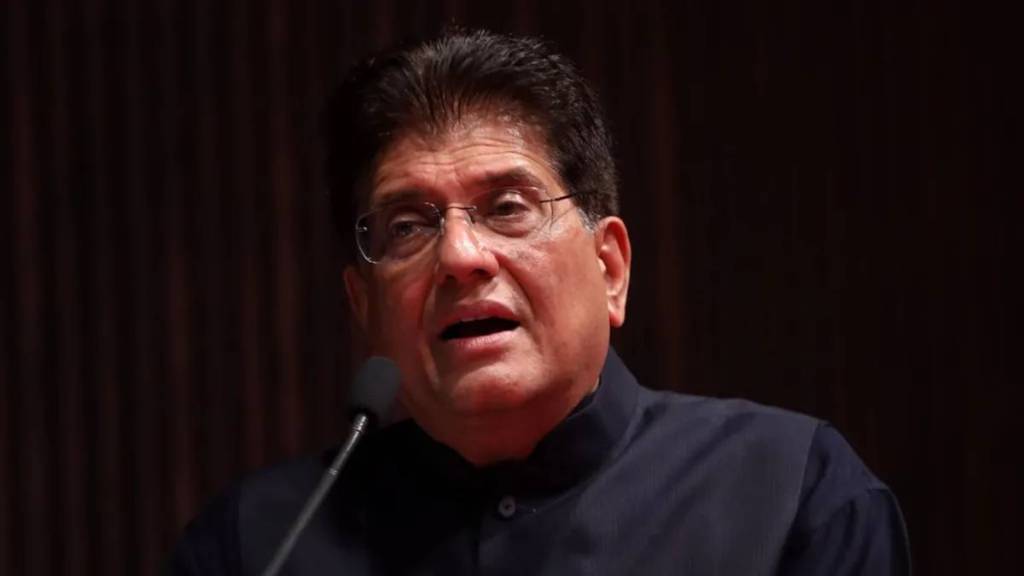

India is holding out for a clear tariff advantage over its competitors in the US market before signing off on the proposed bilateral trade agreement with Washington, Commerce and Industry Minister Piyush Goyal said on Thursday, signalling that the promise of tariff advantage remains the critical demand in the negotiations.
Goyal said India would announce the final details of the agreement only after the US offers Indian exporters preferential tariff rates compared with competing economies.
“As soon as the US is able to give us the preferential rate, in comparison to our competition, we will finalise the BTA and announce the final details,” Goyal said at a national workshop on leveraging free trade agreements organised by the commerce ministry.
The demand puts the relative tariff burden on Indian goods, rather than the headline US duty alone, at the centre of the negotiations. Goyal said the absolute tariff number should not be viewed in isolation and that India’s position relative to competing countries mattered more.
India competes in the American market with countries such as Vietnam, Bangladesh, Indonesia, Malaysia, Thailand and Cambodia. These countries too are negotiating their own agreements with the US.
Goyal’s remarks came as he prepares to embark on a visit to the US at the end of this month for the G-20 Trade Ministers’ meeting that will also offer an opportunity to engage with key trade officials of the US and US Trade Representative Jamieson Greer.
Tariff Advantage Lost
India had secured a tariff advantage in the February framework for an interim trade deal, when the US was imposing different reciprocal tariffs on trading partners. India faced a 25% reciprocal tariff, alongside a separate 25% levy linked to Russian oil purchases. The framework cut the reciprocal tariff to 18% and removed the oil-linked levy.
However, before the deal could be finalised, the US Supreme Court struck down the reciprocal tariffs, putting the agreements based on them in limbo. Washington subsequently imposed a uniform 10% tariff under an emergency provision of the Trade Act. With those tariffs expiring on June 24 and being replaced by Section 301 duties targeting forced-labour-linked imports. Now no exporters, barring those with operational FTAs, have any tariff advantage in the US. Indian exporters no longer enjoy the preferential tariff advantage they had secured in February.
Expanding FTA Footprint
India has implemented FTAs with the UK, Mauritius, Oman, UAE and Australia, while its agreement with New Zealand is expected to become operational soon. A trade pact with the 27-nation European Union is also expected to follow, the minister said
Goyal said agreements being pursued with Canada, Mexico, Chile, Mercosur, South African Customs Union (SACU), the Gulf Cooperation Council (GCC) and Israel, along with reviews of India’s trade arrangements with ASEAN, South Korea and Japan, could eventually give Indian exporters preferential access covering about 75 % of global trade.
He also announced that exporters would receive priority support in the proposed 100 BHAVYA industrial parks, including concessions for companies committing to higher export levels and access to plug-and-play infrastructure.
Commerce Secretary Rajesh Agarwal, however, warned exporters that the preferential access secured through FTAs would not remain a permanent advantage because India’s competitors would eventually negotiate similar agreements.
India trades across around 12,300 tariff lines, most of which are covered in some form by its trade agreements. Agarwal said exporters had a five-to-10-year window to build new supply chains and exploit the market access created by the FTAs as their competitors are also looking at trade agreements with these markets.