


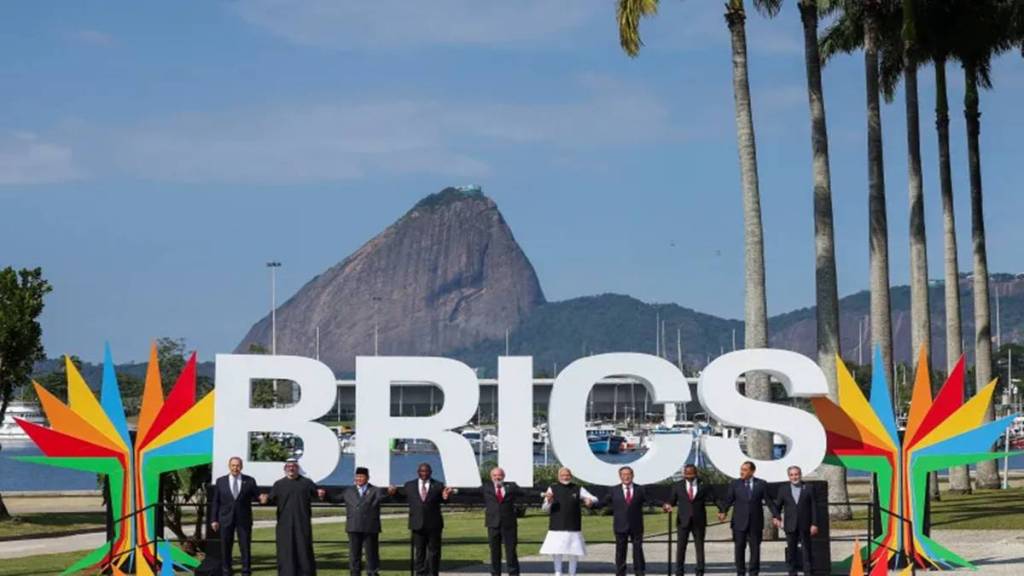

Russia and Iran on Friday called for strengthening BRICS financial and trade mechanisms, including an expanded role for the New Development Bank (NDB), greater use of local currencies and new instruments to mobilise private capital, as geopolitical tensions and sanctions disrupt global trade and investment.
Addressing the BRICS Business Forum, Russian President Vladimir Putin proposed setting up a new investment platform backed by private-sector funding to improve the competitiveness of the bloc’s 11 member economies.
Iranian President Masoud Pezeshkian said the NDB should become the principal engine for financing infrastructure and energy projects through dedicated credit lines, local-currency financing and guarantees to attract private capital.
Pezeshkian also proposed a BRICS joint reinsurance company with an initial capital of $10 billion to cover risks associated with major infrastructure and energy projects and boost private-sector confidence.
He called for greater integration of BRICS trade infrastructure through digitalised and integrated customs procedures, trade facilitation, reduced regulatory barriers and development of cross-border markets.
A key priority, he said, should be expanding the use of national currencies in intra-BRICS trade, supported by mechanisms for currency-risk management and reciprocal settlements. The current global financial system, he argued, remained vulnerable to political shocks because of its concentration in a limited number of currencies.
“BRICS must create an environment in which no country can disrupt the legitimate trade of another country through monopolising a financial instrument or technology,” Pezeshkian said.
Putin, meanwhile, criticised the use of sanctions and other restrictions as instruments of economic competition, saying Russia had faced more than 30,000 sanctions. He also cited attempts to disrupt pipelines, transport corridors and maritime trade, as well as the threat of secondary sanctions against countries pursuing their own interests.
Despite the restrictions, Putin said Russia had strengthened its economic resilience by relying on domestic business, science, technology and engineering capabilities and by developing ties with partners in BRICS and elsewhere.
The two leaders’ proposals underline a broader push within BRICS to build alternative channels for trade, finance, investment and supply chains, reducing members’ vulnerability to geopolitical and financial disruptions.
Pezeshkian also called for BRICS to evolve from a commodity trading platform into a network of integrated value chains and joint industrial production, with Iran offering its energy resources and geographical position as a potential hub for the bloc’s energy, food and transport networks.