


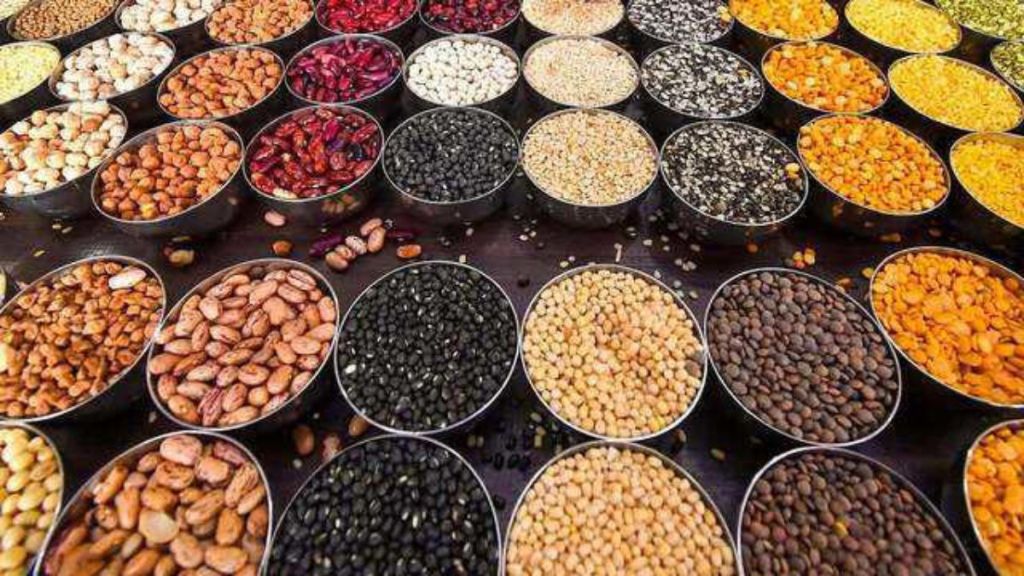

The government’s buffer stocks of pulses have risen to a record 4.5 million tonne (MT), which would be used to curb price rises in case of any shortfall in kharif output and forthcoming rabi or winter crop prospects.
The current stock is against the buffer norm of 3.5 MT.
The pulses strategic reserve is largely built through procurement from farmers under the Price Support Scheme (PSS) of the agriculture ministry by agencies such as farmers’ cooperative Nafed and NCCF and some imports under the Price Stabilisation Fund.
A chunk of pulses stock includes gram or chana (1.95 MT), tur (1 MT), moong (0.88 MT) and masur or lentils (0.56 MT)—which, according to sources will be offloaded in a calibrated manner in the market to contain price spikes. These stocks are usually released through open market sales and supplied to states for welfare schemes such as PM-Poshan, the Integrated Child Development Services (ICDS) and the Public Distribution System (PDS).
“The time to initiate market intervention programmes for pulses will be decided once we get a clear picture of the impact of El Nino on crops for both kharif as well as forthcoming rabi or winter crop prospects,” an official told FE.
Officials said that the kharif crop prospects are still being monitored to ascertain the possibility of a fall in output because of a rainfall shortfall in growing regions of Karnataka and Maharashtra.
Acreage under Kharif pulses including tur, urad and moong, stands at 11.84 million hectares, a 1.42% year-on-year fall as of September 18, 2026. The harvesting of these crops is expected to commence at the end of October.
Retail inflation in the ‘pulses’ category was 3.61% in August 2025 year-on-year.
Average retail prices of major pulse variants – tur, gram and urad – increased to Rs 123.43/kg, Rs 88.23/kg and Rs 122.63/kg on Saturday, according to the price monitoring cell of the Department of Consumer Affairs (DoCA). This represents an increase of 7.19%, 0.79% and 7.42%, respectively, compared to the previous year.
Officials said that there has not been an unusual rise in retail prices of pulses as the government has a stable import policy.
To boost domestic supplies, the government extended the duty-free import policy for key pulses — pigeon pea (tur) and black matpe (urad)—until March 31, 2027. The 30% import duty on yellow peas will continue until the end of FY27, while lentils has a 10% duty.
India imports about 18%-20% of its annual pulse consumption—tur, urad, masoor (lentils), yellow peas and Bengal gram – from Canada, Russia, Brazil, Myanmar and Africa.
Under PSS, the overall quantity of procurement by central agencies is restricted to 25% of the production of pulses and oilseeds varieties and must be disposed of within nine months from the closure of PSS operations to avoid increasing holding costs and quality deterioration.
The DoCA has requested the Department of Agriculture to consider relaxing the PSS stock disposal norm of nine months from the date of grain procurement, especially for tur and chana variants purchased from the farmers in the 2025-26 season. The idea is to preserve the stock until a clear picture emerges regarding the production prospects of forthcoming Kharif and Rabi crops.