


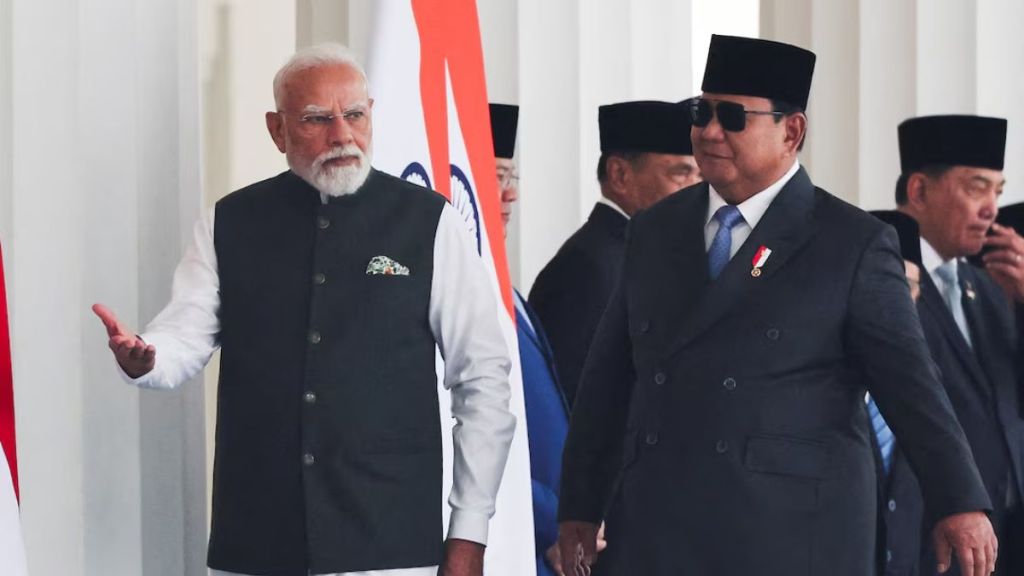

India and Indonesia on Tuesday announced a series of agreements across steel manufacturing, cross-border digital payment networks, and critical mineral supply chains. India also agreed to supply the BrahMos supersonic cruise missiles and Astra air-to-air missiles to Indonesia.
The corporate and trade push was unveiled in a joint statement issued during Prime Minister Narendra Modi’s high-profile state visit to Jakarta from during July 6–8, where he held extensive delegation-level talks with Indonesian President Prabowo Subianto.
The leaders jointly called for a timely conclusion to the review of the Asean-India Trade in Goods Agreement (AITIGA) to establish a more “balanced, mutually beneficial, and facilitative” trade environment.
A total of 14 agreements were inked between the two sides to enhance cooperation.
The bilateral talks focused heavily on locking in economic synergies between India’s ‘Viksit Bharat 2047’ vision and the ‘Indonesia Emas 2045’ development roadmap. Modi announced that India will export high-yield, climate-resilient wheat seeds developed by Indian researchers directly to Indonesia to bolster its domestic food security.
The Steel Authority of India (SAIL) has partnered with Indonesia’s state-backed PT Krakatau Steel to explore establishing a major stainless-steel slab manufacturing facility in Indonesia. The move is accompanied by a bilateral agreement to collaborate on steel supply chain technologies.
As global manufacturing shifts towards green energy, a tripartite Memorandum of Understanding (MoU) was signed between India’s Non-Ferrous Materials Technology Development Centre (NFTDC), Midwest, and Indonesia’s PT Perusahaan Mineral Nasional (PERMINAS). The venture will focus on the extraction and processing of rare earths and critical minerals, aimed at securing domestic manufacturing ecosystems.
In a bid to modernise trade infrastructure and lower transaction costs for businesses, the central banks of both countries are aggressively deploying financial technology linkages.
The Reserve Bank of India (RBI) and Bank Indonesia are in the advanced stages of operationalising a Cross-Border QR Payment Linkage. The platform is expected to sharply boost transaction efficiencies for MSMEs, commercial tourism, and cross-border students.
The leaders lauded ongoing progress toward implementing Local Currency Transaction (LCT) guidelines to reduce dependencies on third-party currencies like the US dollar. Once fully operational, Indian and Indonesian enterprises will be able to settle trade invoices directly in rupees and rupiah, deepening financial integration and mitigating exchange-rate risks.
In another major digital export, Indonesia has launched the “Indonesia Open Network” (ION). The digital platform is built explicitly on the architecture of India’s Open Network for Digital Commerce (ONDC), a move intended to give Indonesian micro, small, and medium enterprises (MSMEs) unprecedented access to expanding digital networks.
On logistics and maritime infrastructure, President Prabowo welcomed India’s formal commercial interest in the integrated development of the strategically vital Sabang Port.
The ambitious project is designed to create an economic corridor connecting India’s Andaman and Nicobar Islands with Indonesia’s Sumatra province. The proposed master plan spans cruise and marine-tourism facilities, shore-based services to support offshore energy activities in the Andaman Sea, and heavy maritime industries like shipbuilding and ship repair.
The two leaders also welcomed the proposed setting up of a campus by Indian Institute of Management, Bangalore in Indonesia.